Background
Trials in adults living with HIV have shown non-inferiority of dolutegravir (DTG) plus lamivudine (3TC) 2-drug regimen (DTG/3TC) compared to 3-drug regimens (3DR) for maintaining viral suppression. Data in children are limited.
Methods
D3 / Penta 21 was a non-inferiority 96-week trial evaluating efficacy and safety of DTG/3TC compared to DTG-based 3DR (control) in children. Children aged 2 to <15 years, virally suppressed with no prior treatment failure, were randomised 1:1 to receive DTG/3TC or DTG plus two nucleoside reverse transcriptase inhibitors. The primary outcome was the intention-to-treat adjusted Kaplan-Meier estimated proportion with confirmed viral load (VL) ≥50 copies/mL (viral rebound) by week 96. The non-inferiority (NI) margin and significance level depended on the control event rate (9.5% NI margin, 99% CI for 7% event rate). Routine 6-12 monthly VLs were used for participant management; children in DTG/3TC with real-time viral rebound returned to 3DR; additional 12 weekly VLs were tested retrospectively.
Results
386 children (193 DTG/3TC; 193 control) were enrolled (74% Uganda, 15% South Africa, 9% Thailand, 3% UK/Spain). Median (range) age was 8.3 years (2.2-15); weight 23kg (10-80); 46% male. At week 96, 99% remained in follow-up.
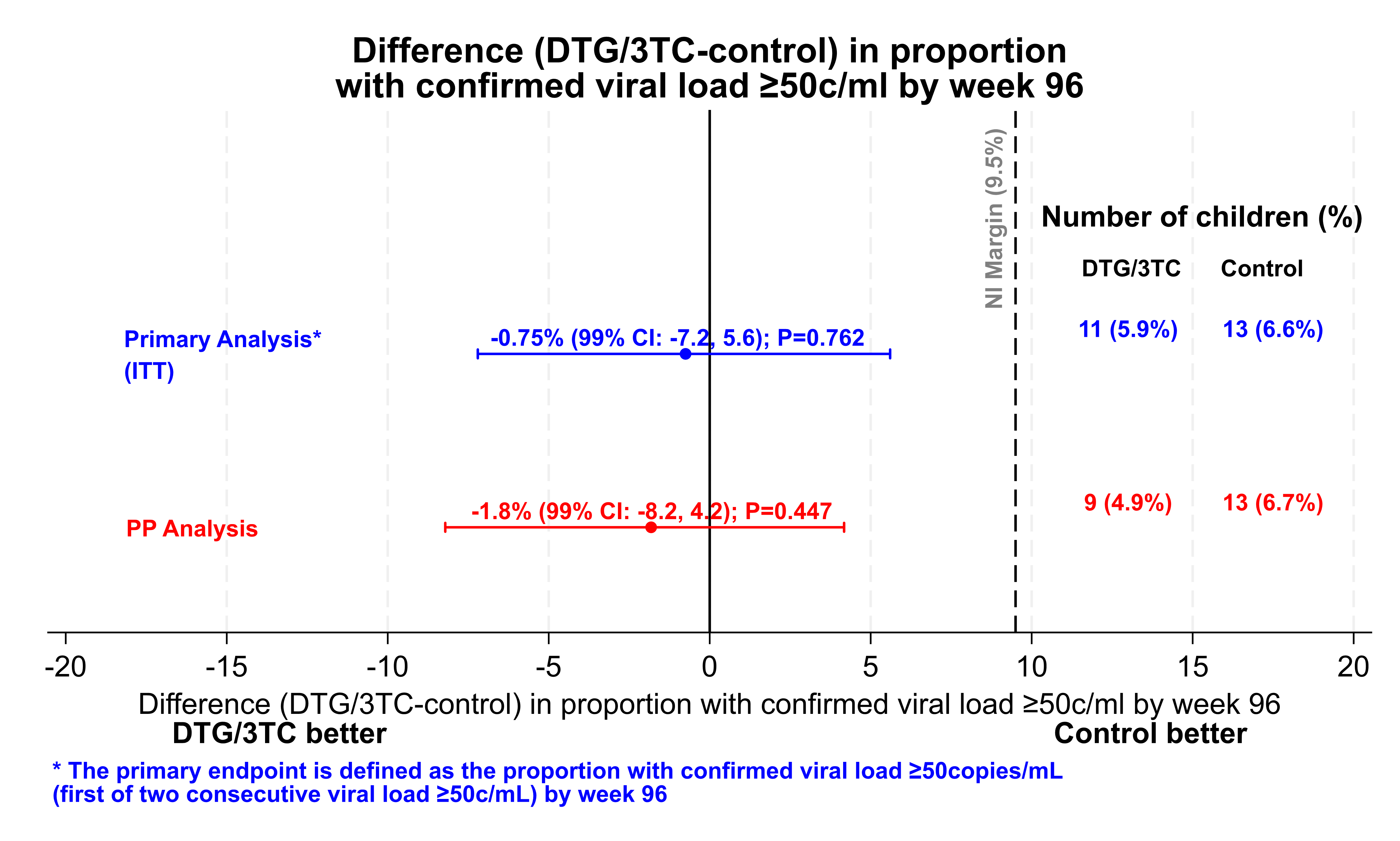
11 (5.9%) children in DTG/3TC vs 13 (6.6%) children in control had viral rebound [difference (DTG/3TC-control): -0.75% (99% CI: -7.2, +5.6); P=0.76]; demonstrating non-inferiority of DTG/3TC vs control (9.5% NI margin). 7/11 in DTG/3TC and 9/12 in control who had viral rebound (excluding 1 rebound at 96 weeks) had VL <50 copies/mL at 96 weeks. Results of per-protocol analysis were similar: 9 (4.9%) DTG/3TC vs 13 (6.7%) control [difference: -1.8% (99% CI: -8.2, +4.2); P=0.45]. Proportions with cross-sectional VL ≥50 copies/mL at week 96 were similar [4.6% DTG/3TC vs 6.5% control; P=0.41].
In DTG/3TC arm, 1 child switched to atazanavir-3DR and 5 to DTG-3DR for viral rebound, 1 switched to DTG-3DR for pregnancy. In control arm, 1 child switched to bictegravir-3DR for simplification, 13 children changed backbone.
One child in DTG/3TC had 2 WHO stage 3/4 events. There were 15 SAEs (11 children) in DTG/3TC vs 12 (9) in control (P=0.65), including 1 death unrelated to HIV/ART (DTG/3TC); 22 (18) grade ≥3 clinical AEs in DTG/3TC vs 15 (11) in control (P=0.18), all unrelated to ART. There were no ART modifying AEs.
Conclusions
DTG/3TC showed similar efficacy and safety to DTG-3DR and provides a simple treatment maintenance option for children.
Table or Figure