Background
Electronic partner notification (ePN) is a digital platform for people diagnosed with a bacterial sexually transmitted infection (STI) to anonymously alert sexual partners and connect them to care. ePN has the potential to reduce STI rates and engage people at risk for HIV who may benefit from PrEP. Our objective was to investigate how the Massachusetts Department of Public Health (MDPH) could best design ePN to inform planned statewide implementation.
Methods
Based on formative work with potential ePN users, we designed and conducted two discrete choice experiments (DCEs) to evaluate ePN delivery preferences: one for index patients to notify their recent partners (notifiers) and one for notification recipients (receivers). From November 2024 to October 2025, cross-sectional online questionnaires hosted on Sawtooth Software™ were administered via convenience sampling to men who have sex with men and to transgender women, recruited from local sexual health clinics, community venues, and online sources. Each DCE consisted of 12 questions, with attributes assessing preferences for content, anonymity, verification, method of access, and delivery source, alongside questions on demographics, experiences with STIs and partner notification, digital health literacy, and STI stigma. Preference consistency was examined by race, ethnicity, STI history, and recruitment site using hierarchical Bayesian and multinomial logit models.
Results
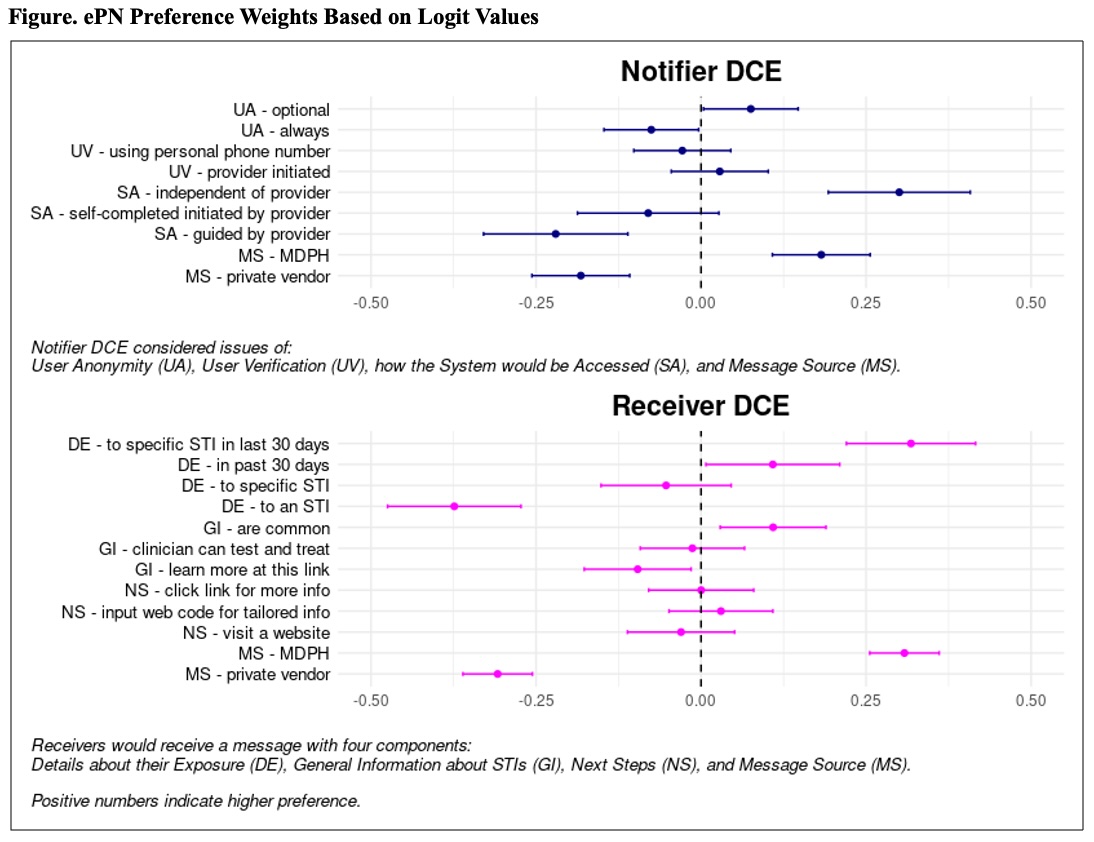
278 total participants (104 notifiers and 174 receivers) enrolled with a median age of 31 (IQR: 25-39). Participants in both surveys were predominantly non-Hispanic white (67% and 69%, respectively); about half reported a prior STI (53% and 50%, respectively). 69% of notifier and 52% of receiver participants were recruited from clinical sites. Among notifiers, there was a strong preference for being able to use ePN outside of a medical appointment (Figure). Among receivers, there was a strong preference for receiving a message specifying the time frame of exposure and the name of the STI. Additionally, it was strongly preferred among both surveys and all subgroups to have the message indicate it was from MPDH (vs. the ePN vendor).
Conclusions
In a study of potential end-users of ePN for bacterial STIs, index patients prioritize flexibility in notification site, and receivers prioritize specificity in notification content. All users prefer notifications signed by MDPH. These preferences may inform statewide ePN implementation.
Table or Figure