Background
Our study investigated sex differences in how individual-level social determinants of health (SDoH) affect COVID-19 related hospitalizations among people with HIV (PWH) and without HIV (PWoH) in the U.S.
Methods
We analyzed the National COVID-19 Cohort Collaborative (N3C) data from January 2020 to November 2023 to assess how SDoH (healthcare access, economic stability, social cohesion) impact COVID-19 hospitalization risk among PWH and PWoH. We conducted hierarchically-nested additive and adjusted mixed-effects logistic regression models stratified by HIV and sex , adjusting for age, race/ethnicity, comorbidities, data source, and mediation by healthcare utilization.
Results
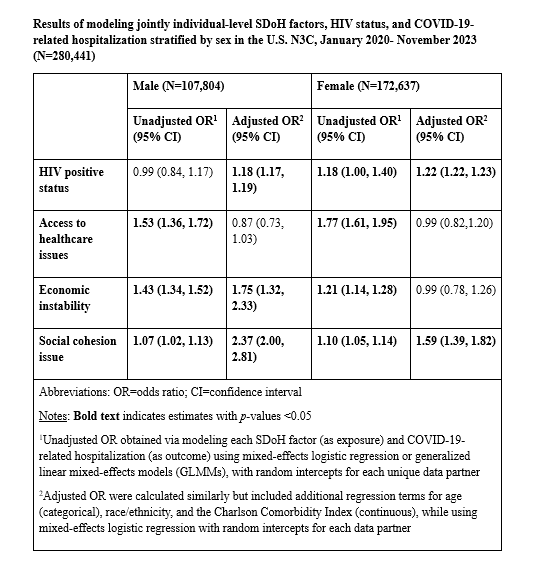
Among our study population of 280,441 individuals from 24 data partner sites, 11.2% were hospitalized due to COVID-19. This hospitalization rate was higher for males (14%) compared to females (9.5%). Overall, females consistently demonstrated higher proportions for issues with access to healthcare (2.1% for females, 1.7% for males), economic stability (11% for females, 9.1% for males), and social cohesion (40.6% for females, 36.4% for males); these proportions were even higher among female PWH. In our initial additive modeling, all three SDoH domains were significantly associated with hospitalizations, with adjusted odds ratios (aOR) ranging from 1.36 to 1.97. Subsequently, our HIV-stratified analyses indicated economic instability was associated with hospitalization among PWH, while all 3 SDoH domains were associated with hospitalization among PWoH (aOR range 1.36 -1.96). Lastly, our fully adjusted, sex-stratified analysis, indicated social cohesion issues were associated with hospitalization across both sex groups (aOR range 1.18 – 2.37) as was HIV positive status (aOR range 1.18- 1.22).
Conclusions
Our results reveal that while males had higher initial COVID-19 hospitalization rates, adjusting for SDoH demonstrated a significant association between female and hospitalization. This study demonstrates the importance of investigating individual-level SDoH variables to unpack the intricate interplay between these factors, HIV status and sex in shaping health outcomes.
Table or Figure