Background
Persons living with HIV (PWH) may be pre-disposed to excessive abdominal fat accumulation, which has profound consequences for cardiometabolic incidence. Common measures for assessing weight, such as body mass index (BMI), do not account for central adiposity. The body roundness index (BRI) was proposed in the general population to encompass central adiposity via inclusion of the waist circumference (WC) and height measurement. Given the prevalence of central obesity among PWH, we aimed to evaluate the ability of the BRI to predict hypertension (HTN) or diabetes (DM) among people with or at risk for HIV.
Methods
MACS/WIHS Combined Cohort Study (MWCCS) participants with >1 measurement of WC and height were included from 1999-2024. Participants were excluded if they were pregnant or had pre-existing HTN or DM, for the respective model. BRI was calculated as 364.2−365.5 × √(1−[WC in centimeters/2π]2/[0.5 × height in centimeters]2). BRI was divided into quintiles (Q1-Q5), with Q3 as reference. A Cox proportional hazard regression model was used to examine the association of BRI with incident DM and HTN. Models were adjusted for age, sex, race/ethnicity, smoking status, and HIV serostatus; stratified models by HIV serostatus were also performed. An ROC analysis was used to determine the discrimination ability of the BRI compared to the BMI.
Results
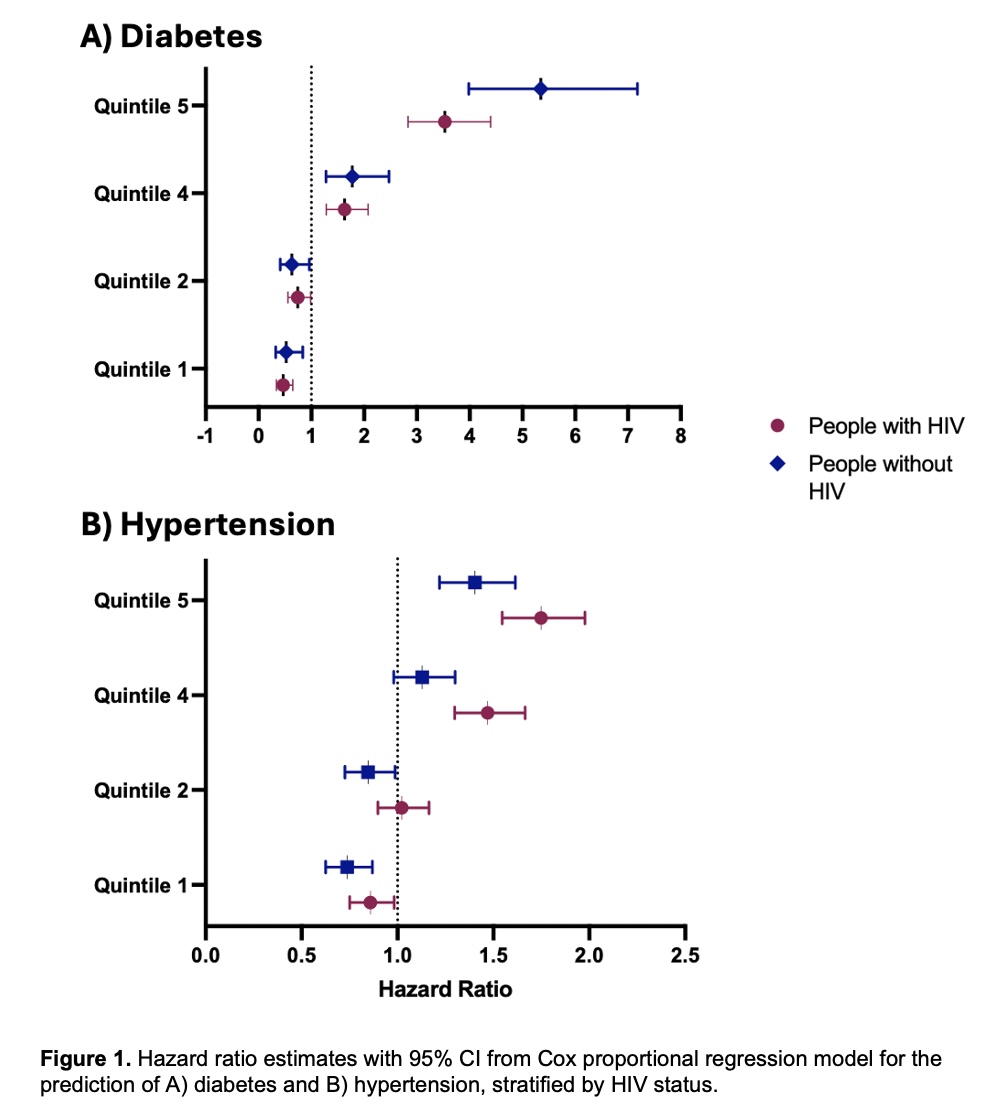
Of 7,523 participants, 56% were female, 51% were Black, and 16% were Hispanic with a median follow-up time of 10.1 years. At baseline, the median (interquartile range [IQR]) age was 41 [34, 49] years. For DM prediction, Q1 (lowest) had a 58% relative hazard reduction compared to Q3 (hazard ratio [HR]: 0.43, 95%CI: 0.33, 0.55). Q5 (highest) had a 295% increased relative hazard compared to Q3 (HR: 3.95, 95%CI: 3.33, 4.67). For HTN prediction, Q1 had a 30% relative hazard reduction (HR: 0.70, 95%CI: 0.64, 0.77) and Q5 had a 48% increased relative hazard, both compared to Q3 (HR: 1.44, 95%CI: 1.31, 1.60). The results were similar for both models when stratified by HIV serostatus (Fig 1). Compared to BMI, the BRI had a lower AUC value at the respective median follow-up time for prediction of DM (BRI: 0.66 vs. BMI: 0.68 and HTN (BRI: 0.52 vs. BMI: 0.55).
Conclusions
Among people with and without HIV, BRI was associated with incident DM and HTN, though BMI may have slightly better discrimination for these outcomes.
Table or Figure