Background
Renal impairment (RI) is a common comorbidity in people living with HIV (PLWH). The availability of safe and effective antiretrovirals (ARVs) in people with RI is important, especially as the population of PLWH ages. DOR/ISL, an investigational once-daily HIV treatment, had a favorable renal safety profile in prior studies with DOR/ISL (100/0.75mg). This post hoc analysis of 2 Phase 3 studies, which included participants with creatine clearance >30 mL/min, evaluated DOR/ISL (100/0.25mg) efficacy and safety in virologically suppressed PLWH with RI.
Methods
P051 (NCT04223778) and P052 (NCT05631093) evaluated PLWH who switched to DOR/ISL (100/0.25mg) from baseline antiretroviral therapy (bART) or bictegravir/emtricitabine/tenofovir alafenamide (BIC/FTC/TAF). Data from P051/P052 DOR/ISL participants were pooled; analyses included within-group comparisons for participants with mild (60 to <90mL/min/1.73m2) and moderate (30 to <60mL/min/1.73m2) RI vs those with normal (≥90 mL/min/1.73m2) renal function at baseline for HIV RNA <50 copies/mL, CD4+ T-cell count, drug-related adverse events (DR-AEs), and serious AEs, and between-group comparisons for estimated glomerular filtration rate (eGFR) by creatinine and cystatin C (to account for potential effects of certain ARVs on tubular creatinine secretion).
Results
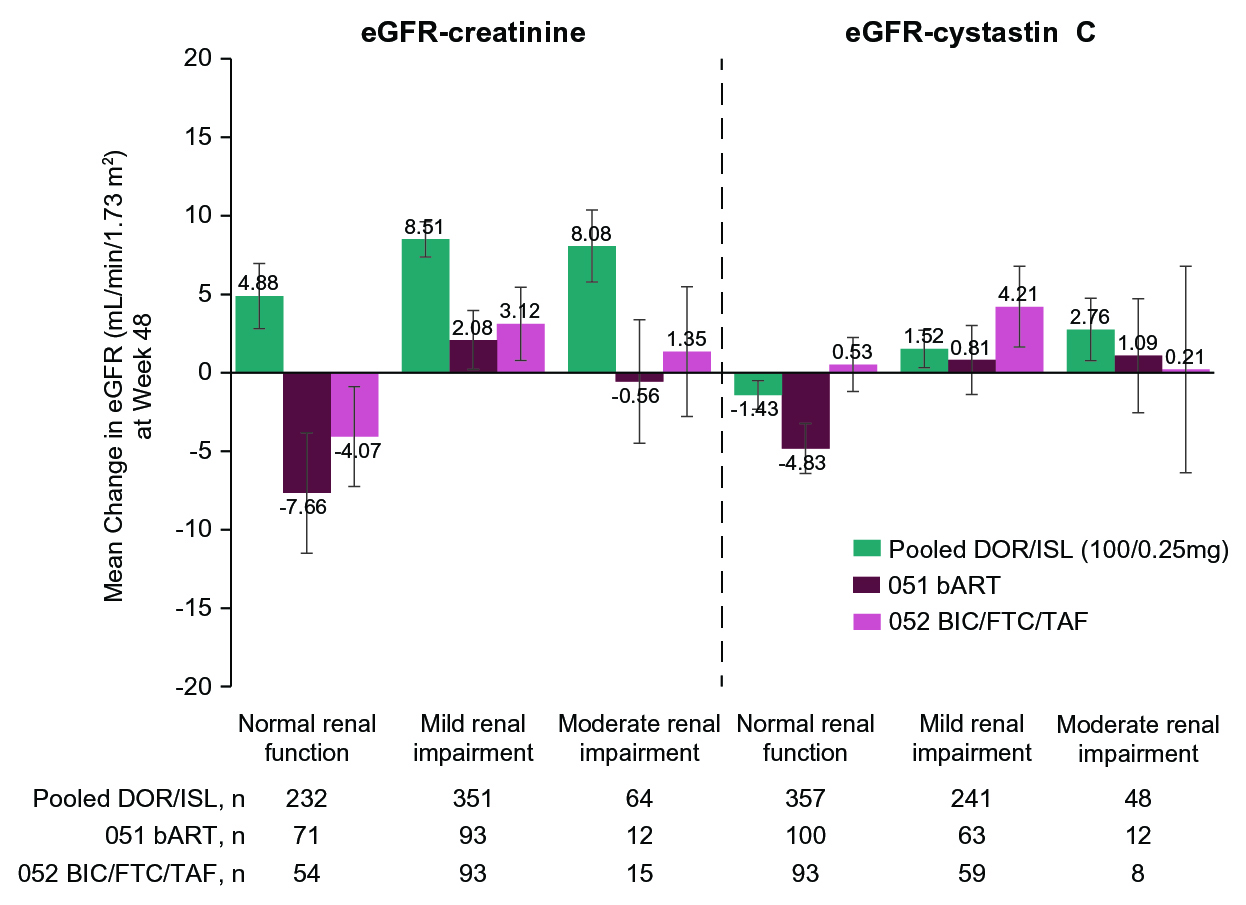
Of 707 DOR/ISL participants at baseline, >90% had normal renal function or mild RI based on eGFR-creatinine (36.5% normal, 54.0% mild RI, 9.5% moderate RI). In the DOR/ISL group, rates of HIV RNA <50 copies/mL (93.4%, 93.2%, 97.0%), mean change in CD4+ T-cell count (20.3, 17.9, 4.6 cells/mm3), DR-AEs (10.5%, 12.3%, 7.5%), and serious AEs (4.7%, 6.0%, 4.5%) were generally similar for those with normal renal function, mild RI, and moderate RI at Week 48, respectively. Among participants with mild or moderate RI who switched to DOR/ISL, renal function remained stable at Week 48 per eGFR (by creatinine and cystatin C) (Figure). eGFR-creatinine improved in all renal function categories in those who switched to DOR/ISL vs the bART and BIC/FTC/TAF groups, consistent with inhibitory effects of some ARVs on creatinine secretion, while mean change in eGFR-cystatin C was comparable across all groups (Figure).
Conclusions
DOR/ISL (100/0.25mg) had a similar efficacy and safety profile in participants with mild or moderate RI compared to those with normal renal function. For participants in all renal function categories, switching to DOR/ISL did not adversely impact renal function through Week 48.
Table or Figure