Background
Solid organ transplantation (SOT) in patients living with HIV (PWH) has become more widely adopted. However, data on long-term patient and graft survival are very limited, and studies analyzing the comorbidities that these patients develop over time are lacking. We aimed to compare 15-year liver transplantation (LT) outcomes between HIV+/HIV- recipients and to evaluate comorbidity prevalence in survivors.
Methods
This multicenter, retrospective, case-control study included 340 patients (85 HIV+ and 255 matched HIV- controls) transplanted between 2003–2012 in four Spanish centers and followed to July 2025. HIV+ recipients were matched with HIV- recipients (1:3 ratio) by center, calendar year (±1 yr), age (±12 yrs), gender, HCV/HBV co-infection, and hepatocellular carcinoma (HCC). A descriptive analysis was performed. Survival time from LT was estimated using the Kaplan-Meier product-limit method; the curves obtained in HIV+ and HIV- recipients were compared using the generalized log-rank test (univariate Cox model analysis).
Results
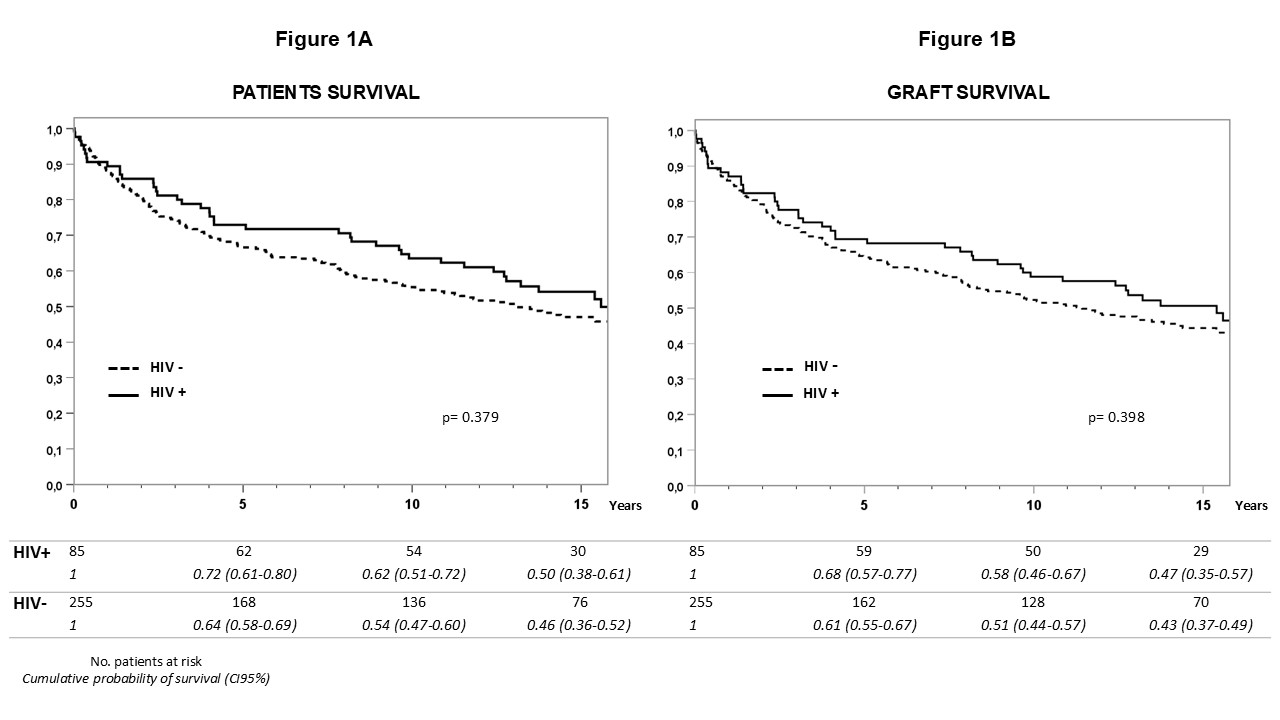
Overall, 82% of cases were males; median (IQR) age was 48 (44–53) years; among PWH, 72% were former drug addicts; and globally 88% of the patients had an active HCV infection at the time of LT. After a median (IQR) follow-up of 12 (3-16) years, 154 patients (45%) remained alive with no differences between HIV+ and HIV- groups (49.4% vs 44%; p= 0.382). HIV+ patient and graft survival rates (95% Confidence Interval) at 15 years were 50% (38–61) and 47% (35–57), respectively, compared to 46% (36–52) and 43% (37–49) for HIV- recipients (p>0.05) (Figure 1A/1B). Overall, main cause of death was HCV recurrence, mostly before the era of anti-HCV direct acting antivirals. HCV was eradicated in all survivors. The development of comorbidities (gastrointestinal, cardiovascular, neurological, bone, renal, respiratory, metabolic, and infectious diseases) and de novo cancer was similar in both groups, except for diabetes mellitus which was more frequent in HIV- recipients (24% vs. 43%, p=0.005). At last visit, all PWH were suppressed on ART and median (IQR) CD4+ T-cell count was 330 (233-509) cells/µL. Integrase strand-transfer inhibitors-based ART was the most common regimen (76%) in recent years, as dual (14%) or triple (62%) therapy.
Conclusions
This multicenter study showed that long-term outcomes (survival rates and prevalence of comorbidities) between HIV+ and HIV- recipients were good and similar. These results support LT in PWH when clinically indicated.
Table or Figure