Background
We have previously reported that tuberculosis (TB) patients with poorly controlled diabetes mellitus had a lower risk of adverse drug reactions (ADR), presumably due to low drug concentrations. Here, we focused on the two first-line sterilizing drugs, rifampicin (RIF) and pyrazinamide (PZA), in population pharmacokinetic (PopPK) models in TB patients receiving routine care.
Methods
RePORT-Brazil study participants with drug-susceptible, culture-confirmed pulmonary TB who received standard TB treatment were included and sparsely sampled at month 1. We developed a one-compartment PopPK model, with absorption rate constant (ka), volume of distribution (Vd), and clearance (CL) parameters. Random effects captured inter-individual variability. Age, sex, weight (CL- and Vd-adjusted), glycated hemoglobin (HbA1c) levels, and HIV status at baseline were used in analyses. ADR were physician-determined; any ADR after TB treatment initiation was included. Liquid chromatography-mass quantified drug concentration. Time since last dose (hours) was self-reported; samples >8 h post-dose and below quantification level were excluded. Stochastic approximation of the expectation maximization algorithm in Monolix was used for estimating model and individual parameters. Since CL and Vd are primary model-derived parameters, we tested their associations with HbA1c levels, HIV, and ADR occurrence for RIF and PZA.
Results
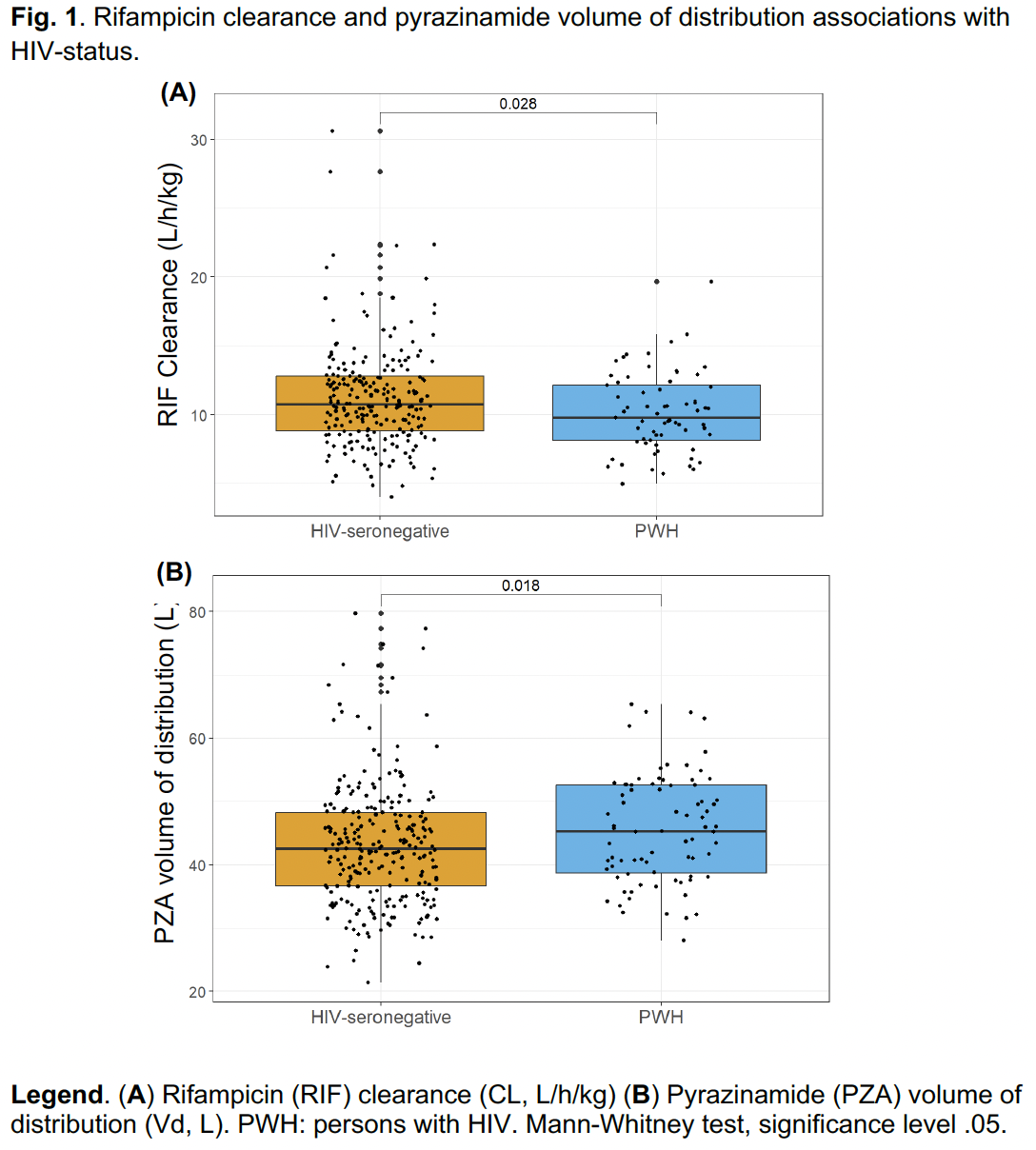
Detectable drug levels were present in 295 RIF and 338 PZA samples. The final PopPK model for RIF estimated ka=0.16, Vd=32 L, and CL=2.34 L/h/kg, and included age, sex, CL-adjusted weight, HIV, and HbA1c. For PZA, ka=2.13, Vd=17 L, and CL=0.64 L/h/kg, with HIV, HbA1c, sex, and Vd-adjusted weight. TB patients with poorly controlled diabetes (HbA1c>11%) had significantly higher RIF CL and higher PZA Vd compared to those with normal HbA1c levels (p<0.001 for both). Persons with HIV (PWH) had lower CL but higher Vd compared to HIV-seronegative persons (Fig. 1). Compared to those without ADR, participants with any ADR had lower RIF CL (9 L/h vs 11 L/h, p=0.015). No association was found between any PZA parameters and ADR.
Conclusions
Higher HbA1c was associated with increased RIF CL, suggesting faster RIF elimination, and with higher PZA Vd, suggesting greater PZA tissue uptake and possible lower plasma concentrations. HbA1c, however, was not associated with absorption of either RIF or PZA. PWH and ADR occurrence were associated with lower RIF CL, indicating higher systemic RIF exposure.
Table or Figure