Background
Dolutegravir (DTG)-based first-line regimens (TLD) achieve high rates of viral suppression, with integrase (IN) resistance mutations rarely detected in treatment-naïve individuals. However, some patients experience virological failure (VF) despite good adherence and absence of IN mutations, suggesting alternative non-canonical resistance pathways such as mutations in HIV-1 envelope (Env) and gag nucleocapsid (Gag-NC).
Methods
We investigated HIV-1 Gag-NC and polymerase (Pol) mutations in 17 participants with VF (>400 copies/mL) of 155 participants from the UTRA study – which enrolled those with adherence challenges – in South Africa. Adherence was assessed by tenofovir diphosphate (TFV-DP) concentrations in dried blood spots (DBS). Gag-NC and Pol were amplified from plasma, followed by Oxford Nanopore sequencing. Consensus sequences were generated using NanoREcall. Pol mutations were interpreted using the Stanford HIV Drug Resistance Database. Translated Gag-NC sequences were assessed for changes at previously described resistance-associated positions. NC mutations detected in 7 participants were compared to baseline sequences to assess their emergence on TLD. Env single genome sequencing (SGS) was performed for a participant with emergent non-polymorphic NC mutations.
Results
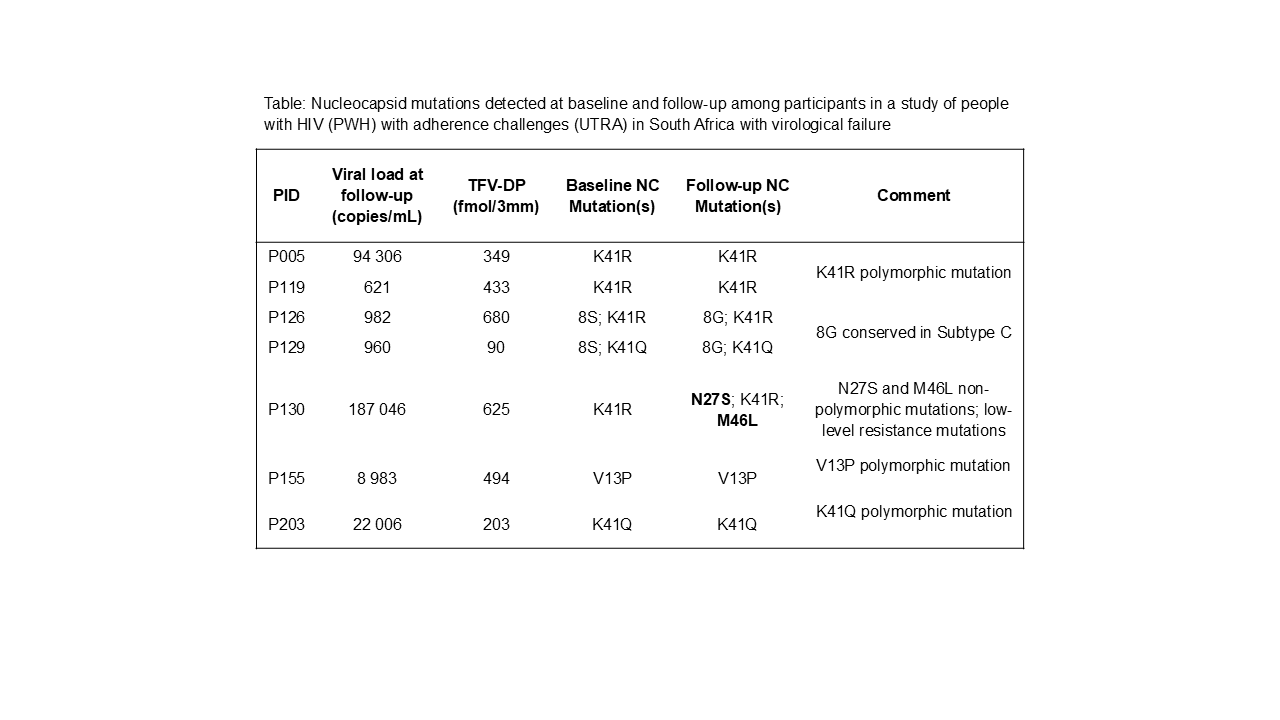
Of the 17 participants with VF, 4 had unexplained failure, defined by TFV-DP > 400 fmol/3mm in DBS and no major IN mutations (Table). Across the 7 participants analysed longitudinally, polymorphic NC mutations were observed at baseline and follow up: K41R (n=3); K41Q (n=2) and V13P (n=1). The 8S variant, present at baseline (n=2), changed to 8G at follow-up, which is the predominant variant in subtype C (Table). One protease inhibitor (PI) experienced participant who maintained an HIV viral load >100 000 copies/mL over 12-months, despite high drug exposure (TFV-DP in DBS >600 fmol/3mm) had 3 mutations in NC at follow-up: K41R, and two emergent non-polymorphic mutations, N27S and M46L, both conferring low-level DTG resistance. Env SGS revealed 641I enrichment, 17/17 sequences compared to 2/11 at baseline, associated with low-level INSTI resistance in HIV subtype C.
Conclusions
Our study shows non-canonical pathways, including mutations in Gag-NC and Env, may contribute to DTG failure in the absence of IN resistance mutations. Further studies are needed to define their phenotypic impact and clinical relevance, and to assess whether these mutations should be considered in resistance interpretation algorithms.
Table or Figure