Background
Full metabolomic tryptophan (T) profiling allows determination of T-metabolites from the serotonin pathway, Kynurenine (K) pathway (upregulated by peripheral inflammation) and the Indole/Gut pathway (dependent on gut microbiota). We assessed metabolomic profiling including T-metabolites, depressive symptoms, cognitive function and sleep measures in persons with and without HIV from the Pharmacokinetic and clinical Observations in PeoPle over fiftY (POPPY)-Sleep cohort.
Methods
Persons with HIV on ART and lifestyle-similar persons without HIV completed depressive symptoms questionnaire (PHQ-9), detailed cognitive testing (7-test, 5-domain battery, converted to T-score), actigraphy to assess sleep for 7 days and early morning fasting blood sampling for metabolomic profiling (LC-MS, UK National Phenome Centre). Statistical analysis used Mann-Whitney U tests and Spearman rank correlation.
Results
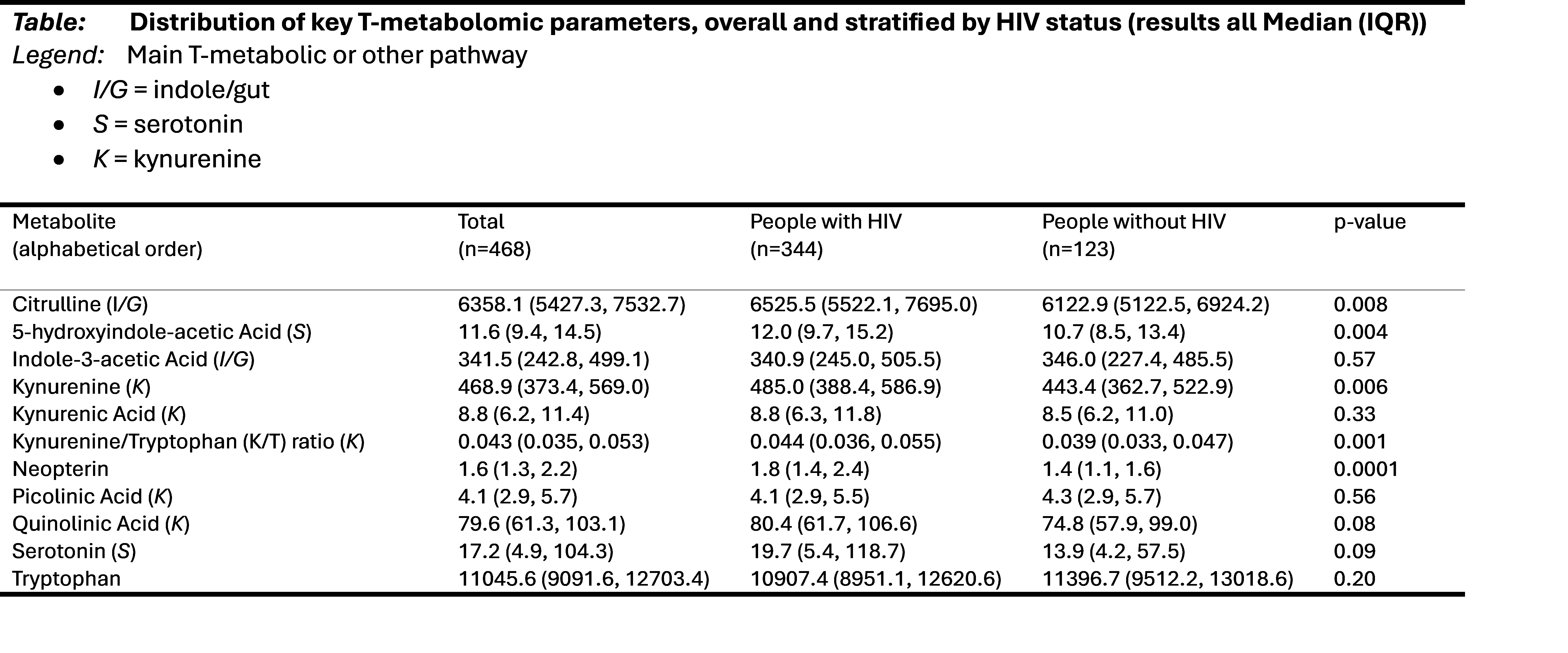
Of 468 individuals (345 with HIV, median CD4 608 (IQR 470-780) cells/uL), 81% were male and median age was 58 (IQR 53-63) years. Several metabolites, including citrulline, 5-hydroxyindole-acetic Acid (5-HAA), K, neopterin and K/T ratio differed in those with and without HIV (Table). Median (IQR) PHQ-9 scores were 5 (1-10) and 1 (0-3) in those with and without HIV, respectively. In those with HIV, higher PHQ-9 scores were associated with higher K-pathway markers (quinolinic acid [r=0.11, p=0.05], K [r=0.13, p=0.02] and K/T ratio [r=0.13, p=0.02]) but associations were not seen in those without HIV (r=0.06, p=0.51; r=-0.02, p=0.83; r=0.13, p=0.17, respectively). Cognitive testing T-score (with HIV: 50.0 (44.0-54.9); without HIV: 52.0 (48.3-55.8)) was positively associated with higher Indole/Gut-pathway markers in those with HIV (Citrulline [r=0.16, p<0.0001], Indole-3-acetic Acid [r=0.17, p<0.0001]), but not in those without HIV (r=0.01, p=0.88; r=-0.09, p=0.34, respectively). No associations between actigraphy sleep measures (including sleep duration and onset latency) and T-metabolites were observed.
Conclusions
Several metabolite markers differed in persons with HIV compared to lifestyle-similar persons without HIV. Our findings suggest that peripheral inflammatory responses are associated with depressive symptoms and markers of gut inflammation associated with cognitive function in those with HIV; these observations were not evident in those without HIV. Further understanding of these mechanisms could assist in the development of future therapeutic interventions.
Table or Figure