Background
Persistent exceptional elite controllers (P-EEC) show undetectable HIV-1-RNA levels in plasma by commercially available techniques in the absence of antiretroviral treatment (ART) for more than 20 years and no clinical progression. However, sporadic cases of loss of virological control are being reported in these individuals. At a population level, the incidence of loss of elite status and its associated factors are unknown.
Methods
From the HIV Controller Spanish cohort (ECRIS) (n=807), elite controllers with virological control below the limits of detection for more than 20 years were selected. We analyzed clinical, epidemiological, and immunogenetic factors associated with the loss of elite control status after more than 20 years using binary logistic and Cox regression models.
Results
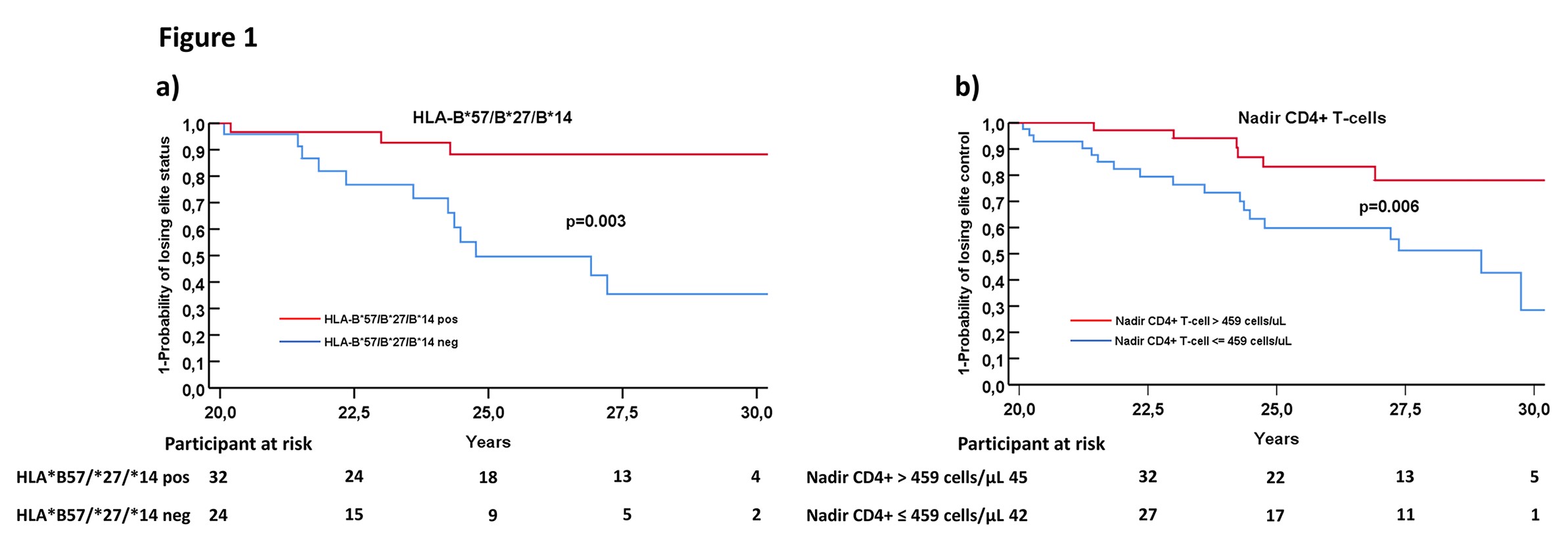
Elite control for more than 20 years was maintained in 87 participants. A total of 39.1% were women; 83.9% were infected through intravenous drug use during the 80s, with a median age at diagnosis of 24 [IQR, 21–29] years and a nadir CD4+ T-cell count of 459 [350–675] cells/µL. HLA alleles were available in 61 participants, with 57.1% carrying the protective HLA-B*14, HLA-B*27, or HLA-B*57 alleles. According to clinical records, 27 participants (31.0%) lost control after 20 years (detectable viremia >1 year or ART onset), and were grouped as transient controllers (T-EEC). Univariate analysis showed no differences in sex, age, transmission route, or calendar year of diagnosis between groups. However, differences were observed in nadir CD4+ T-cell counts (516 [397-718] in P-EEC vs 363 [270-601] in T-EEC, p=0.007) and in the presence of protective alleles HLA-B*14, HLA-B*27 or HLA-B*57 (74% in P-EEC vs 22% in T-EEC, p=0.001). A multivariate analysis show that only the presence of protective alleles was independently associated with the permanent control after 20 years of follow-up (p=0.006; EXP(B) [Confidence interval] 0.1 [0.04-0.6]). These results were reproduced in a time-to-event analysis (Fig 1). In a subgroup, P-EEC showed higher Gag-specific T-cell polyfunctionality (IFNɣ, TNF-α, IL-2, CD107a and Perforin) than T-EEC.
Conclusions
These results demonstrate how loss of control in controllers with more than 20 years of follow-up is relatively common and is primarily associated with the absence of protective HLA-B alleles. These data suggest that a heightened T-cell response or other innate immunological factors associated with these haplotypes are involved in maintaining exceptional long-term control.
Table or Figure