Background
Short-horizon, province-level signals of HIV case increases can help anticipate testing capacity and targeted outreach. Conventional time-series and machine-learning methods typically demand long look-back windows and numerous predictors for both training and inference. We examined whether a low-rank adaptation (LoRA)-adapted pretrained large language model (LLM) can forecast short-term increases using limited observations.
Methods
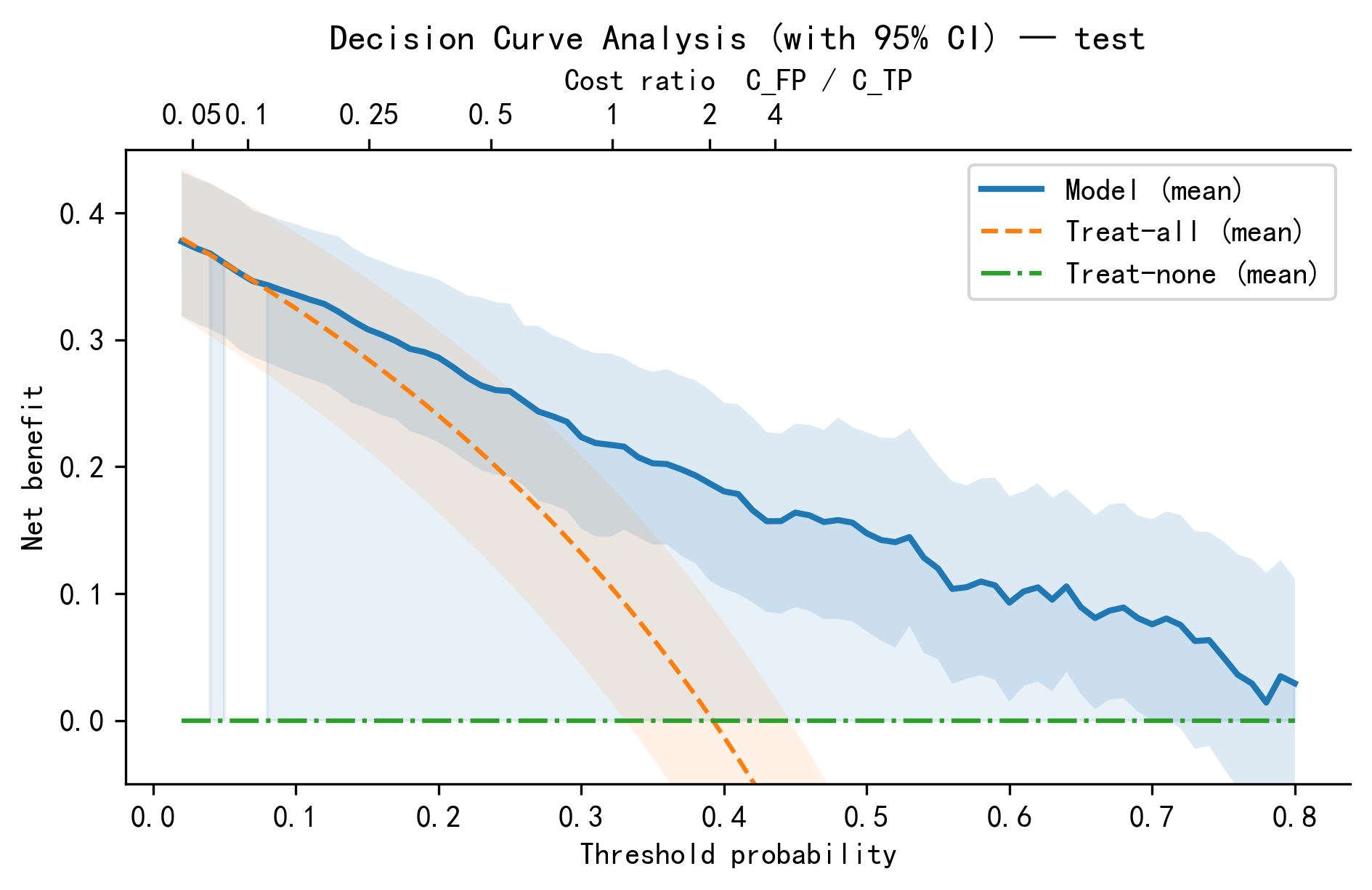
We used provincial monthly counts of newly reported HIV infections from the National Notifiable Diseases Surveillance System (NNDSS) and Baidu Search Index (BSI) for “HIV/AIDS” from January 2017 to December 2020 to train and evaluate a single, multi-province LLM (Qwen3-1.7B)-based model forecasting 10% HIV cases increases in the next month from a rolling three-month input window using LoRA for all 31 provinces/municipalities in China. Data were split in temporal order using a 7:2:1 ratio for training, validation, and testing. Calibration was assessed with quintile plots plus a flexible LOWESS/isotonic curve. Clinical utility was evaluated by decision-curve analysis (DCA).
Results
In 2020, provincial medians for newly reported HIV cases varied widely across China, ranging from 17 in Tibet (IQR 12.8–22.0) to 1,672 in Sichuan (IQR 1,404–1,865). In the validation window, operating at the F1-optimized decision threshold determined on validation, the model achieved an accuracy of 0.792, macro-F1 of 0.761, weighted-F1 of 0.796, balanced accuracy of 0.775, and recall of 0.734; the probability-based ROC-AUC was 0.853, indicating good discrimination. In the testing window, it also demonstrated comparable performance: accuracy 0.750, macro-F1 0.748, weighted-F1 0.752, balanced accuracy 0.756, recall 0.790, and ROC-AUC 0.833. On the test set, Brier=0.167 and rescaled Brier=0.300 (95% CI 0.169–0.427); the flexible curve and quintile means lay close to the 45° line. DCA showed positive net benefit for thresholds 0.04–0.80; the policy-optimal threshold was 0.40, yielding net benefit 0.182—about 18 more true alerts and 29 fewer unnecessary alerts per 100 province-months versus the best baseline.
Conclusions
Our study showed that a LoRA-adapted pretrained LLM can deliver accurate, multi-provincial HIV increase forecasts from minimal inputs without long look-back windows or high-dimensional covariates. The approach is readily integrable into routine workflows and is extensible to other notifiable diseases and subnational settings.
Table or Figure