Background
DoxyPEP is highly effective in preventing chlamydial infections most of which are asymptomatic. Its effect on NGU is not well-defined. Using data collected in a sexual health clinic (SHC) to conduct clinic- and patient-level analyses, we evaluated trends in the etiology of NGU among both men who have sex with women (MSW) and men who have sex with men (MSM) and the impact of doxyPEP on NGU caused by C. trachomatis (CT-NGU), M. genitalium (MG-NGU), and NGU without an identified bacterial cause (UNK-NGU), respectively, among MSM.
Methods
We used data from the King County SHC electronic medical record to calculate the annual number of NGU, CT-NGU, MG-NGU, and UNK-NGU cases from 1/1/2019 through 8/31/2025, excluding cases with positive tests for trichomonas, HSV, and adenovirus. We defined NGU by 1) Gram stain of urethral secretions with ≥5 WBCs/high power field or 2) positive leukocyte esterase on urinalysis in the absence of gonococcal infection by microscopy or nucleic acid amplification. We fit a Cox model modified for recurrent events and flexible hazards for initial and recurrent NGU to calculate the incidence of NGU by etiology among MSM with >30 days of follow-up from 4/1/2023 (start of doxyPEP) through 8/31/2025 and calculated hazard ratios comparing the risk of NGU between visits at which MSM reported taking and not taking doxyPEP in the prior month.
Results
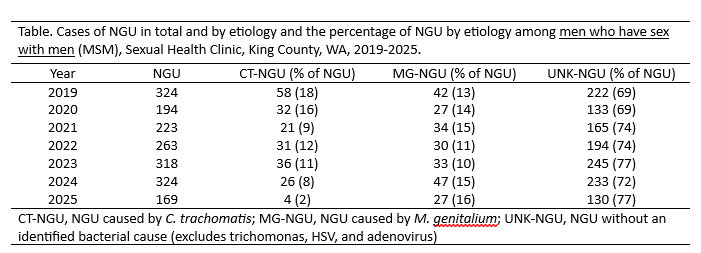
Among 15204 people assigned male at birth, there were 3188 cases of NGU between 1/1/2019 and 8/31/2025. Among 7268 MSM, there were 1815 cases and among 7328 MSW, there were 1288 cases. Among MSM, the proportion of NGU caused by CT decreased from 18% in 2019 to 2% in 2025 and the ratio of UNK-NGU to CT-NGU increased from 4:1 to 32:1. There were 4 cases of CT-NGU in 2025 as of 8/2025. In 2025, 77% of NGU was UNK-NGU compared to 69% in 2019. Among MSW, the proportion (12%) and ratio (4:1) for CT-NGU remained stable. At visits during which MSM reported doxyPEP use in the prior month, there was an 80% decrease in the risk of CT-NGU (0.19/100 person-years v 0.98/100 person-years; HR=0.20;95%CI%:0.05, 0.84) compared to visits at which patients reported not taking doxyPEP. MG-NGU (HR=1.09; 95%CI:0.71,1.66) and UNK-NGU visits (HR=1.03; 95%CI:0.84,1.25) did not differ by doxyPEP use.
Conclusions
DoxyPEP has dramatically reduced the proportion of NGU caused by CT and the incidence of CT-NGU. The majority of NGU among male patients is without an identified bacterial cause and MG-NGU and UNK-NGU do not seem to be prevented by doxyPEP.
Table or Figure