Background
Although initial trials of long-acting cabotegravir/rilpivirine (LA CAB/RPV) included only people with HIV (PWH) with virologic suppression (VS) on oral ART, 33% of U.S. PWH have not achieved VS. LA CAB/RPV is superior to oral ART among PWH with adherence challenges who first achieved VS on oral ART, and is increasingly used among those with viremia, with US-based guidelines now permitting this approach. However, limited data are available on blips, persistent low-level viremia (PLLV) and VF among PWH initiating LA ART with viremia.
Methods
We evaluated longitudinal data from the two largest clinic-based cohorts of U.S. PWH on LA ART to compare virologic outcomes among those initiated with and without viremia. The Grady Ponce Center (Atlanta, GA) and UCSF Ward 86 Clinic (San Francisco, CA) established LA ART programs in 2021 and began enrolling PWH with viremia and/or oral ART adherence challenges shortly thereafter. Electronic medical record data was abstracted from both clinics and analyzed for VF (two VL >200 cp/mL); blips (single VL >50); and PLLV (consecutive VL >50) after achieving VS. Mixed-effects logistic regression compared virologic outcomes between PWH who initiated LA ART with and without viremia, adjusted for demographics, site, and dosing pattern.
Results
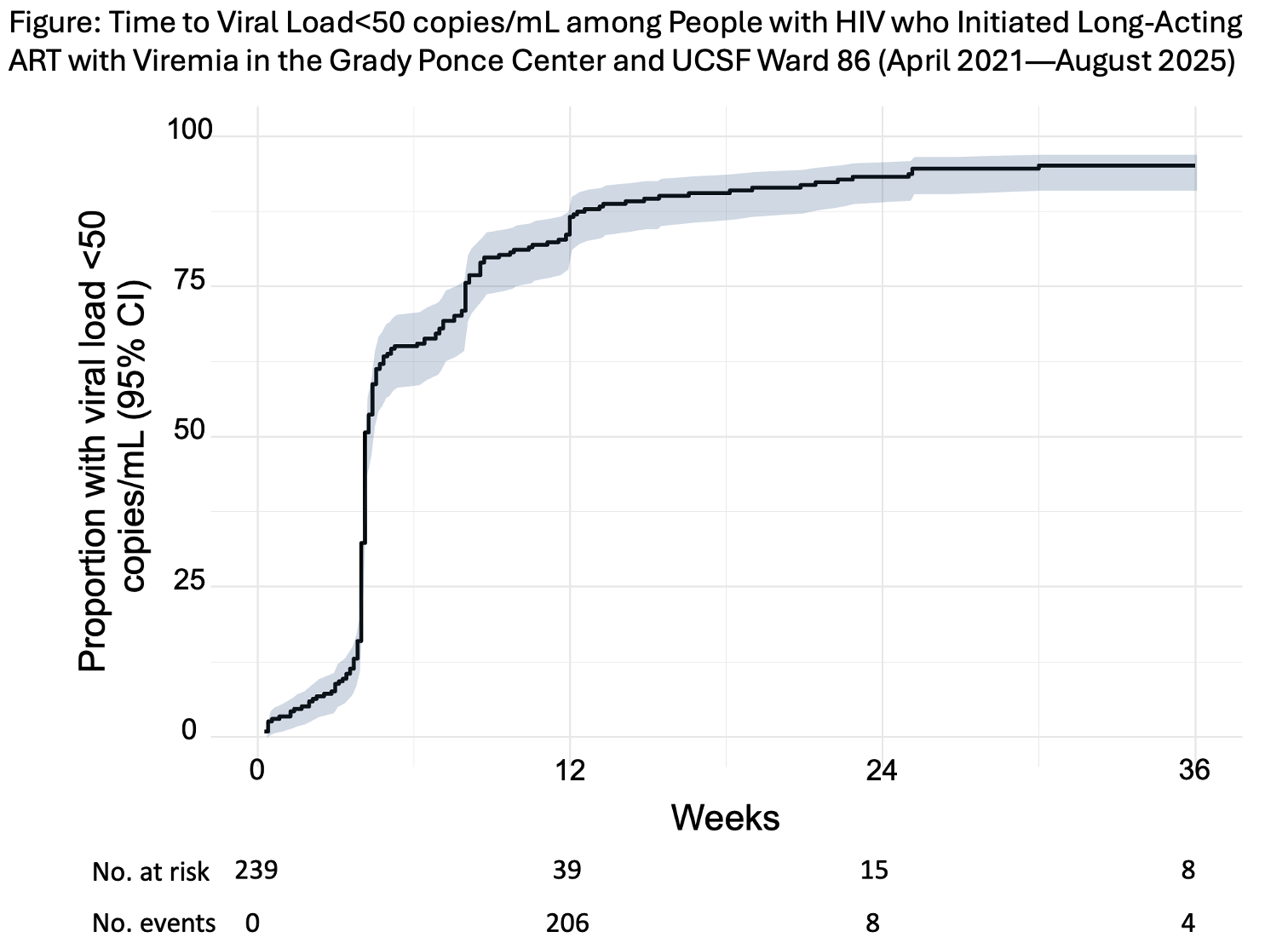
Overall, 1,070 PWH met inclusion criteria, including 23% who initiated LA ART with viremia (>50 cp/mL). The cohort had a median age of 42 (IQR: 34-54) years, 25% were women, 60% identified as Black race, 17% as Hispanic, and 37% experienced homelessness. Among the viremic group with ≥2 follow-up viral loads, 97% achieved a viral load <50 cp/mL at a median of 4 weeks (IQR: 4-8 weeks; Figure). Among PWH who initiated LA ART while viremic, blips were more common (12% vs. 4% with ≥1 blip; AOR 1.06 95% CI: 1.02-1.10; p=0.003); and a trend towards higher PLLV was observed (3 vs. 1%; p=0.10). VF, although infrequent, was more common among the viremic cohort (3% vs. 0.2%; p=0.001).
Conclusions
In the two largest clinic-based cohorts of PWH on LA ART in the U.S., nearly all PWH who initiated LA ART with viremia achieved VS at a median of 4 weeks. Virologic failure and blips were rare, but occurred more frequently among those initiating LA ART with viremia. Future studies should examine mechanisms underlying virologic outcomes while using LA ART, including contribution of pharmacokinetics and the viral reservoir, and investigate strategies for optimized treatment success such as therapy augmentation with lenacapavir.
Table or Figure