Background
Some public health authorities are advocating the discontinuation of routine gonorrhea (GC) and chlamydial (CT) screening and the empiric treatment sex partners of persons with GC and CT as measures to decrease antimicrobial use. DoxyPEP use is rising rapidly among MSM. We estimated how changes in STI screening, empiric treatment of partners, and doxyPEP might affect antimicrobial use among MSM.
Methods
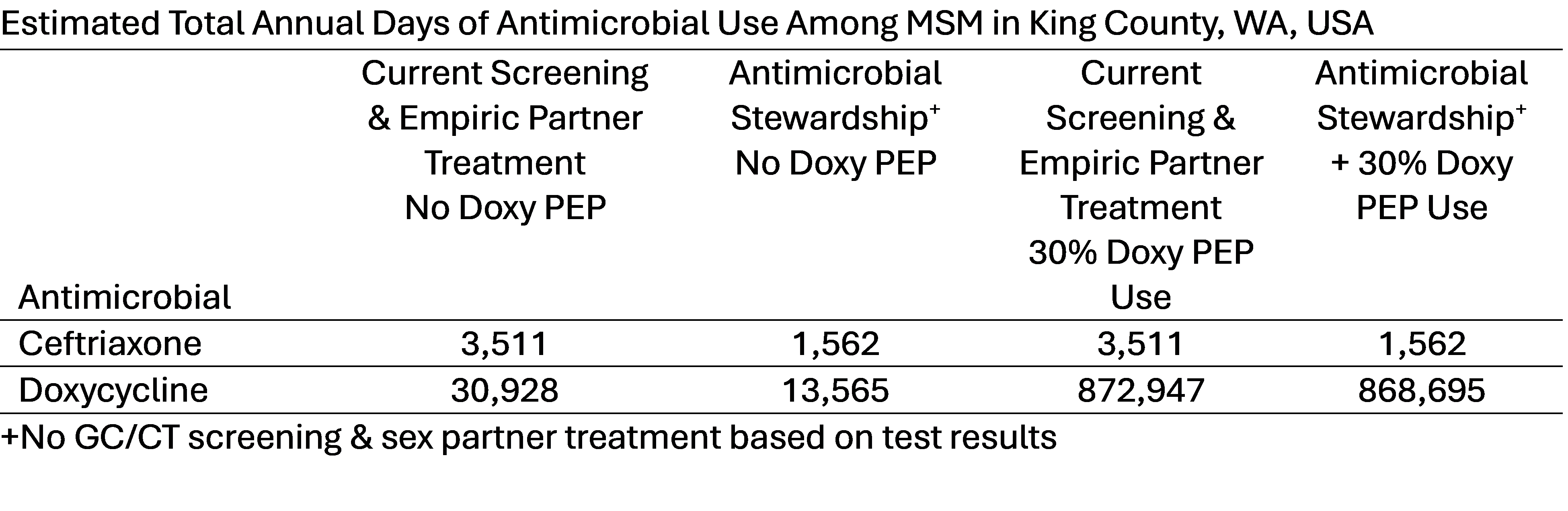
We used 2022 public health medical provider-initiated case report data from King County, WA, USA to estimate the number of MSM diagnosed with GC and CT because of symptoms, contact to a partner with GC/CT, and asymptomatic screening. We estimated the number of cases of nonchlamydial, nongonococcal urethritis (NGNCU) based on the ratio of cases of symptomatic chlamydial urethritis to NGNCU among MSM in King County’s sexual health clinic in 2022 (1:3.5) and estimated the number of MSM aged >18 years in King County using census and Behavioral Risk Factor Surveillance System data (n=79,560). We modeled 4 scenarios of doxycycline and ceftriaxone use: continued GC/CT screening and empiric therapy following exposure to GC/CT (Current Practice) without doxyPEP, elimination of GC/CT screening and empiric therapy (Antimicrobial Stewardship) without doxy PEP, Current Practice with doxyPEP, and Antimicrobial Stewardship with doxyPEP. For doxyPEP models, we assumed 30% doxyPEP use among MSM (mean 3 days per month) with a 60% decline in CT diagnoses and no change in GC diagnoses. We estimated non-STI antimicrobial use based on 2022 CDC data on outpatient antibiotic use among adult men (552 prescriptions per 1000).
Results
With Current Practice, King County MSM receive approximately 3,511 days of ceftriaxone for GC and 30,928 days of doxycycline for CT/NCNGU treatment annually. Antimicrobial Stewardship decreases ceftriaxone and doxycycline for GC and CT by 56% and 55%, respectively. DoxyPEP increases doxycycline use 27-fold (842,019 extra days) compared to Current Practice. Based on national estimates of antimicrobial use among all men, the MSM population of King County receives approximately 290,712 days of antimicrobials annually; doxyPEP increases the population’s total number of days of antimicrobials by approximately 190%.
Conclusions
Changes in GC/CT screening and empiric treatment of partners could substantially reduce the use of ceftriaxone and doxycycline, though widespread use of doxyPEP will dwarf the impact of such measures on doxycycline use.
Table or Figure