Background
Lung cancer (LC) is a leading cause of death in people with HIV (PWH), with an estimated cumulative mortality rate of 23% by age 80 in men in HIV care with moderate smoking history. Lung cancer screening (LCS) via low-dose CT scan (LDCT) improves LC mortality through early detection; however, the limited research on LCS in PWH shows low uptake. One systems-level barrier is that the tobacco history necessary to determine LCS eligibility is often incomplete. We aimed to characterize tobacco history documentation and LDCT uptake in PWH in a large health system in the Washington, DC metropolitan area, a region with one of the highest HIV rates in the US.
Methods
Electronic Health Record (EHR) data from most recent office visit from August 2024 to August 2025 in PWH age-eligible for LCS (50-80 years) were analyzed. Complete tobacco history was defined as having smoking status, packs-per-day, start date in current smokers, plus quit date in former smokers, in discrete EHR fields. Generalized estimating equations with a Poisson distribution and robust standard errors were used to model the prevalence of 1) complete tobacco history and 2) LDCT order, accounting for correlation between rooming and visit providers, respectively.
Results
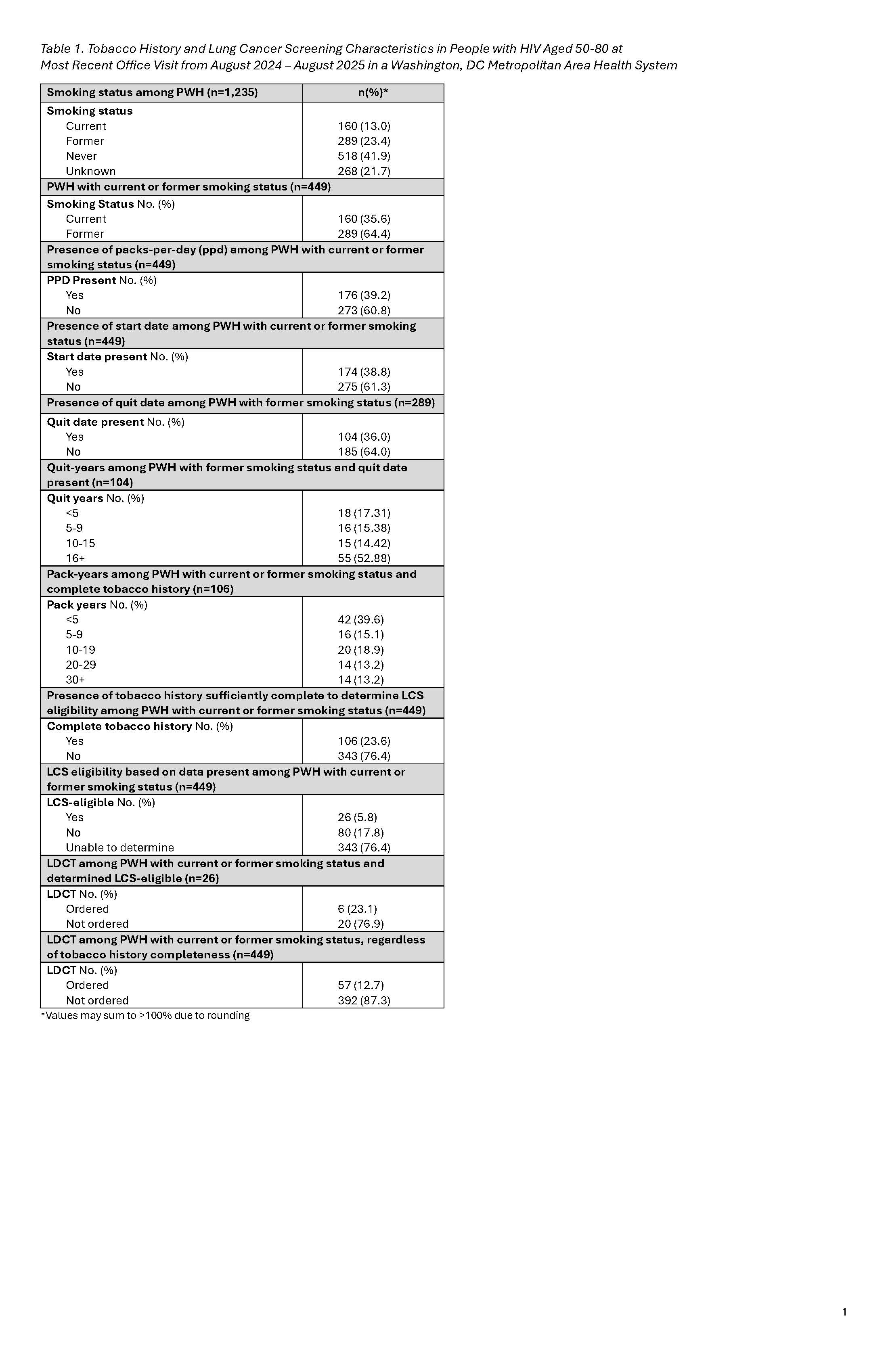
Of 48,459 people aged 50-80, 2.6% (n=1,235) had HIV (Table 1). Smoking status was unknown in 21.7% (n=268) of PWH. Complete tobacco history was present in 23.6% (n=106) of PWH with current or former smoking status. Of those with complete tobacco history who were LCS-eligible, 23.1% (n=6) had a LDCT ordered. After adjusting for key demographic and clinical factors, higher prevalence of complete tobacco history was associated with having ≥4 visits vs. 1 visit (4-5 visits: aPR=2.39, 95% CI: 1.11-5.14; 6+ visits: aPR=3.48, 95% CI: 1.77-6.87). Lower prevalence of LDCT order was associated with former vs. current smoking status (aPR=0.36, 95% CI: 0.23-0.57) and with Medicaid vs. private insurance (aPR=0.47, 95% CI: 0.23-0.95).
Conclusions
In this large sample of PWH age 50-80, smoking status was unknown in over one-fifth of individuals. Over three-fourths of those with current or former smoking status had insufficient tobacco history to determine LCS-eligibility, and LDCT referral was low among eligible. Given PWH have elevated risk of LC, new strategies are needed to improve tobacco history documentation and LCS, particularly in those with Medicaid and former smoking status.
Table or Figure