Background
HIV is hypothesized to accelerate human aging, an effect modified by comorbid conditions including substance use. Cannabis is among the most common psychoactive substances used by people with HIV (PWH) yet its effects on aging in this population are poorly understood. Prior work has found that cannabis alters the epigenome in the general population, though whether deleteriously is unclear. We hypothesized that DNA methylation (DNAm) clocks are accelerated in people with HIV (PWH) who regularly use cannabis (HIV+/CB+) compared to non-using PWH (HIV+/CB-) or people without HIV, either users (HIV-/CB+) or non-users (HIV-/CB-).
Methods
Cannabis use was self-reported and confirmed via urine metabolites; all participants had undetectable HIV viral load. DNA was extracted from peripheral blood mononuclear cells, and DNAm levels were quantified using Illumina MethylationEPIC microarrays. The mortality-sensitive GrimAge, morbidity-sensitive PhenoAge, and longitudinally predictive DunedinPACE clocks were calculated using the principal component method of Levine et al. Clocks were normalized by zeroing the mean age residual of non-user controls. The study hypothesis was tested using linear regression with age, biological sex, and blood cell proportions as covariates.
Results
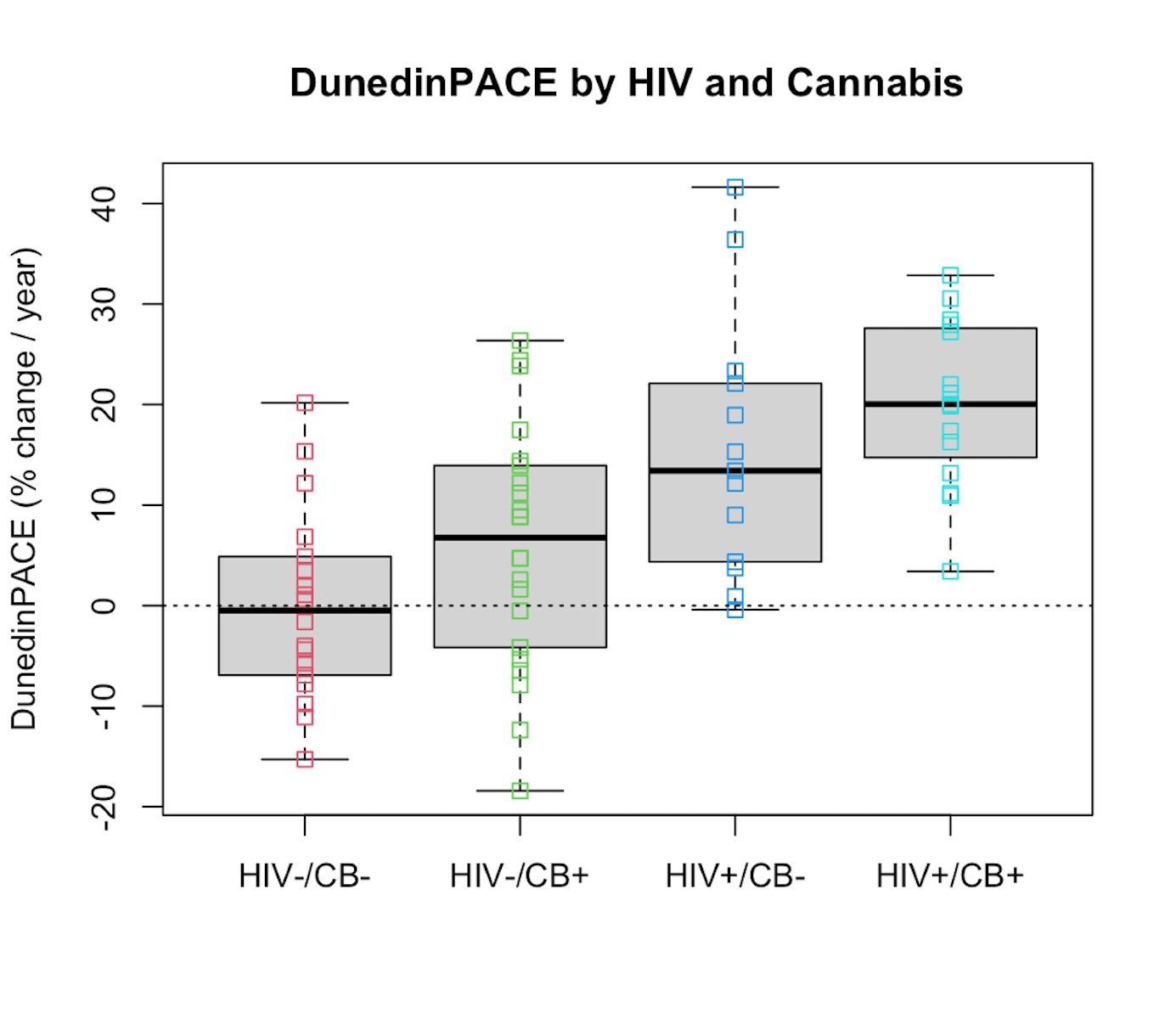
Participants included 15 HIV+/CB+; 13 HIV+/CB-; 22 HIV-/CB+; and 18 HIV-/CB-, i.e., control group. The DunedinPACE rate of aging showed a stairstep increase by exposure, with HIV-/CB+ having +6.0% acceleration (p=0.06); HIV+/CB- having +11.4% acceleration (p=0.017), and HIV+/CB+ having 13.5% acceleration (p=0.002) vs. controls (see Figure). GrimAge was accelerated for HIV+/CB+ by +4.1 years (p<0.001) and HIV+/CB- by +3.2 years (p=0.015), and HIV-/CB+ by +2.5 years (p=0.005), but no significant differences were found among the exposure groups. PhenoAge was sensitive to HIV serostatus: it was increased by +9.3 years in HIV+/CB- (p=0.003) and +7.3 years in HIV+/CB+ (p=0.009) but was not cannabis-sensitive.
Conclusions
These data indicate that HIV and cannabis both alter biological aging, and that various DNAm clocks have differential sensitivity to HIV and cannabis. DunedinPACE, which predicts longitudinal ‘pace of aging’, was the only clock accelerated by the additive effects of HIV and cannabis. This may indicate that PhenoAge and GrimAge are better at capturing legacy effects while DunedinPACE responds to ongoing insults. Cannabis use represents a modifiable risk factor for poor health outcomes in aging PWH.
Table or Figure