Background
Low level viremia (LLV) on long-acting (LA) cabotegravir/rilpivirine (CAB/RPV) appears frequent in clinic cohorts, which may portend future risk of virologic failure (VF). Further, drug concentrations of CAB and RPV in real-world settings appear more variable than what was reported in clinical trials. In this study within a large clinic-based cohort, the Ward 86 Special Program on LA ART to Stop HIV (SPLASH), we measured CAB/RPV drug levels and examined their association with subsequent virologic outcomes.
Methods
We collected residual plasma samples for analyses of CAB/RPV levels via liquid chromatography-tandem mass spectrometry in the UCSF Hair Analytical Laboratory among a subset of participants within the SPLASH program from 8/2024-2/2025. We analyzed the proportion whose drug levels were below the protein adjusted inhibitory concentration to inhibit 90% viral replication (PAIC90), and 4x the PAIC90, excluding those with late injections. Tobit regression examined predictors of current viral load ≥30 copies (cp)/mL.
Results
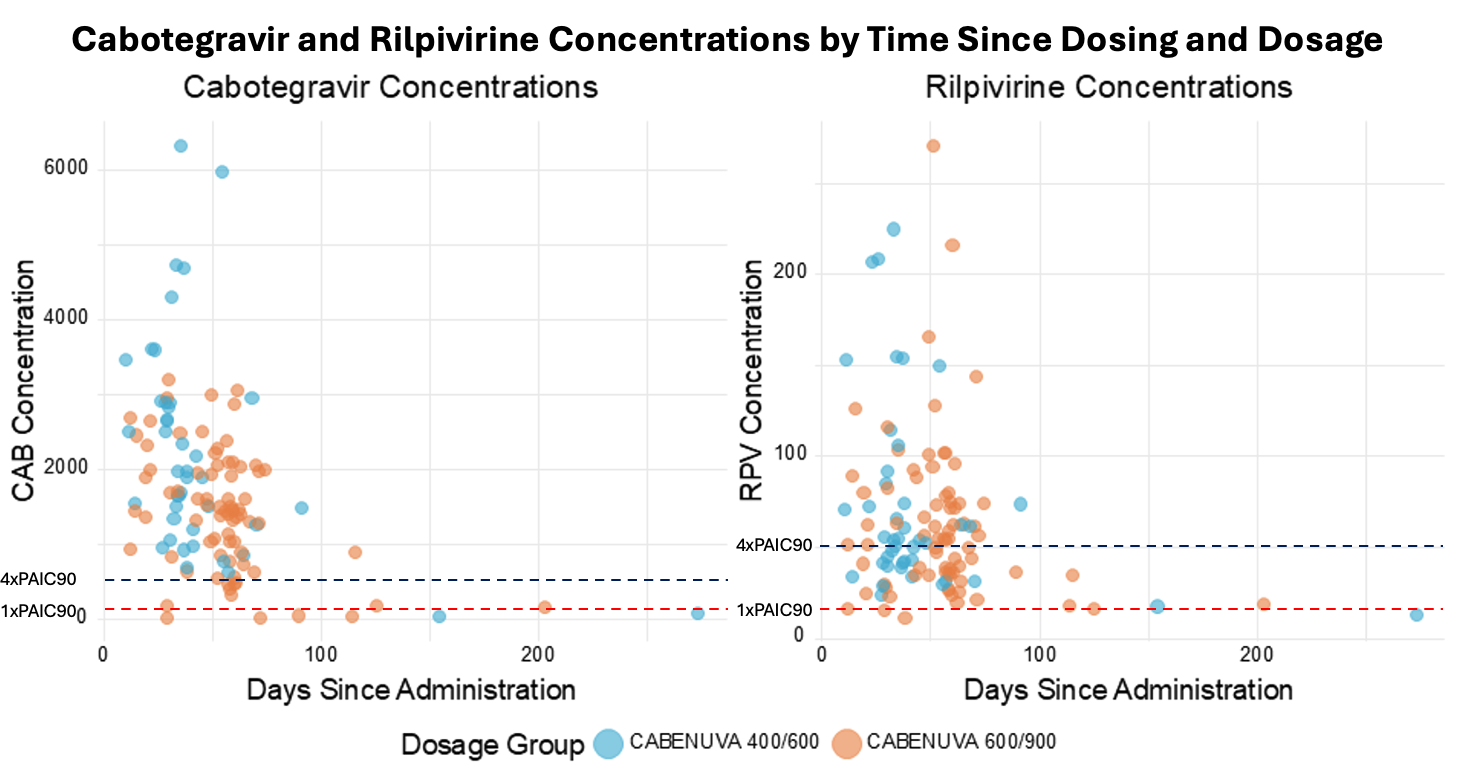
Overall, 114 people with HIV (PWH) provided 195 samples; the median age was 51 (IQR 38-59); 22% women; 26% Black, 47% White; 29% were Hispanic. One-third initiated LA ART with viremia ≥50 cp/mL. Overall, 8% had a most recent viral load 30-200 cp/mL, 4% >200. The mean CAB concentration was 1694 ng/mL (SD 1133), while for RPV it was 45 ng/mL (SD 49). After controlling for age, sex, and BMI, we found that drug levels were highly variable (Figure). For RPV, 41% of samples demonstrated concentrations below the 4x PAIC90, with 8% below the PAIC90. For CAB, 17.1% were <4xPAIC90, 4.2% <PAIC90. Among PWH receiving bimonthly 600/900mg dosing, LLV was more frequent (15% with VL>30) compared to those in the monthly 400/600mg group (7.5% with VL>30, p=0.03), controlling for viremia status at initiation and time since administration. An increased risk of viral load >30cp/mL was seen among those with lower CAB (two-fold higher risk of viral load >30cp/mL with <4xPAIC90, p=0.04), but not RPV (p=0. 22), levels.
Conclusions
CAB/RPV concentrations on LA ART are highly variable in a real-world clinic setting, potentially related to differences in population or injection technique compared to clinical trials. Lower CAB. but not RPV, concentrations portended elevated viral loads, potentially related to the greater importance of CAB in treatment success. Dose optimization based on drug levels (i.e. concentration-dependent dosing) may be needed to enhance success on LA ART.
Table or Figure