Background
The fastest growing HIV epidemics in Europe are in Russia and Ukraine. Conflict between Russia and Ukraine has resulted in significant population displacement in Eastern Europe, impacting regional HIV epidemiology. Poland has experienced a 15% increase in people living with HIV (PLH) and introduction of HIV-1 subtype A6 into a predominantly subtype B region. The impact of this population displacement on the epidemiology of HIV in Georgia remains unclear.
Methods
This cross-sectional study aims to characterize HIV risks, molecular epidemiology, and associated infections amongst PLH receiving care at the T. Tsertsvadze Infectious Diseases, AIDS, & Clinical Immunology Research Center in Tbilisi, Georgia. We are enrolling up to 650 PLH aged ≥ 18 years into four groups: from Georgia taking antiretroviral therapy (ART); ART-naive; from Abkhazia; from non-Georgian Eastern European countries. Data collection includes demographics, health and sociobehavioral factors, HIV viral load with sequencing for those with ≥1000 copies/mL, CD4 count, and associated infection testing. Robust Poisson regression identified factors associated with viral suppression (≤1000 copies/mL).
Results
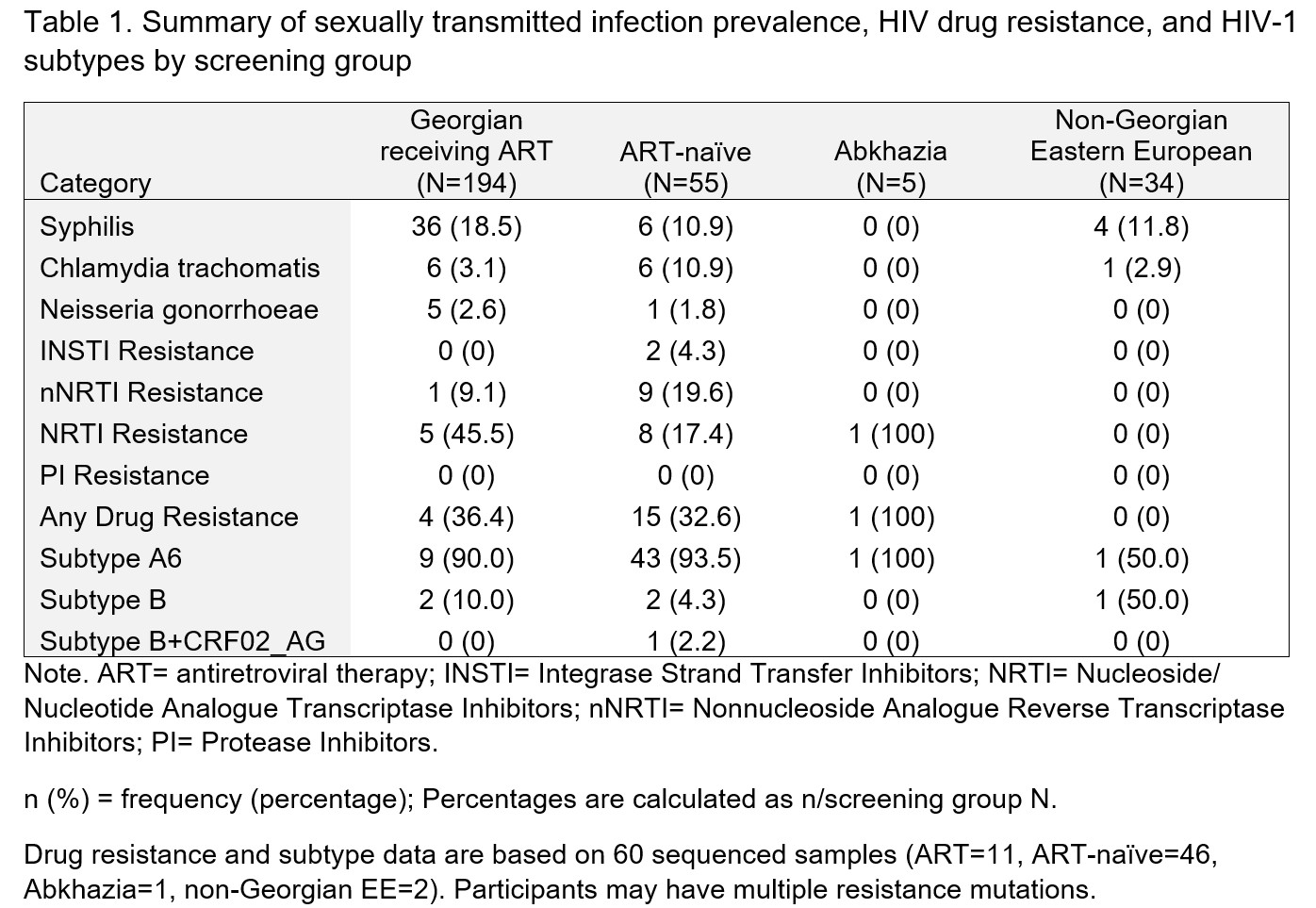
As of September 2025, data from 288 participants was available for analysis (Table 1). Median age was 37.5 years; 23.3% were female. Viral suppression rates were high amongst participants from Georgia taking ART (94.9%), Abkhazia (80%), and non-Georgian Eastern European countries (97.1%). Among 60 sequenced samples, subtype A6 predominated (90.0%), with subtype B (8.3%) and B+CRF02_AG (1.7%) also detected. Drug resistance was present in 33.3%, mainly NRTI-related (23.3%). ART-naïve individuals had higher chlamydia prevalence (referent: participants from Georgia taking ART; Risk Ratio [RR]=3.53, 95% confidence interval [CI] 1.18-10.5). Low CD4 count (≤199 cells/mm3 vs ≥500 cells/mm3; RR=0.63, 95% CI 0.39-0.99) and not taking ART (RR=0.12, 95% CI 0.05-0.30) were associated with unsuppressed viral load.
Conclusions
High viral suppression rates suggest effective HIV care in Georgia. The predominance of subtype A6 and detection of subtype B and B+CRF02_AG reflect regional epidemic influence. High chlamydia prevalence amongst ART-naïve participants suggests distinct sociobehavioral patterns within this group. Continued data collection and analysis from this unique study will further clarify the impact of population displacement on HIV and related infection epidemiology in Georgia to inform regional public health strategies.
Table or Figure