Bictegravir/emtricitabine/tenofovir alafenamide (B/F/TAF) is a guidelines-recommended single-tablet regimen for people with HIV-1 (PWH). We present cumulative outcomes from open-label extension (OLE) that followed 144 Weeks (W) of blinded treatment in phase 3 studies in treatment-naïve PWH.
We conducted 2 randomized, double-blind, phase 3 studies of B/F/TAF in treatment-naïve adults – Study 1489: B/F/TAF vs dolutegravir/abacavir/lamivudine (DTG/ABC/3TC) and Study 1490: B/F/TAF vs DTG+F/TAF. After completing 144W of blinded treatment, participants were offered to continue on B/F/TAF for 96W in the OLE. Efficacy was assessed as the proportion with HIV-1 RNA <50 copies/mL at each visit after starting B/F/TAF using missing=excluded (M=E) analysis; safety by adverse events (AEs) and laboratory results. Bone mineral density (BMD) in OLE was measured in those randomized to B/F/TAF in Study 1489. We present cumulative results for all participants treated with B/F/TAF in the randomized or OLE phases through a maximum of 192 weeks of follow up (i.e. OLE W48). The final phase of this study will complete once all participants reach a total of 240 weeks (i.e. OLE W96).
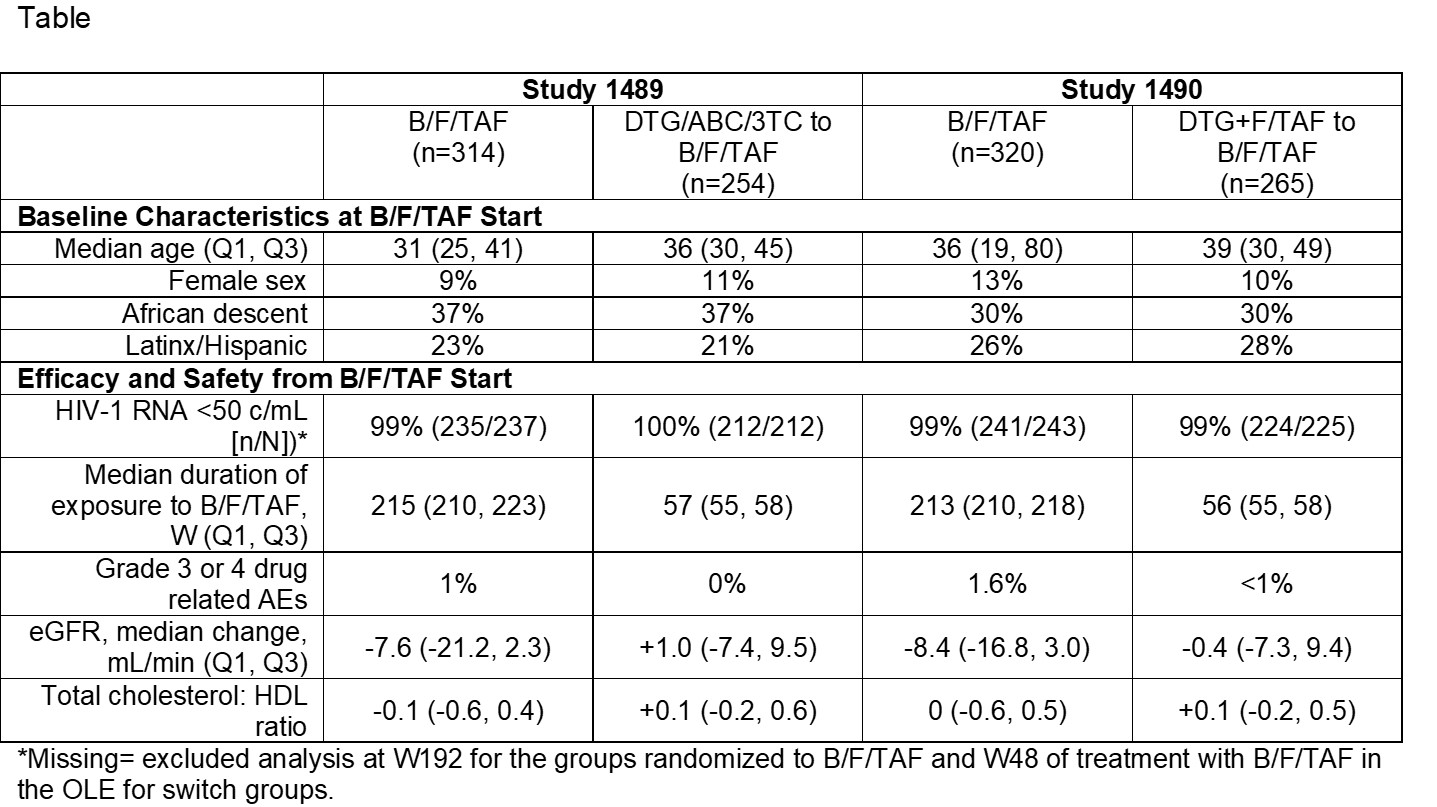
In Study 1489, 314 participants were randomized to B/F/TAF and 315 to DTG/ABC/3TC; 252 and 254 entered the OLE. In Study 1490, 320 were randomized to B/F/TAF and 325 to DTG+F/TAF; 254 and 265 entered the OLE. Efficacy was >98% after W48 at each study visit through W192 in both studies. Across both studies, only one participant experienced an AE that led to drug discontinuation during the OLE analysis window. Grade 3 or 4 drug-related AEs were rare (Table). There were no discontinuations due to renal AEs. In participants initially randomized to B/F/TAF, the median change in weight from baseline to W192 was 4.6 kg in Study 1490 and 5.0 kg in Study 1490. The mean percent changes (SD) in hip and spine BMD through W192 were -1.5% (4.9) and -0.9% (5.2), respectively. 13% of participants with baseline osteopenia in hip and 3% with osteopenia of the spine improved to normal at W192, 4% with normal baseline hip and 6% with normal baseline spine BMD progressed to osteopenia and none developed osteoporosis.
Over 4 years of follow-up in treatment-naïve participants, B/F/TAF was safe and highly efficacious. Similar outcomes were demonstrated in participants who switched from DTG-containing regimens to B/F/TAF. These results confirm long term safety and efficacy of B/F/TAF.