Background
Major adverse cardiovascular events (MACE) are more common among people with HIV (PWH). REPRIEVE demonstrated a 36% reduction in MACE with pitavastatin, but the relationship of circulating biomarkers to MACE in this asymptomatic primary cardiovascular prevention population remains unknown.
Methods
We assessed the relationship of baseline concentrations of cardiac (NT-proBNP, hs-cTnT), inflammatory (IL-6, hs-CRP) and lipid biomarkers (ApoB-100, oxLDL, Lp(a)) to incident confirmed MACE. Biomarkers were measured on commercial platforms or ELISA (oxLDL) and assessed with clinically defined thresholds. Associations with MACE were assessed using Cox models adjusted for randomized treatment and atherosclerotic CVD (ASCVD) risk by pooled cohort equations (PCE). The added predictive value of biomarkers for MACE was assessed using C statistic and AUC at 5-years (AUC5).
Results
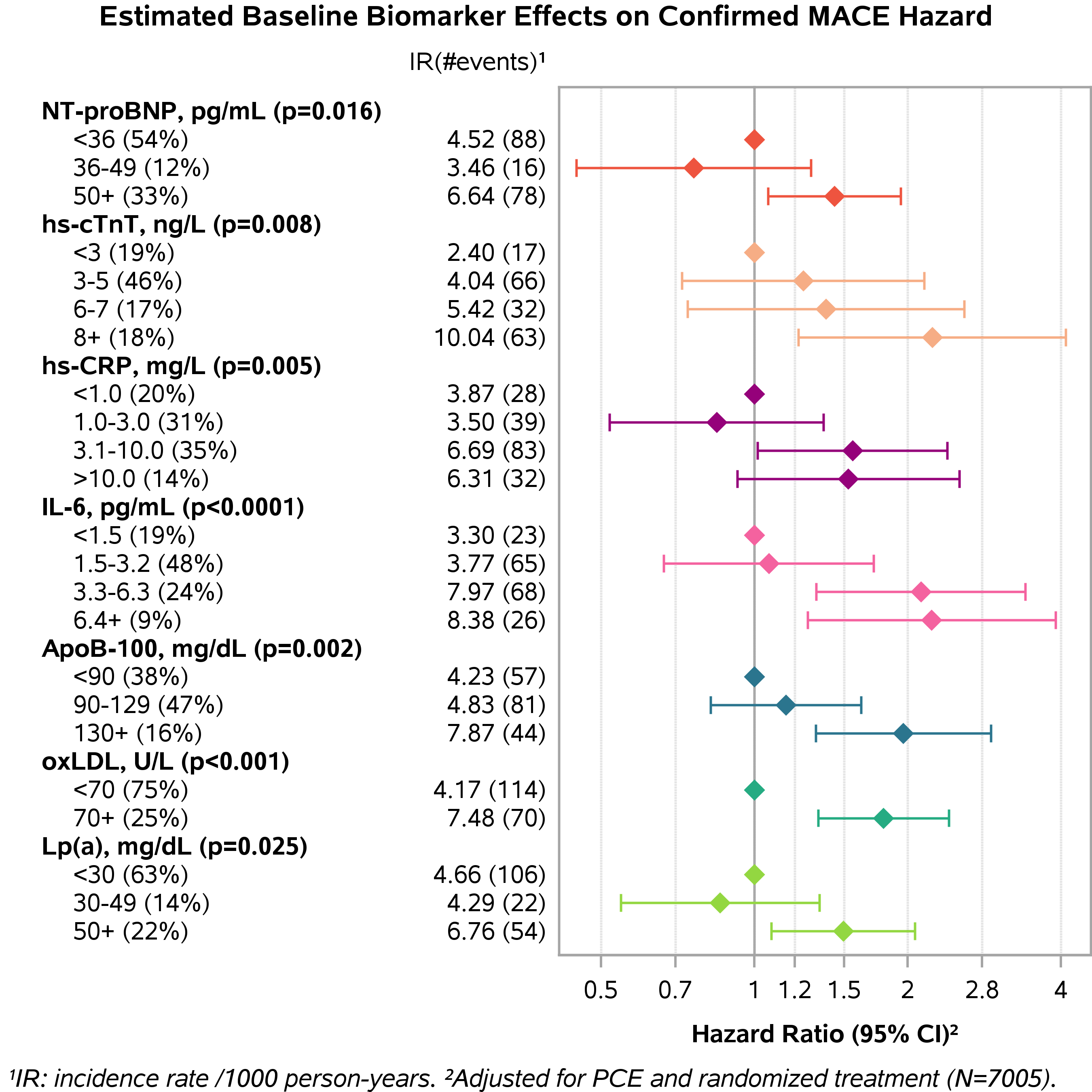
Of 7769 REPRIEVE participants, 7005 (90%) had biomarker data available at baseline, with similar demographics to the full trial population and median follow-up of 5.6 years. Biomarker distributions, with percentages of participants at increasing thresholds, are shown in the Figure. For example, median hs-CRP was 3.0 mg/L with 49% >3 mg/L and median hs-cTnT was 4.8 ng/L with 81% detectable at ≥3 ng/L and 35% at ≥6 ng/L. Cardiac biomarkers showed little correlation with inflammatory or lipid biomarkers (|rho|<0.12). All biomarkers were individually related to MACE in the PCE-adjusted analysis, with the largest hazard ratios for elevated IL-6 and hs-cTnT (Figure). Individual biomarkers provided only modest improved prediction (0.01-0.02) from a base model with PCE score and randomized treatment (C statistic 0.68, AUC5 0.70). A model with cardiac and inflammatory markers together increased C statistic to 0.72 and AUC5 to 0.74, whereas a full model with all biomarkers increased both C statistic and AUC5 to 0.75. Lipid markers, partially accounted for in PCE, added least to the base prediction model.
Conclusions
Among an asymptomatic, primary prevention population of PWH with low to moderate predicted ASCVD risk, clinically relevant cardiac and inflammatory biomarkers were associated with the residual risk of MACE after adjustment for statin randomization and ASCVD risk. A combination of inflammatory and cardiac markers indicating innate immune activation, general inflammation, and subclinical cardiac dysfunction may be useful as an adjunct to traditional risk scoring to predict MACE.
Table or Figure