Background
The Randomized Trial to Prevent Vascular Events in HIV (REPRIEVE) demonstrated a 36% reduction in major adverse cardiovascular events (MACE) with pitavastatin among people with HIV (PWH). Little is known about the relationship between lipid-lowering and MACE in this population. We evaluated pitavastatin effects on lipids and examined mediation of pitavastatin effects on MACE through lipid-lowering.
Methods
REPRIEVE was a global Phase III randomized clinical trial evaluating pitavastatin (4 mg daily) or placebo for prevention of MACE in PWH. Participants aged 40–75 years and at low-to-moderate atherosclerotic CVD risk with minimally elevated LDL cholesterol (LDL-C) were followed for a median of 5.6 years. Centrally-tested fasting lipids were captured at entry and annually thereafter. Linear mixed-effects models were used for assessment of the pitavastatin effect on lipids, Cox regression for relationship of lipids to MACE, and traditional and contemporary counterfactual methods for mediation analyses.
Results
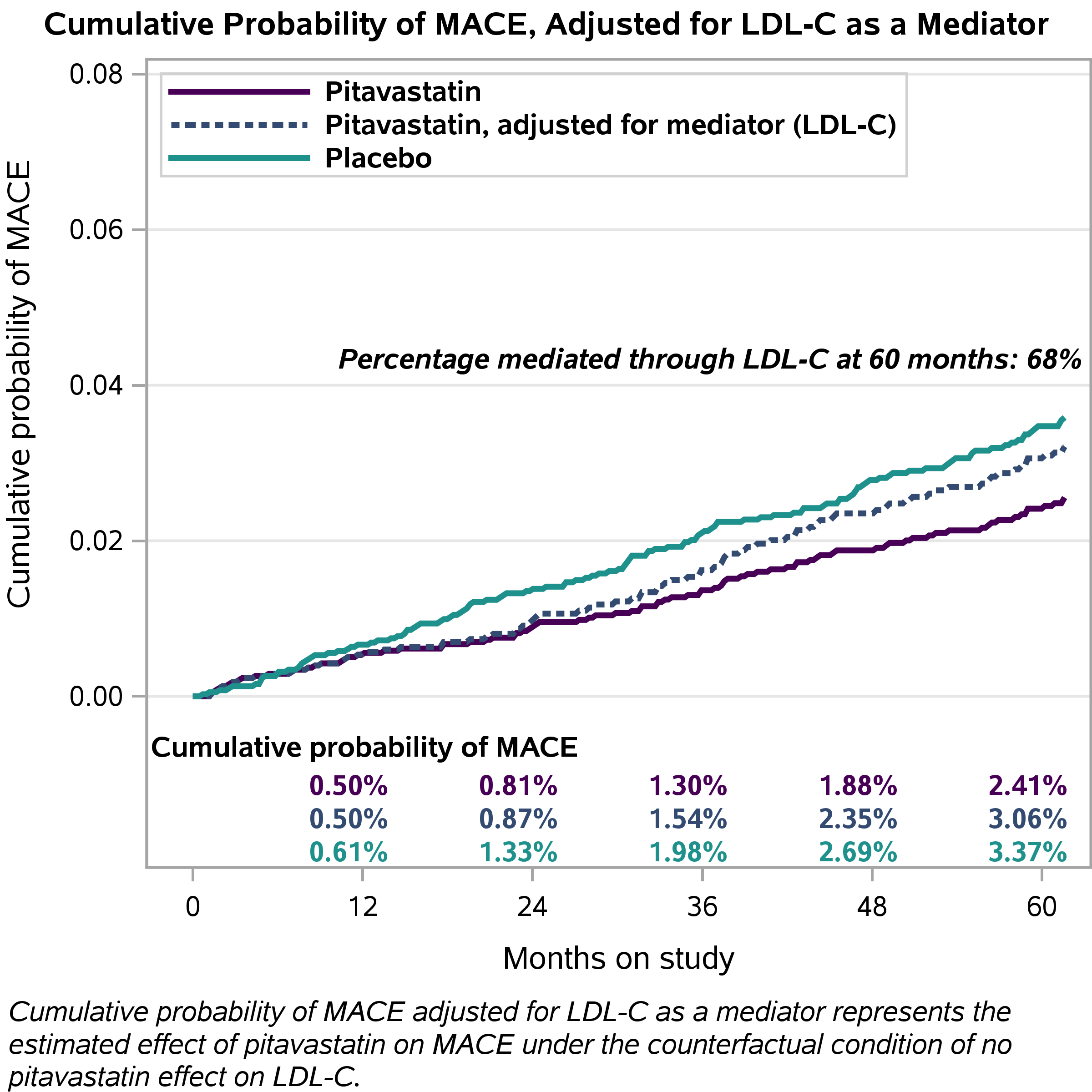
Among 7769 participants, the median baseline LDL-C was 108 mg/dL, HDL-C 48 mg/dL and triglycerides (TG) 114 mg/dL, all similar by treatment groups. Pitavastatin effects were primarily observed on LDL-C, with a modest reduction in TG (median change from baseline to month 12: -11 mg/dL with pitavastatin vs. 1 mg/dL with placebo), and no apparent effect on HDL-C (1 vs. 0 mg/dL, respectively). At month 12, the estimated treatment group difference (pitavastatin minus placebo) in LDL-C was -30 mg/dL (95% CI: -31, -29), corresponding to a 30% reduction, with relatively stable levels thereafter. With pitavastatin, 82% had LDL-C <100 mg/dL and 42% <70 mg/dL at month 12, compared to 43% and 11% with placebo, respectively (unchanged from baseline in the placebo group). The relative reduction in LDL-C from baseline was generally consistent across key baseline subgroups, including baseline LDL-C. A 30%-lower time-updated average LDL-C was associated with 20% lower risk of MACE (hazard ratio: 0.80; 95% CI: 0.68, 0.94). Exploratory mediation analyses indicated that the observed pitavastatin effect on MACE was largely through LDL-C (between 36% to 50% with traditional methods, 68% with a counterfactual method (Figure)).
Conclusions
Among a primary prevention cohort of PWH with minimally elevated LDL-C, pitavastatin demonstrated a robust 30% LDL-C-lowering. Pitavastatin effects on LDL-C were strongly related to MACE but unlikely to fully account for all the MACE reduction.
Table or Figure