Background
The use of protease inhibitors (PIs) has played a central role in antiretroviral (ARV) therapy, but has also driven the emergence of specific resistance mutation patterns. Over time, the PI class has evolved from first-generation drugs such as indinavir (IDV), saquinavir (SQV), nelfinavir (NFV) and amprenavir (APV), to more robust and better tolerated agents such as lopinavir/ritonavir (LPV/r), atazanavir (ATV/r) and darunavir (DRV/r). The aim of this study was to assess changes in resistance levels and mutation profiles to PIs in relation to the evolving use of different PIs over a 17-year period in people living with HIV (PWH) experiencing virological failure.
Methods
We analyzed in parallel the use of the different PIs in ARV-treated PWH in an academic center and the HIV PI resistance profiles in RNA (2008-2024; analyzed using the latest ANRS-MIE algorithm v35).
Results
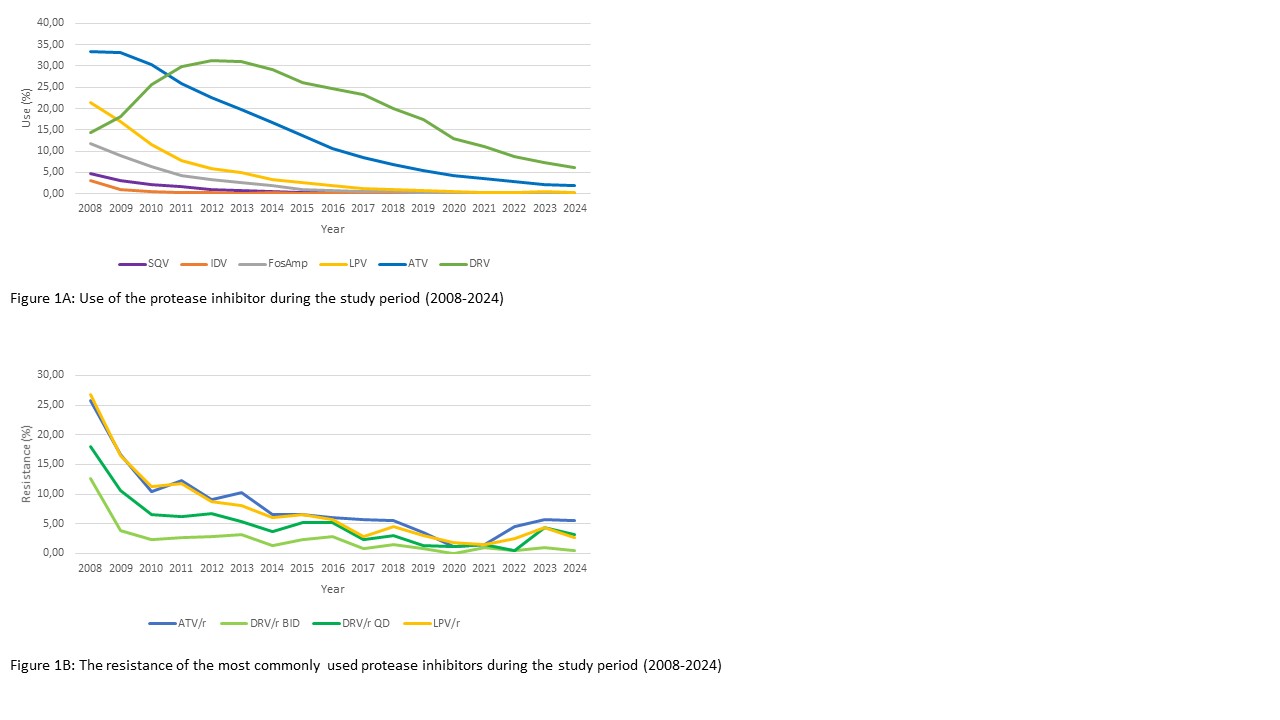
The total number of PWH on ARV treatment was 3 108 people in 2008 and has increased to 4 384 people in 2024. During this period, the proportion of PI users among the total number of ARV-treated PWH decreased from 73.5% (n=2 278/3 100) to 8.3% (n=362/4 384). The use of NFV, APV and TPV did not exceed 1% over the period of the study. In 2008, SQV and IDV were prescribed in fewer than 5.0% of cases, and their use subsequently declined sharply (figure 1A). Although more frequently prescribed in 2008, the use of fAPV and LPV/r showed a progressive decline over the subsequent years. Despite the limited current use of ATV/r (2.0%) and DRV/r (6.1%), these agents were the most frequently prescribed PI over the 17-year observation period (figure 1A).
The number of HIV RNA protease genotypic resistance tests increased from 205 at the start of testing in 2008 up to 217 in 2024. Overall, the level of resistance to PI has declined progressively over time (figure 1B). Consistently, resistance to DRV/r BID has been the lowest among PIs, decreasing to 0.5% in 2024. The highest resistance rate in 2024 (5.5%) was observed with ATV/r, whereas LPV/r (2.8%) and DRV/r QD (3.2%) displayed intermediate resistance levels within the PI class.
Conclusions
Over 17 years, the use of PIs markedly declined in favor of integrase inhibitors, accompanied by a progressive decrease in PI resistance. Although PI resistance is now rare, PIs particularly DRV/r BID, remain important options in salvage therapy, warranting continued surveillance of resistance.
Table or Figure