Background
In August 2022, a state-of-emergency (SOE) was declared in California due to the global mpox outbreak. During the SOE, gay, bisexual, and other men who have sex with men (GBMSM) adopted mpox prevention strategies, which contributed to the reduction in the number of mpox infections from the initial peak in late summer 2022. We used California mpox surveillance data to describe sexual behaviors among people infected with mpox before, during, and after the SOE.
Methods
Information related to STI prevention behaviors were elicited from California residents with mpox who identified as GBMSM during routine public health interviews from May 2022 through July 2024. Time periods were defined as pre-SOE (May 12 – July 31, 2022), during SOE (August 1, 2022 – January 31, 2023) and post-SOE (February 1 – July 31, 2024). Characteristics were compared using Pearson’s chi-squared test; Fisher’s exact test was used if <10 people were in a group. When a specific characteristic was unknown, that individual was excluded from that specific sub-analysis.
Results
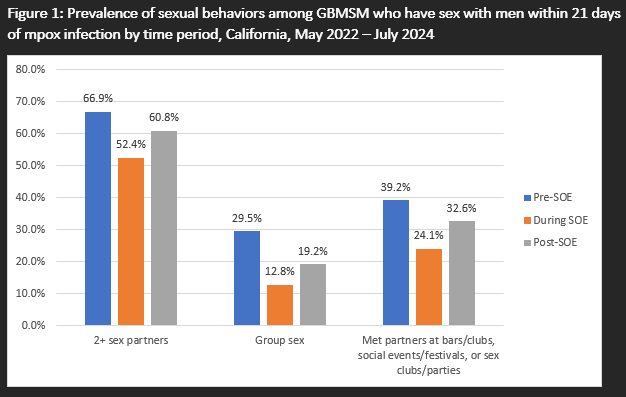
There were 6,384 confirmed mpox infections in California May 2022-July 2024; of those, 4,714 (73.8%) were GBMSM. Pre-SOE, significantly more GBMSM with mpox reported group sex (29.5%, p<.0001), two or more sex partners (66.9%, p<.0001), and meeting partners at bars/clubs, social events/festivals, or sex clubs/parties (39.2%, p<.0001), compared to 12.8%, 52.4%, and 24.1% during SOE, respectively. Compared to during SOE, a higher proportion of GBMSM post-SOE reported group sex (19.2%, p<.0001), two or more sex partners (60.8%, p=0.003), and meeting partners at bars/clubs, social events/festivals, or sex clubs/parties (32.6%, p<.0001); however, these proportions still remained significantly lower than pre-SOE (p<.0001, p=.043, and p=.016, respectively).
Conclusions
Sexual behaviors among GBMSM with mpox during the SOE differed significantly from behaviors pre- or post-SOE. During the SOE, a lower proportion of GBMSM with mpox engaged in group sex, had two or more partners, and reported meeting partners at bars/clubs, social events/festivals, or sex clubs/parties. Post-SOE, these behaviors, albeit at lower levels, have increased. The ongoing circulation of mpox in California, coupled with use of fewer mpox avoidance strategies, suggest that mpox will pose an ongoing risk to Californians and underscores the need to ensure accessible stigma-free prevention and care in the at-risk population.
Table or Figure