Background
How HIV reservoir is established in lymphoid tissues remain elusive.
Methods
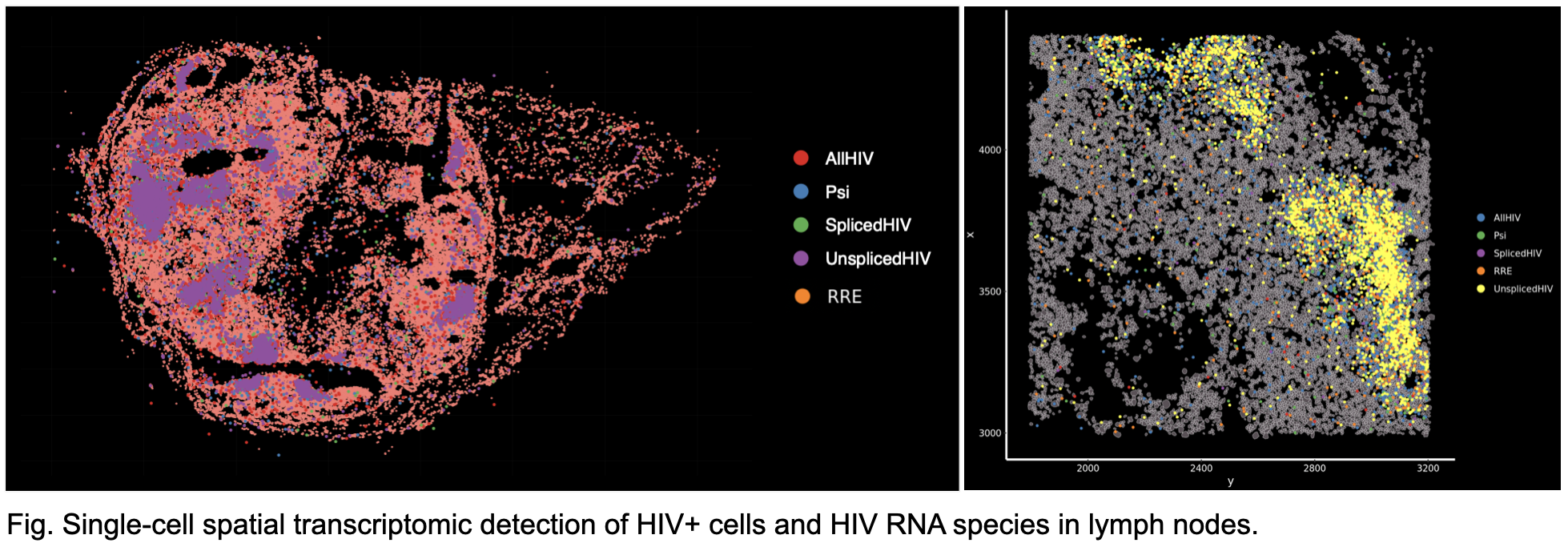
We obtained frozen lymph nodes from 2 viremic donors and 2 virally suppressed donors from the Last Gift Cohort. Lymph nodes from 2 uninfected donors served as negative controls. We performed single-cell spatial transcriptomic profiling (475 immune genes) of 11 tissue sections using 10x Genomics Xenium, which uses cell segmentation to identify bona fide single cells. To distinguish intact vs non-intact HIV RNA, we designed 5 sets of HIV probes targeting packaging signal, Rev-response element (RRE), unspliced HIV (gag-pol), splice junctions, and all HIV. A threshold of >2 HIV RNA reads/probe defines HIV RNA+ cells. Detection of both packaging signal and RRE defines cells having intact HIV. An adjusted P<0.05 with a log2 fold change >2 is considered significant.
Results
We found that nonspecific RNA detection was a major caveat of this platform. We identified 791,108 cells (162,326 from viremic, 129,754 from virally suppressed, and 499,028 from uninfected donors). In viremic samples, we identified 1,967 HIV+ cells (1.21%, 12,117.6/million), including 17 cells having intact HIV RNA (104.7/million). Comparing non-intact HIV+ cells vs HIV– cells in viremic samples showed no differentially expressed genes, indicating the robustness of intact HIV detection. Of note, HIV– cells in viremic (vs virally suppressed) samples already showed upregulated type I IFN response (IFI44L, MX1, IFIT1, IFIT2, IFIT3, ISG15, APOBEC3G), Th1 (EOMES, IFNG, TNF), cytotoxic (NKG7, CD8B, GZMH, GZMK, GZMB), and exhaustion (LAG3, TIGIT) genes, indicating immune responses to HIV in the tissues in uninfected cells. In viremic sample, HIV+ cells having intact HIV (vs uninfected cells) had higher levels of type I IFN response (ISG20, IRF8), cytotoxic (PRF1, GZMK, GZMH, NKG7), memory (SELL, CCR7, TCF7), activation (TNFRSF9, ICOS, CD40, CD74), exhaustion (TOX, PDCD1), Th1 (TBX21), Th17 (CCR6), homing (CD69, ITGB7), and HIV coreceptor (CCR5, CXCR4) genes. Of note, we found upregulation of BACH2 and BCL2A1 in intact HIV+ cells which may promote long-term survival. In contrast, in virally suppressed (vs uninfected donor) samples, IFITM3 and IL1B were the only upregulated type I IFN response genes, indicating minimal but detectable viral sensor expression.
Conclusions
We identified immune profiles of cells having intact HIV in lymph nodes and the lymph node microenvironment during viremia and viral suppression.
Table or Figure