Background
Steatotic liver disease (SLD) is an increasingly recognized complication in people with HIV (PWH) on integrase strand transfer inhibitor (INSTI)-based ART. In resource-limited settings without transient elastography (TE) or ultrasound (US), simple prediction scores using available clinical information could help identify SLD, but their performance in PWH with INSTI-base ART era remains understudied.
Methods
We retrospectively analyzed PWH from the HIV-NAT 006 cohort, Bangkok, Thailand, who received ≥6 months of INSTI-based ART. Baseline characteristics included HIV viral load, CD4 count, ART regimen, duration, HBV/HCV status, diabetes, body mass index (BMI), waist circumference (WC), alcohol use and statin use.
SLD was defined as a controlled attenuation parameter (CAP) ≥263 dB/m on TE or US-confirmed fatty liver. Three prediction scores: hepatic steatosis index (HSI), lipid accumulation product (LAP), and triglyceride-glucose (TyG) index, were evaluated using area under the receiver operating characteristic curve (AUROC). Predictive accuracy was assessed overall and stratified by HBV/HCV co-infection. Model fit and discrimination were compared using Akaike information criterion (AIC), Bayesian information criterion (BIC), and AUROC.
Results
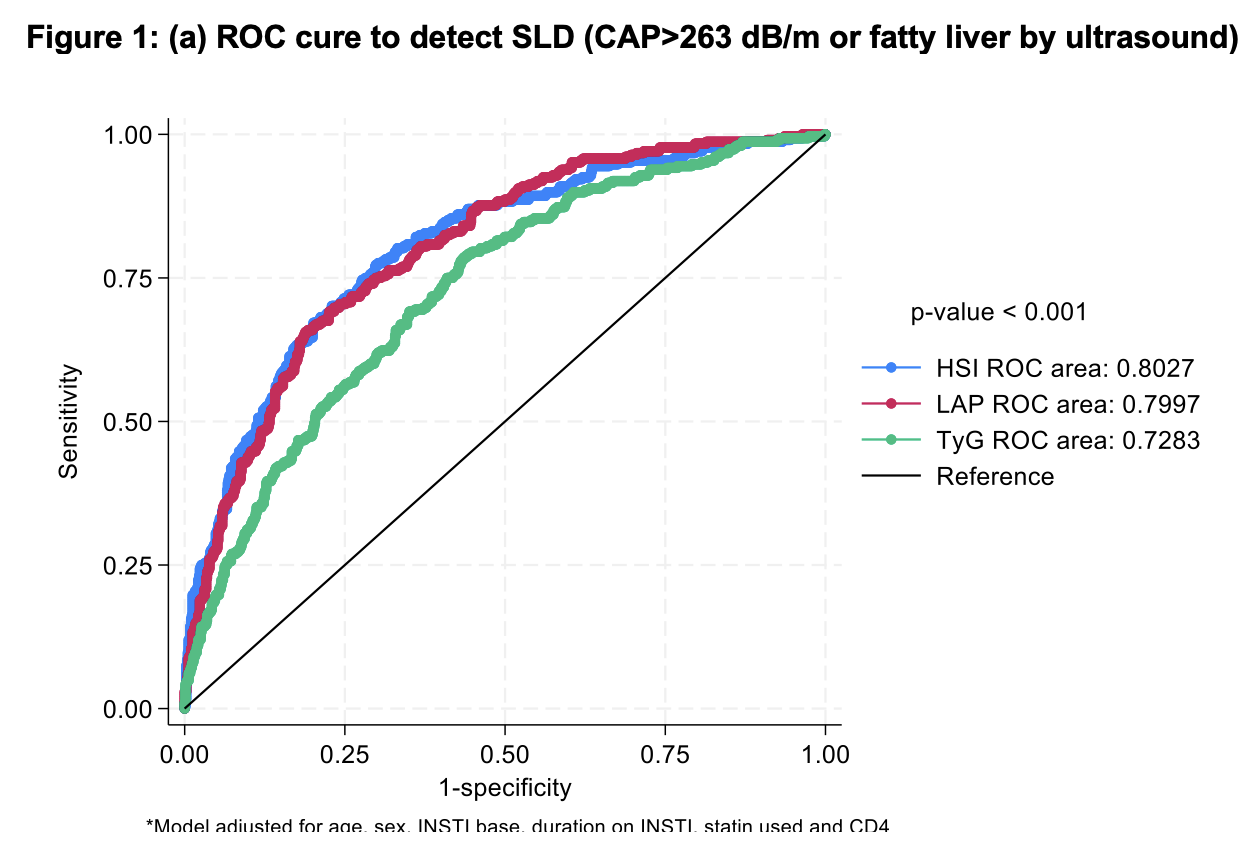
Among 1,312 participants (median age 46 years; 69% male; median BMI 23.1 kg/m²; HBV/HCV co-infection 31.6%), SLD prevalence was 29.1%. Median CAP was 223 dB/m, and median INSTI duration was 28.5 months, with 86% on DTG-based ART. Overall, LAP (AUROC 0.794, 95%CI 0.768–0.820) and HSI (0.792, 95%CI 0.765–0.819) demonstrated superior accuracy compared with TyG (0.709, 95%CI 0.679–0.740; p<0.001). In participants with HBV/HCV co-infection (n=369), predictive accuracy declined, although LAP retained the best performance (0.799, 95%CI 0.750–0.849). In those without co-infection, HSI performed best (AUROC 0.809) followed by LAP (0.788). In multivariable logistic regression after adjusting for age, sex, INSTI regimen, duration on INSTI, statin use and CD4 count, the HSI and LAP models had better fit (lower AIC and BIC) and higher discriminatory power (ROC 0.803 and 0.800, respectively) compared to TyG (ROC 0.728, p < 0.001).
Conclusions
In Thai PWH on INSTI-based ART, LAP and HSI demonstrated high accuracy in predicting SLD and may serve as practical screening tools in resource-limited settings where imaging is unavailable. LAP, requiring only WC and triglycerides level was particularly robust among those with viral hepatitis co-infection.
Table or Figure