Background
Recent global mpox outbreaks have caused significant morbidity and burdened healthcare systems. Asymptomatic cases have been reported, particularly in Southeast Asia, and may have fueled sexual transmission before mpox was detected by public health systems. We used banked blood samples to evaluate possible sub-clinical circulation of mpox via serologic testing among men who have sex with men (MSM) in the Philippines.
Methods
We used data and samples from the ongoing Multinational Observational Cohort of HIV and other Infections (MOCHI), which enrolls MSM disproportionately affected by sexually transmitted infections (STIs). From May 2024 to February 2025, we identified participants with≥3 mpox risk factors (≥18 years of age, ≥10 sex partners in the past year or ≥ 4 sex partners in the past 3 months, STI in the past month, illicit drug use, PrEP use at cohort enrollment, and close mpox contact). Seropositivity was determined using the Meso Scale Discovery (MSD) system on the V-PLEX Orthopoxvirus Panel 1 (IgG) kit (Meso Scale Diagnostics).
Results
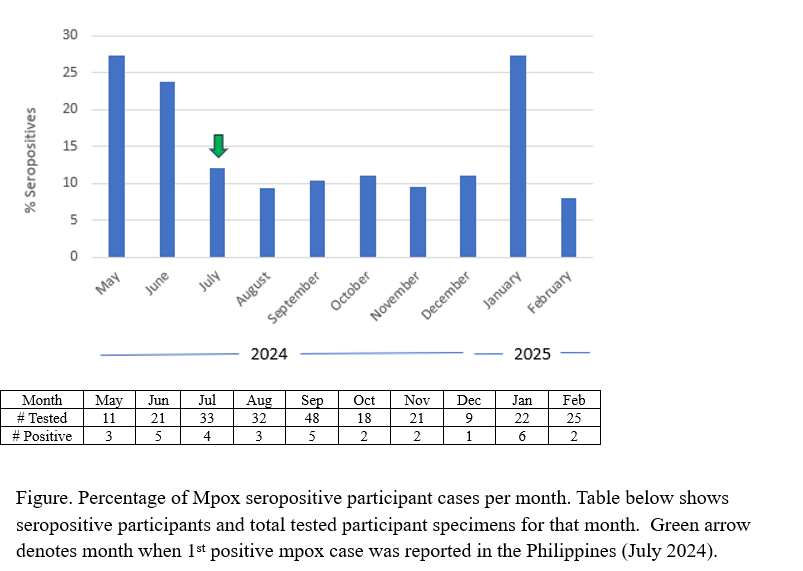
We tested 138 MSM participants with median age 28 years (interquartile range [IQR] 24-34); 17% were on oral STI post-exposure prophylaxis (DOXYPEP). Thirty-five (25.3%) had detectable mpox IgG with mean signal of 1151.87 AU/mL (STD 1388.797). Seropositive participants were slightly older, with a median age of 28 (IQR=24-35). Nine (25%) and 5 (14%) out of 35 were positive for Chlamydia and Gonococcal infection (from any site) respectively. Only 1/35 (3%) was reactive for rapid plasma reagin (RPR), but 18/35 (51%) had abnormal physical exam findings, 13/18 (72%) of which were suspicious for mpox. January 2025 (6/35) had the highest number of cases, followed by June and September 2025 (5/35 each) with the earliest cases identified in May 2024, 3 months before the 1st positive case was reported in the country.
Conclusions
Findings suggest possible unrecognized sub-clinical mpox in the Philippines circulating earlier than previously reported by public health systems. More research is needed to understand disease transmission kinetics and to raise clinician awareness on this silent disease. This study also highlights the need to explore the role of serology in predicting future disease outbreaks.
Table or Figure