Background
Adolescents and young adults living with HIV (ALWH) have the lowest viral suppression rates of all age groups. Depression and anxiety may undermine treatment outcomes yet have not been systematically assessed among ALWH in Africa at scale. Using population-representative data, we estimated the prevalence of depressive and anxiety symptoms among ALWH and their association with viral non-suppression.
Methods
We analyzed Population-based HIV Impact Assessments (2019–2023) from nine Southern and Eastern African countries: Botswana, Eswatini, Lesotho, Malawi, Uganda, Tanzania, Mozambique, Zambia, and Zimbabwe. Participants aged 15–24 years old living with HIV were included. ALWH were screened for depressive and anxiety symptoms using the Patient Health Questionnaire-2 (positive screen: score ≥3) and Generalized Anxiety Disorder-2 (positive screen: score ≥3) scales. Mental health exposure was categorized as no symptoms, depressive symptoms only, anxiety symptoms only, or both symptoms. Viral non-suppression was defined as having a detectable viral load of over 200 copies/ml. Survey weighted log binomial regression models estimated adjusted prevalence ratios (aPRs) with 95% Confidence Intervals (CIs), controlling for age, sex, urbanicity, and marital status. Jackknife replicate weights were used to account for the survey design.
Results
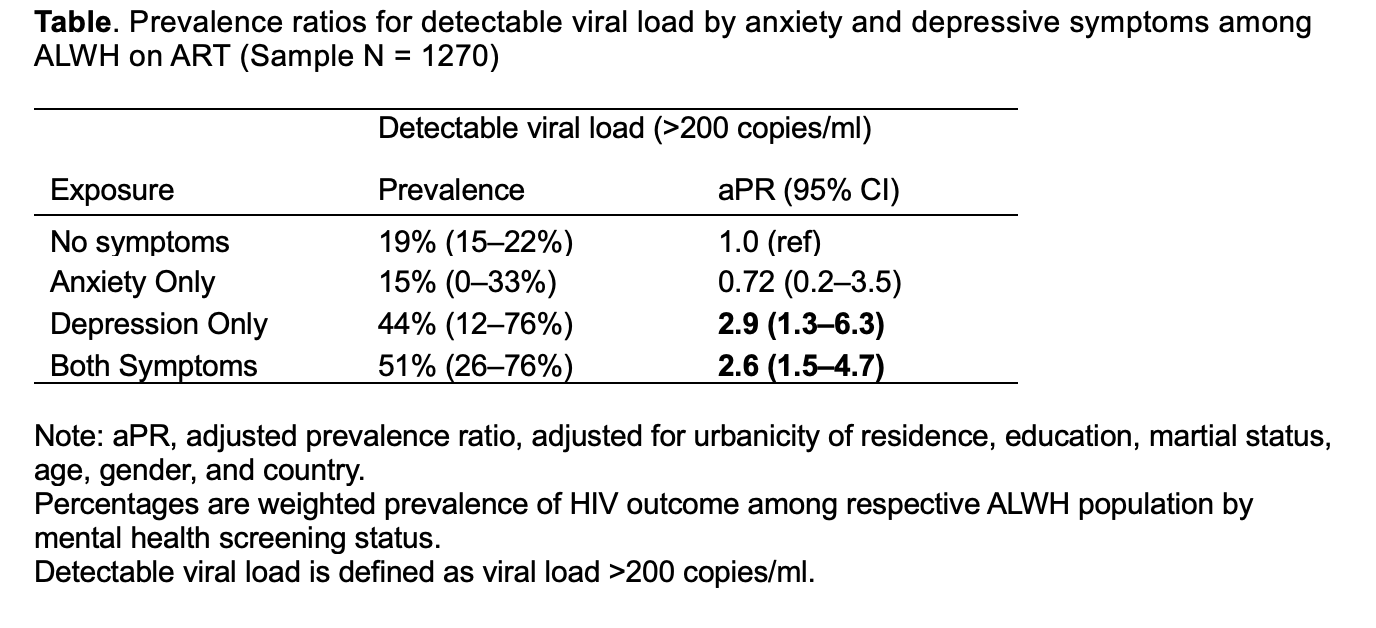
A total of 1,799 ALWH were included in the sample, representing 1.0 million ALWH living in the region, and 5.0% (95% CI: 3.6-6.8%) screened positive for mental health symptoms. Of those screened positive, 22% had depressive symptoms only, 41% had anxiety symptoms only, and 37% had both depressive and anxiety symptoms. Among ALWH receiving treatment (n=1270), the prevalence of detectable viral load was 19% with neither symptom, 15% with anxiety only, 44% with depression only, and 51% among those with both symptoms. Depressive symptoms alone were associated with detectable viral load (aPR=2.9, 95% CI 1.3–6.3). Anxiety symptoms alone were not associated with detectable viral load (aPR=0.72, 95% CI 0.2-3.5). Co-occurring symptoms were strongly associated with prevalence of detectable viral load (aPR=2.6, 95% CI 1.5–4.7).
Conclusions
Mental health symptoms are linked to poor viral suppression among ALWH. Integrating mental health screening and interventions into adolescent HIV care may improve viral suppression outcomes, a necessary step towards achieving UNAIDS 95-95-95 targets.
Table or Figure