Background
HIV has been associated with multidrug-resistant tuberculosis (MDR-TB), possibly due to lower TB drug concentrations that can favor the development of resistance. To explore this, we compared serum drug levels of second-line antimycobacterials in people being treated for MDR-TB with and without HIV.
Methods
The PREEMPT study included adult participants from Brazil and India with culture-confirmed pulmonary MDR-TB, i.e., resistant to rifampin and isoniazid, and preserved baseline susceptibility to fluoroquinolones, between 2019 and 2023, with a 1-year post-treatment follow-up. MDR-TB treatment regimens followed the respective national guidelines. The focus of this pharmacokinetic study was on drugs commonly used in both countries: levofloxacin (LFX), moxifloxacin (MFX), ethionamide (ETO), pyrazinamide (PZA), and, in India, high-dose isoniazid (INH). Intensive pharmacokinetic sampling (at 6 time points after the dose) was performed for 20% of participants, and sparse sampling (at 2 time points) was performed for the rest, within 14-28 days of treatment initiation. All assays used Liquid Chromatography–Mass Spectrometry methods. Maximum concentration (Cmax) and Area Under the Curve (AUCtau) were imputed using Phoenix WinNonlin (Certara, V-8.5.2.4).
Results
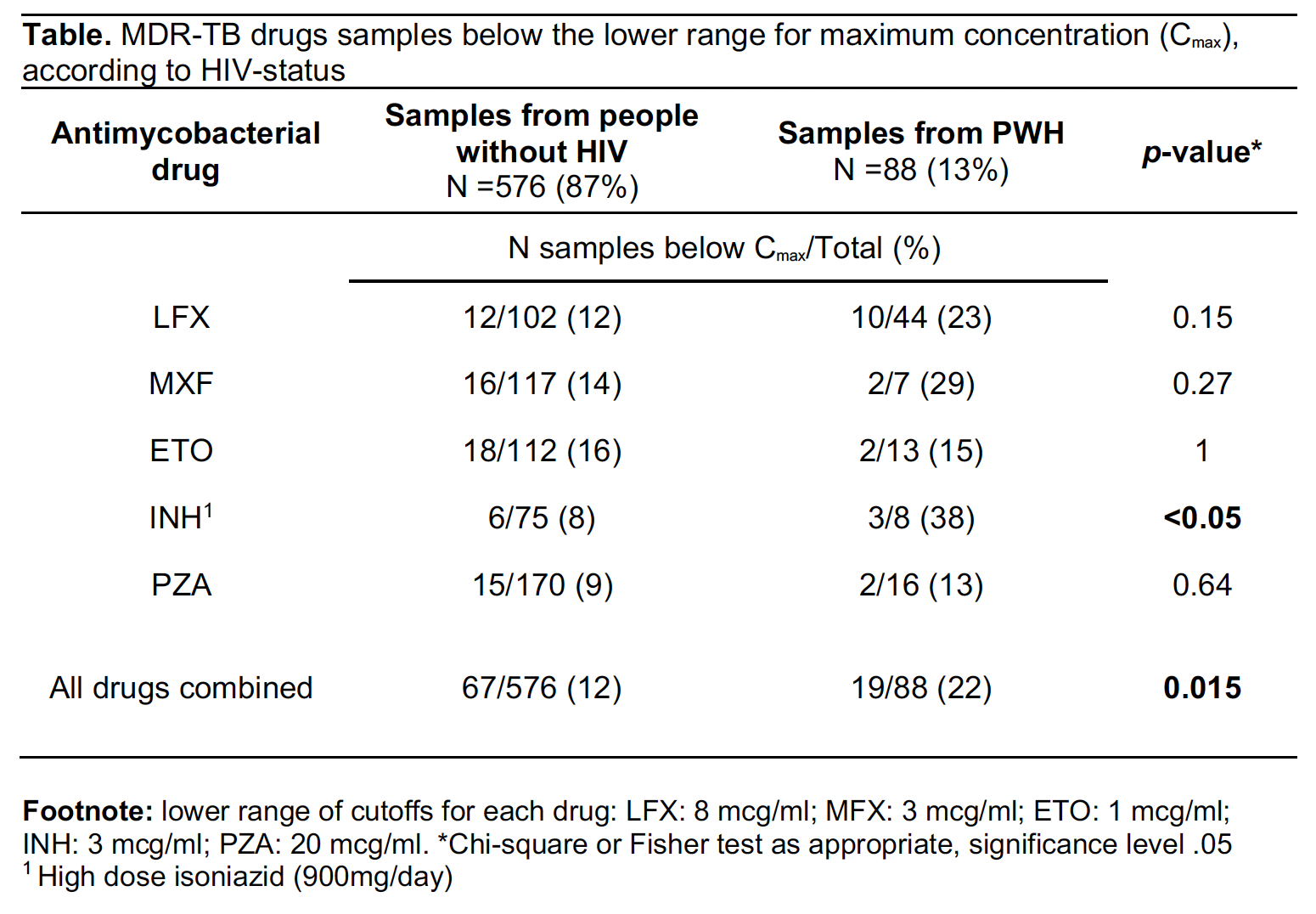
We evaluated 365 participants, 285 (78%) from India and 80 (22%) from Brazil. Persons with HIV (PWH) represented 23% (n=85), with median baseline CD4 cell count 226 cells/mm3 (Interquartile range 102-406). Compared to those without HIV, PWH were older (p=0.01), had less frequent comorbid diabetes (p<0.001), and were more frequently sputum smear negative at baseline (p<0.001). Proportions of samples with Cmax below the lower bound of the expected range are shown in the Table. AUCtau was also lower in PWH than in those without HIV for 3 of the 5 drugs (MFX, PZA, and INH), but these differences were not statistically significant (data not shown).
Conclusions
PWH were significantly more likely to have Cmax values below the lower limit of normal compared to people without HIV, especially for isoniazid and all samples combined. This may predispose them to develop additional resistance during MDR-TB treatment. These results suggest a role for monitoring serum drug concentrations to ensure adequate exposures are achieved in PWH being treated for MDR-TB.
Table or Figure