Background
People with HIV (PWH) have an increased risk of hypertension (HTN), partly related to metabolic disturbances. The Triglycerides-glucose (TyG) index, a surrogate marker of insulin resistance and hepatic steatosis, has been associated with cardiovascular outcomes in the general population. Still, its role in predicting incident HTN in PWH remains unclear.
Methods
We conducted a retrospective cohort study of treatment-naïve individuals who initiated antiretroviral therapy (ART) between January 2009 and December 2023, without changes in ART for at least 48 weeks, at a single centre in Spain. Participants were followed from ART start until incident HTN, ART change or interruption, death or censoring. Subjects with prevalent HTN, diabetes, lipid-lowering therapy, or missing data to calculate TyG were excluded. We defined incident HTN as two consecutive visits with BP ³ 140/90 mmHg, diagnosis in clinical records, or initiation of antihypertensive medication. Cox proportional hazards models were used to assess the association between baseline TyG and HTN, adjusting for age, sex, HIV duration, body mass index (BMI), and CD4 nadir.
Results
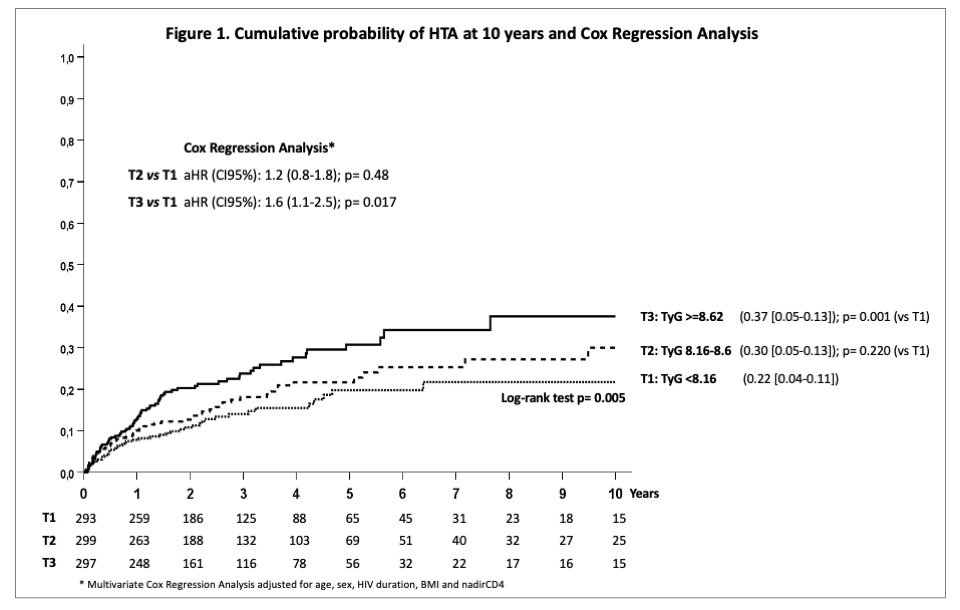
A total of 889 individuals (89% male) were included [median (P25-P75) age 34.9 (29.7-41.8) years, follow-up 2.4 (1.4-4.6) years, nadir CD4+ T cell count 319 (207-439.5) cells/mm3]. During follow-up, 176 participants (19.8%) developed HTN, with an incident rate of 5.5 per 100 person-years. The median (P25-P75) TyG at baseline was 8.40 (8.07-8.76). The risk of HTN increased across TyG strata: 15.2% in the lowest tertile (<8.16), 19.5% in the middle tertile (8.16-8.61), and 26.4% in the highest tertile (³8.62); p=0.003). Survival analysis confirmed a higher cumulative incidence of HTN in higher TyG categories (log-rank p=0.005). In Cox regression, TyG, as a continuous variable, predicted incident HTN (aHR 1.54, 95% CI 1.13-2.10, p = 0.006). Compared with the lowest tertile, individuals in the highest tertile had a significantly higher risk (aHR, 1.6; 95% CI, 1.10-2.5; p = 0.017). Figure 1
Conclusions
The TyG index independently predicted incident hypertension in PWH initiating ART, with a stepwise increase in risk across higher strata. Pre-ART TyG may provide a simple tool to identify individuals at higher risk of HTN and support early preventive interventions in this population.
Table or Figure