Background
Recent studies demonstrate substantial weight gain among people with HIV (PWH) starting modern antiretroviral (ART) regimens, as well as a high prevalence of obesity among those on long-term treatment. As a result, routine body mass index (BMI) measurements have been proposed to assess cardiovascular (CV) and other comorbid illness risk. However, prior studies show substantial variability in visceral abdominal fat accumulation among PWH. We sought to investigate the relationships between BMI, excess visceral abdominal fat (EVAF), and cardiovascular risk factors in PWH in the modern ART era.
Methods
The Visceral Adiposity Measurement and Observations Study (VAMOS) is a multi-center observational study in PWH with long-term viral suppression and BMI ranging from 20 to 40 kg/m2. Participants completed study visits, labs and an abdominal computed tomography scan in the overnight fasting state. Visceral fat was quantified by a single slice at L4-L5, with EVAF defined as a visceral adipose tissue (VAT) surface area ≥130 cm2. CV risk was evaluated by 10-year ASCVD risk scores. Kruskal-Wallis and Dunn’s tests were performed to determine how cardiovascular risk factors differed by BMI and EVAF classifications.
Results
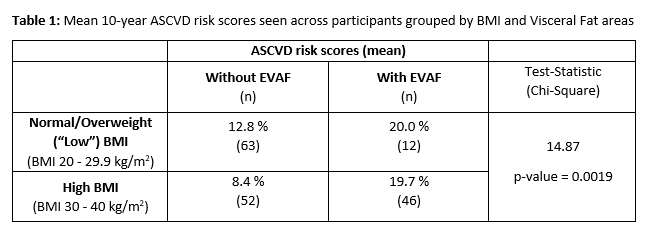
Among the 170 participants, median (IQR) visceral fat area was 148 cm2 (94, 218) with an EVAF prevalence of 58%. While individuals with BMI>35 kg/m2 group had the highest prevalence of EVAF (66.7%), EVAF was present in 56.6% and 43.2% of participants with overweight (25-29.9 kg/m2) and normal BMI (<25 kg/m2), respectively. To explore relationships between BMI, EVAF and CV risk factors, four distinct groups were created (Table 1). A statistically significant difference in CV risk scores was found across the groups (χ²(3)=14.87, p=0.0019). Importantly, individuals with EVAF and low BMI had the highest CV risk scores among the groups, with significantly higher scores not only compared to those with low BMI without EVAF (Z value = 3.39; p=0.0039), but also to those with high BMI without EVAF (Z value = 2.75; p=0.0301). The presence of EVAF also was associated with higher HOMA-IR levels among those with low BMI (Z value = 2.85; p=0.0224).
Conclusions
These data highlight the limitations of utilizing BMI alone in assessing CV risk among PWH, particularly given the high CV risk seen in participants with low BMI but high EVAF. Incorporating tools to assess EVAF, such as waist circumference, could provide critical information in identifying PWH at risk of CVD.
Table or Figure