Background
Mean-based approaches of measuring cognition ignore variability in cognitive performance; yet higher levels of cognitive intra-individual variability (IIV) are associated with underlying neuropathology. Prior literature demonstrates the predictive value that cognitive IIV has on several important outcomes including everyday functioning tasks, cognitive decline, and even mortality, but to our knowledge, there have not been any studies that examined the predictors of cognitive IIV itself. If we know what the predictors of cognitive IIV are, this may help with our theoretical and conceptual understanding of this nuanced variable; likewise, it may provide insights on intervention development. Understanding what impacts cognitive IIV may reveal ways to intervene. This study examined predictors of cognitive IIV in 1,686 women with HIV (WWH) and 448 women without HIV (WWoH).
Methods
Objective cognitive performance was assessed across seven domains among participants of the Women’s Interagency HIV Study (WIHS). Cognitive IIV was calculated from the standard deviation across these cognitive domains to calculate dispersion (i.e., sdIIV). Using all available data across all the waves (up to visit 49), linear mixed effects models were conducted in the overall sample (WWH + WWoH), WWH only, and WWoH. Several predictors of sdIIV were considered (i.e., any hypertension, current smoking, drug use, drinking alcohol, etc.)
Results
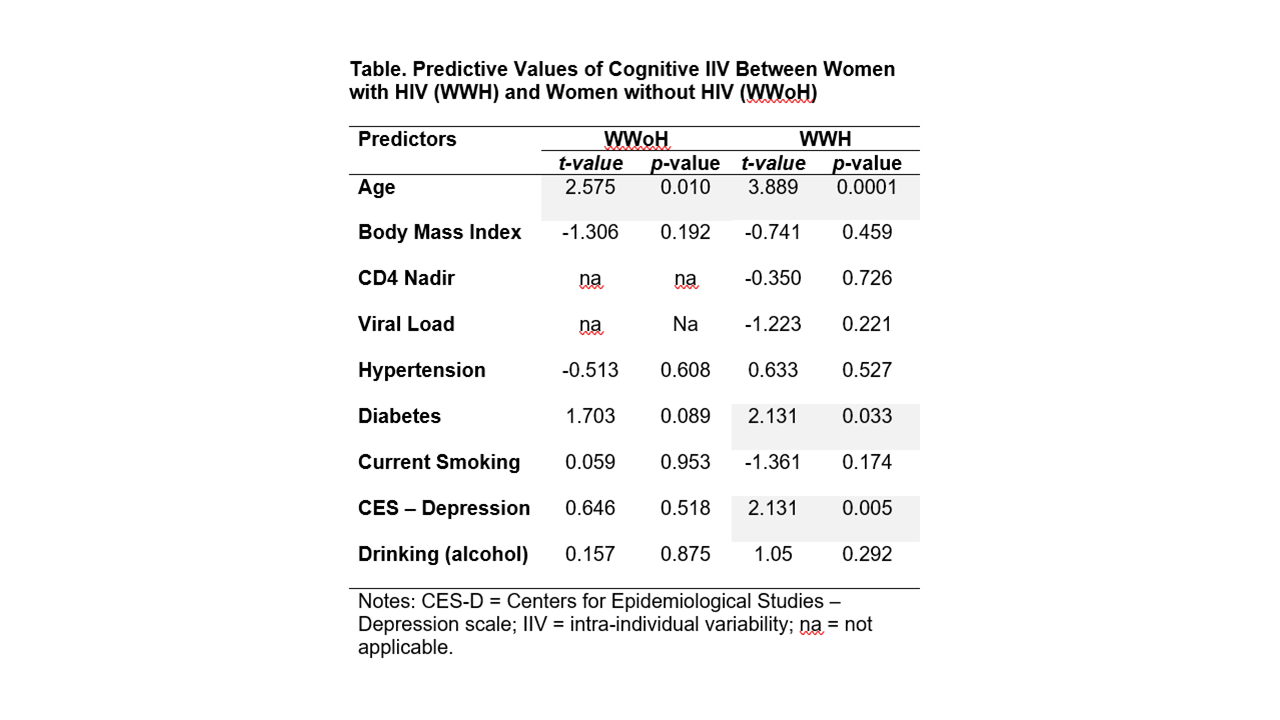
Although not significant, WWH had higher levels of cognitive IIV across the lifespan than WWoH. Few predictors of cognitive IIV emerged. For the entire sample, older age (t=4.831, p=0.000), having diabetes (t=2.467, p=0.0137), and having greater depressive symptomatology (t=2.801, p=0.005) were associated with greater cognitive IIV. In WWH, older age (t=3.889, p=0.001), having diabetes (t=2.131, p=0.033), and greater depressive symptomatology (t=2.813, p=0.005) were associated with greater cognitive IIV. In WWoH, older age (t=2.575, p=0.010) was associated with greater cognitive IIV.
Conclusions
WWH experienced higher levels of cognitive IIV than WWoH, and aging contributed to higher levels in both groups. Diabetes and depressive symptomatology predicted cognitive IIV in WWH; this suggests addressing diabetes and depression may improve cognitive IIV.
Table or Figure