Background
First-line antiviral therapy of outpatient COVID-19 is nirmatrelvir/ritonavir (NMV/r) with molnupiravir (MOV) as an alternative. MOV promotes viral RNA mutations but its potential to increase host DNA mutations is unclear. We assessed host DNA mutations using ultra-sensitive assays in a mutagenesis substudy of the VISION study, a prospective cohort of adults in North Carolina testing positive for SARS-CoV-2 within the prior 7 days.
Methods
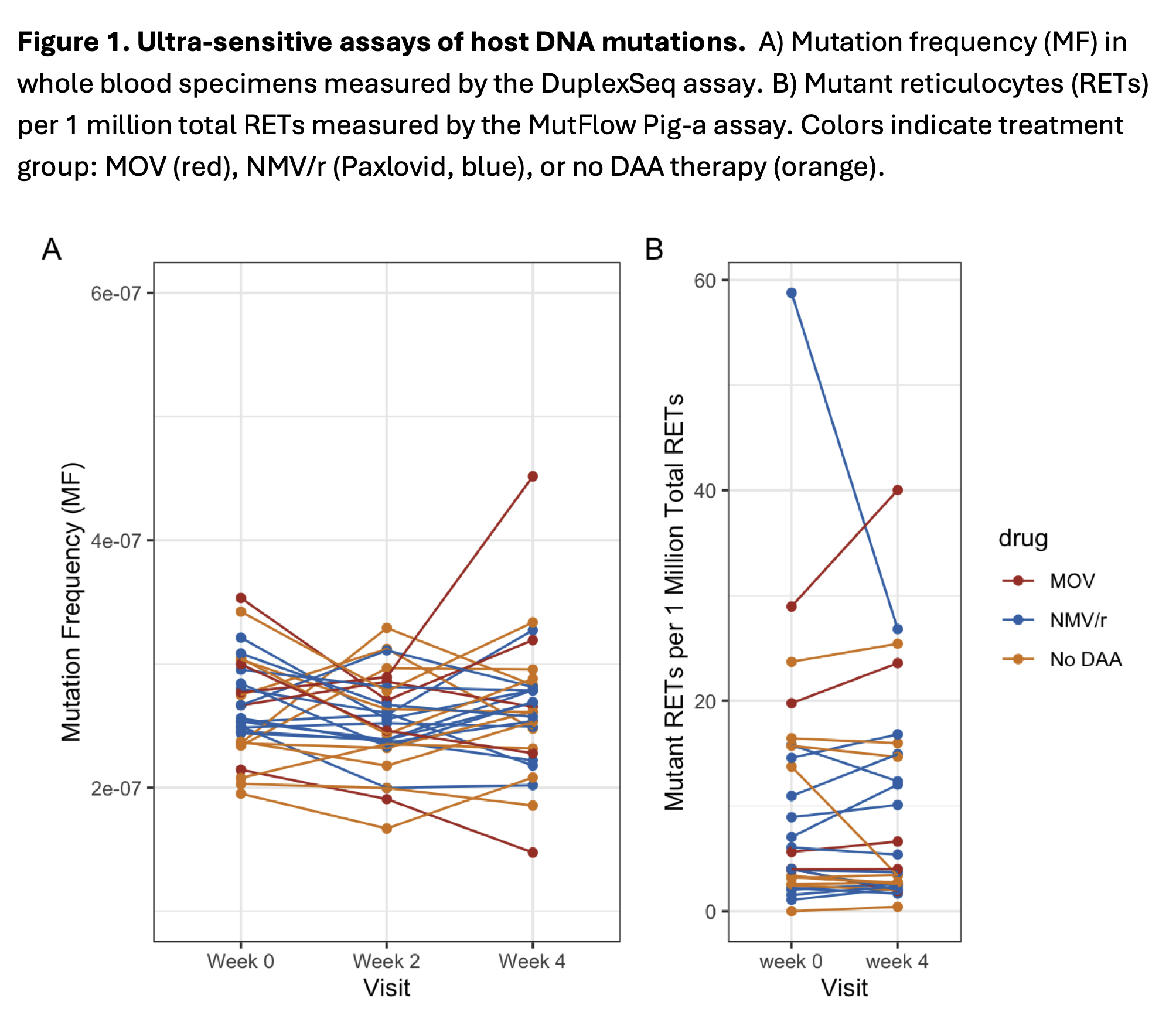
Participants who initiated or planned to initiate NMV/r or MOV within 48 h of entry were eligible and age- and sex-matched to untreated controls. Whole blood was collected at Weeks 0, 2, and 4. Two ultra-sensitive assays were applied to detect host DNA mutations. MutFlow Pig-a assay (sensitivity ≥10⁻⁶), was performed at study Weeks 0 and 4. TwinStrand DuplexSeq V2 mutagenesis panel (sensitivity 10⁻⁷–10⁻⁸), was used at Weeks 0, 2, and 4 to directly quantify host DNA mutations. Nasopharyngeal (NP) swab specimens were obtained at Week 0, Day 5, and Week 4, and Primer ID sequencing was performed to assess viral RNA sequence diversity. Linear mixed-effects models (LMMs) compared changes in DNA mutation rates, with exact nonparametric tests for sensitivity analyses.
Results
Twenty-nine participants were analyzed: 5 MOV, 13 NMV/r, and 11 controls. All participants in the DAA groups finished the 5-day therapy. Median age was 53 (IQR 47-70) years and 48% were female. DuplexSeq assays achieved a median sequencing depth of 600M duplex bases per specimen and a median DNA mutation frequency of 2.6 × 10⁻⁷. No effects of treatment, time, or their interaction on DNA mutation frequency were detected. One MOV participant had the highest DNA mutation rate at Week 4 (4.5 × 10⁻⁷) but lacked MOV-signature patterns. In the Pig-a assay, mutant red blood cells (RBCs) and reticulocytes (RETs) were quantified per 10⁶ RBCs or RETs, with no treatment effects observed. Among two MOV participants with detectable SARS-CoV-2 at Day 5, viral RNA mutation density decreased, and no fixed mutations detected compared with Week 0 – a pattern inconsistent with prior reports of viral RNA mutation accumulation in lung tissues of non-human primate models.
Conclusions
In this first study to directly measure host DNA mutations in real-world participants treated with MOV for COVID-19, no significant changes in host DNA mutation rates were detected. Although reassuring, interpretation of these results is limited by the small sample size and larger studies of MOV-treated patients are warranted.
Table or Figure