Background
Cabotegravir+Rilpirivine (CAB+RPV) is the first complete long-acting injectable antiretroviral therapy (ART) for the treatment of HIV for ART-experienced PWH with undetectable viral load (VL <50 copies/mL [cpm]). This study examined the utilization and effectiveness of CAB+RPV in real-world settings in the US.
Methods
ART-experienced adults with undetectable VL at initiation who received ≥1 CAB+RPV injection between Feb 2021-Mar 2024 were identified from electronic health records in the Trio Health Cohort. Discontinuation of CAB+RPV was defined as 2 consecutive missed injections or an ART regimen switch, while confirmed virologic failure (CVF) was defined as 2 consecutive VLs >200 cpm or 1 VL >200 cpm with discontinuation within 4 months (mo) of the first elevated VL; delayed injections were defined as occurring >7 days after target date (Q1M or Q2M). ART resistance based on HIV genotype results prior to baseline and at CVF was available for a subset of PWH and analyzed using the Stanford HIVdb algorithm.
Results
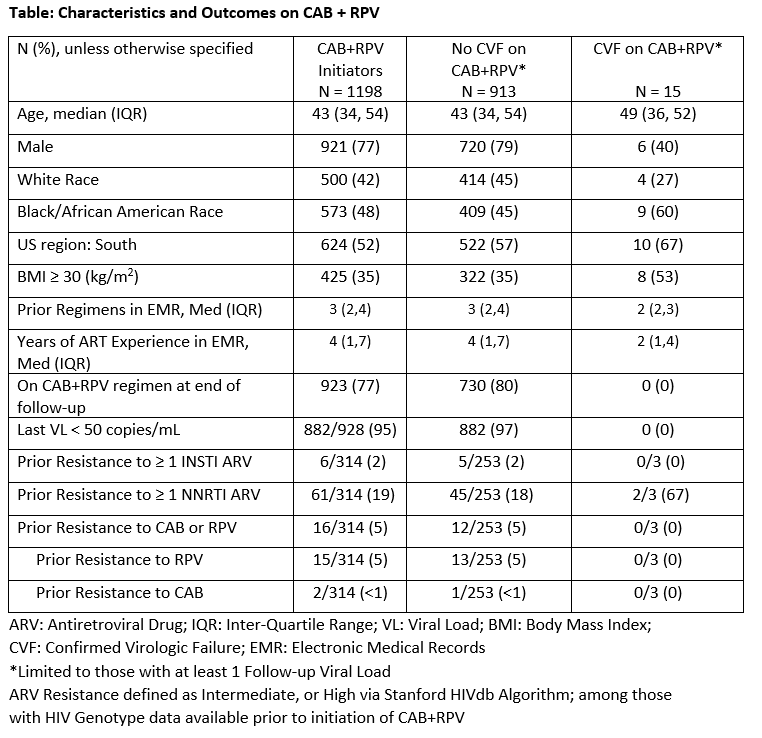
Analyses included 1198 PWH who initiated CAB+RPV; median age was 43 years (IQR: 34-54), predominately male (77%), non-Black (52%), and treated in the US South (52%). Median follow-up time after the first injection was 12 mo (IQR 5-19). At the end of follow-up, 923 (77%) PWH remained on CAB+RPV; among 275 PWH who discontinued CAB+RPV, 24 (9%) re-initiated CAB+RPV, 4 (1.5%) experienced injection site reactions. Among all CAB+RPV initiators, 928 (77%) individuals had ≥1 follow-up VL; among these, 882 (95%) had last VL < 50 cpm. CVF was observed in 15 (1.6%) individuals, of whom, 8 (53%) had >2 mo follow-up on a subsequent regimen, with re-suppression observed in 6 individuals (75%). Injection delays were observed in 4 (27%) individuals with CVF (delay range: 2-11 days). Of 314 PWH with HIV genotype data prior to initiation, 6 (2%) had resistance to ≥1 INSTIs, and 61 (19%) had resistance to ≥1 NNRTIs. Among 15 PWH with CVF, HIV genotype at CVF was available for 5 (33%); RPV resistance was identified in 3 PWH (Y181C + G190S; K101E; Y181C), 1 of whom also had CAB resistance (S147G + N155H).
Conclusions
High rates of viral suppression were seen among PWH initiating CAB+RPV, including those with prior NNRTI/INSTI resistance. CVF with emergent INSTI resistance was rare. These results are consistent with previous studies reporting low rates of emergent INSTI resistance and higher rates of NNRTI resistance among failures.
Table or Figure