Background
Some people with HIV (PWH) exhibit high levels of inflammation despite effective treatment. In two independent cohorts of treated PWH, we previously demonstrated that PWH fall into three distinct inflammatory clusters: cluster 1 defined by lower inflammation, cluster 2 by high innate immune activation, gut microbial translocation, vascular inflammation, and cluster 3 by gut epithelial dysfunction, T-cell activation, systemic inflammation; cluster 3 phenotype being associated with a 7-fold increased risk of prevalent cardiovascular disease (CVD). We aimed to determine the transcriptional pathways associated with these distinct inflammatory phenotypes in PWH compared to a demographically similar HIV uninfected control group.
Methods
Within a cohort of treated PWH and HIV uninfected controls, the samples with the shortest Euclidean distance to the centroid of each of the above clusters were used to identify three PWH groups who were the most representative of each inflammatory cluster and an HIV uninfected control group matched in age (±5years), smoking status, sex, BMI, and ethnicity. We measured gene expression in peripheral blood mononuclear cells using the NanoString immune exhaustion 800 genes panel. Differential expression (DE) was defined as ±1.5 foldchange and P<0.05 was considered significant. HIV uninfected group was used as a baseline for DE gene analyses. Reactome Voronoi tool was utilised to show the overrepresented pathway topologies of DE genes.
Results
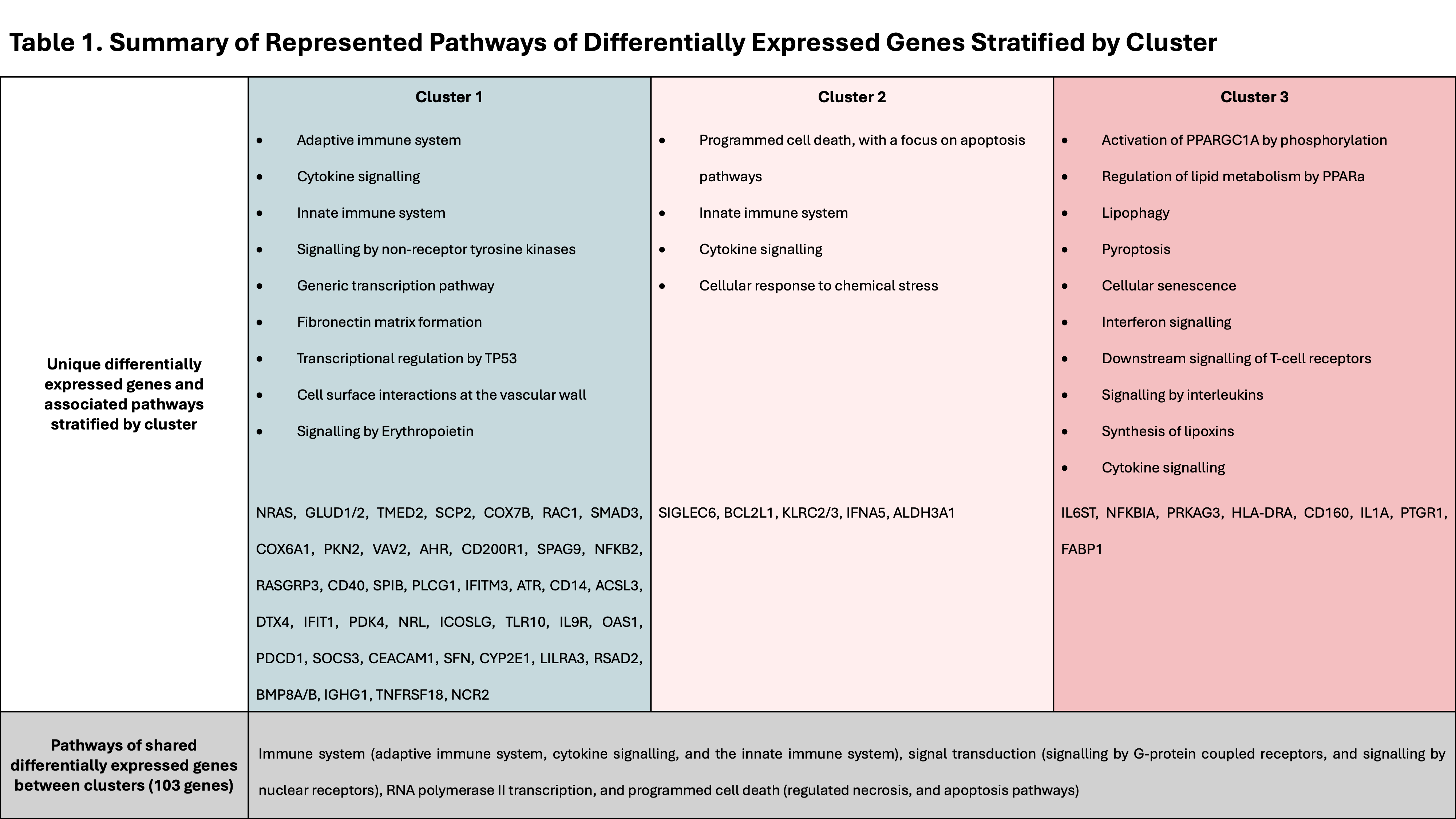
143 (87.4% PWH) participants were included in the analysis, median age of 45 years, 56% male, and 30% current smokers. After adjusting for multiple comparisons using the Benjamini-Hochberg to estimate the false discovery rate, 206 genes were DE in PWH compared to the HIV uninfected controls (Table 1), with 103 genes shared across the three inflammatory clusters. The overrepresented pathway topologies of adaptive immune system, cytokine signalling, and innate immune system were shown in cluster 1 (low-inflamed), programmed cell death topology was overrepresented in cluster 2, while the CVD associated cluster 3 unique gene list mapped to regulation of lipid metabolism, pyroptosis, and cellular immune senescence.
Conclusions
Distinct inflammatory profiles in PWH that are linked to altered risk of CVD, map to specific transcriptional pathways involved in lipid metabolism, pyroptosis and immune senescence. These insights suggest distinct pathways that may offer therapeutic targets to further reduce impact of CVD in PWH.
Table or Figure