Background
An important factor that increases susceptibility to neurocognitive disorder (NCI) or dementia in people with HIV (PWH) is divergence in host genetics. However, prior studies have been limited by small sample sizes and overrepresentation of the Caucasian population and young adults. This study aims to identify and compare the host genetic factors associated with cognitive impairment in PWH versus propensity score-matched people without HIV (PWoH).
Methods
Using data from All of Us Research program, a large-scale genome-wide association study (GWAS) and gene-environmental interaction analysis of NCI were conducted among PWH (n = 13,013) and matched PWoH (n = 112,132). GWAS was adjusted for age, sex, race, ethnicity, and the top five principal components to account for population structure, with a genome-wide significance threshold of p < 5×10⁻⁸ and the suggestive significance threshold of p < 1×10⁻⁵.
Results
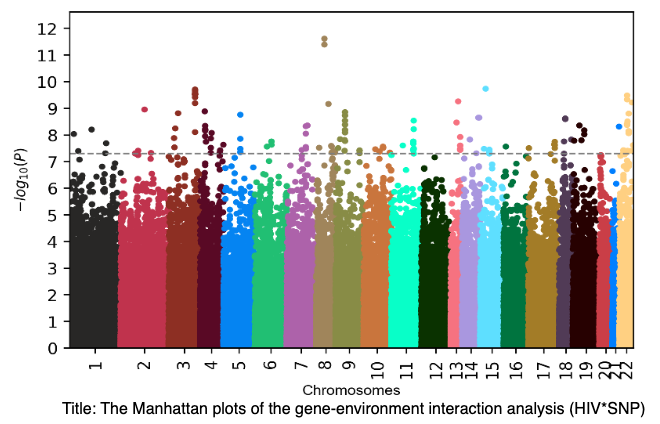
In both the total sample and the subset of PWoH, three genome-wide significant Single Nucleotide Polymorphism (SNP) have been identified, including rs429358 (Gene: APOE, p = 8.8×10⁻¹⁸), rs769449 (Gene: APOE, p = 1.48×10⁻¹²), and rs4420638 (Gene: APOC1, p = 8.15×10⁻¹⁰). Among PWH, three suggestively significant variants located in MPLH and TH genes were associated with NCI. The gene-environment interaction analysis identified 143 SNP x HIV status interactions reaching the significant threshold (p < 5×10⁻⁸), with the top six associated genes including CACNA1B, ADAMTS9, MYH9, NAGA, and STIM1.
Conclusions
This study highlighted the distinct genetic variants associated with NCI in PWH and PWoH, as well as significant interaction effects between genetic variants and HIV status.
Table or Figure