Background
In randomized clinical trials, tuberculosis preventive treatment (TPT) reduced TB incidence and mortality among people living with HIV (PLHIV); however, real-world impact has not been evaluated since the “treat all” era when antiretroviral therapy (ART) expanded to all PLHIV, regardless of CD4 count. We examined programmatic effectiveness of TPT among PLHIV in six high-TB-burden, PEPFAR-supported countries.
Methods
We emulated a clinical trial using individual-level electronic health records in Haiti, Kenya, Nigeria, Uganda, Ukraine, and Zimbabwe to estimate TPT effectiveness among PLHIV initiating ART during 2018–2021. We excluded PLHIV diagnosed with TB six months before to one month after ART start. We used marginal structural models to calculate hazard ratios (HRs) and two-year cumulative incidence of TB and all-cause mortality, comparing TPT initiation within an eight-week grace period after ART start to never initiating TPT. Estimation used a clone-censor-weight approach with weights adjusted for confounders including age, sex, and alcohol use (time-fixed); CD4 count, viral load, World Health Organization (WHO) stage, ART initiation, and ART adherence (time-varying). Pooled HRs were calculated using inverse-variance weighting and heterogeneity assessed using I2.
Results
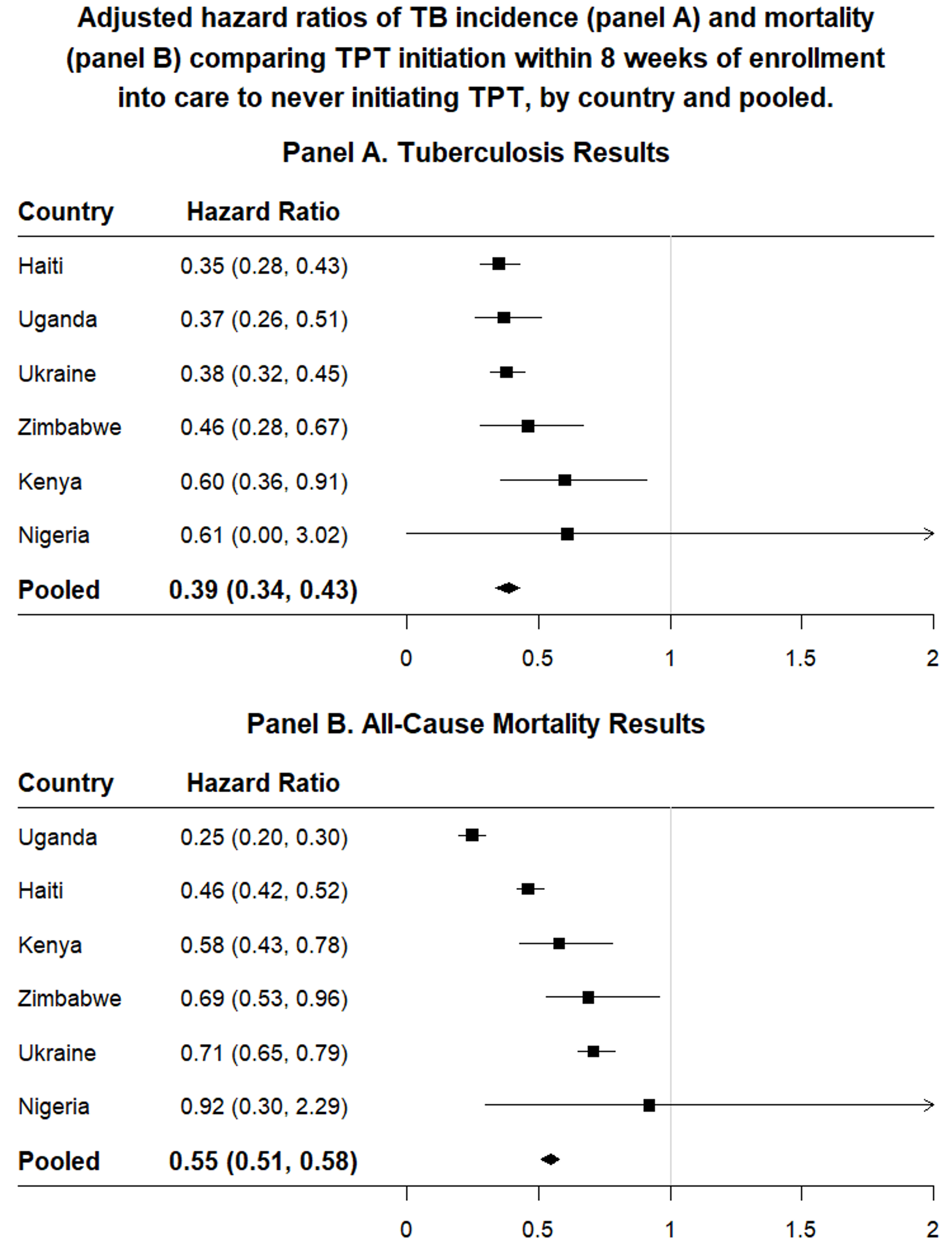
We included 235,424 PLHIV: Haiti (n=69,936), Kenya (n=9,549), Nigeria (n=8,053), Uganda (n=65,936), Ukraine (n=57,851), and Zimbabwe (n=24,099). The majority were 25-44 years old (62.7%), female (56.4%), WHO stage 1 (57.7%), and on dolutegravir-based regimen (59%). Adjusted HR for TB ranged from 0.35 (95% CI 0.28, 0.43) in Haiti to 0.61 (95% CI 0.00, 3.09) in Nigeria (Figure, Panel A). Pooled HR for TB was 0.39 (95% CI 0.34, 0.43) with I2 of 0% (95% CI 0%, 75%). Adjusted HR for death ranged from 0.25 (95% CI 0.20, 0.30) in Uganda to 0.92 (95% CI 0.30, 2.29) in Nigeria (Figure, Panel B). Pooled HR for death was 0.55 (95% CI 0.51, 0.58), though there was significant variation across countries (I2 = 96%, 95% CI 93%, 97%). Power to detect effects in Nigeria was reduced by limited number of endpoints observed.
Conclusions
We applied innovative causal inference methods to a large observational cohort of PLHIV and found that early receipt of TPT after ART initiation was associated with 61% reduction in TB incidence and 45% reduction in mortality. In an era of universal test-and-treat, newer ART regimens, and decreasing TB incidence, these results provide renewed support for TPT for all PLHIV.
Table or Figure