Background
Oral PrEP uptake remains limited in Latin America, even as new HIV diagnoses continue to rise, especially among sexual and gender minorities (SGM). Previous research has highlighted a preference for long-acting PrEP in the region. With the approval of long-acting injectable cabotegravir and recent results of lenacapravir for PrEP, understanding PrEP preferences is vital for integrating these technologies into national PrEP programs. This study aims to describe PrEP preferences and identify factors associated with a 6-month long-acting PrEP preference among Brazilian SGM.
Methods
National cross-sectional online survey among Brazilian SGM aged 18+ years, self-reporting HIV negative/unknown, recruited through advertisements on dating apps (Scruff and Grindr) and social media (Instagram and Facebook). Main outcome was assessed with the question: “Assuming all of the PrEP modalities below are equally effective, which one would be your favorite”, with possible answers: daily oral (d-PrEP), event-driven oral (ED-PrEP), injectable in gluteus at each 2 months (2-month-PrEP), injectable subcutaneous at each 6 months (6-month-PrEP), would not use PrEP. We used logistic regression models to evaluate factors associated with preferring 6-month-PrEP (yes/no).
Results
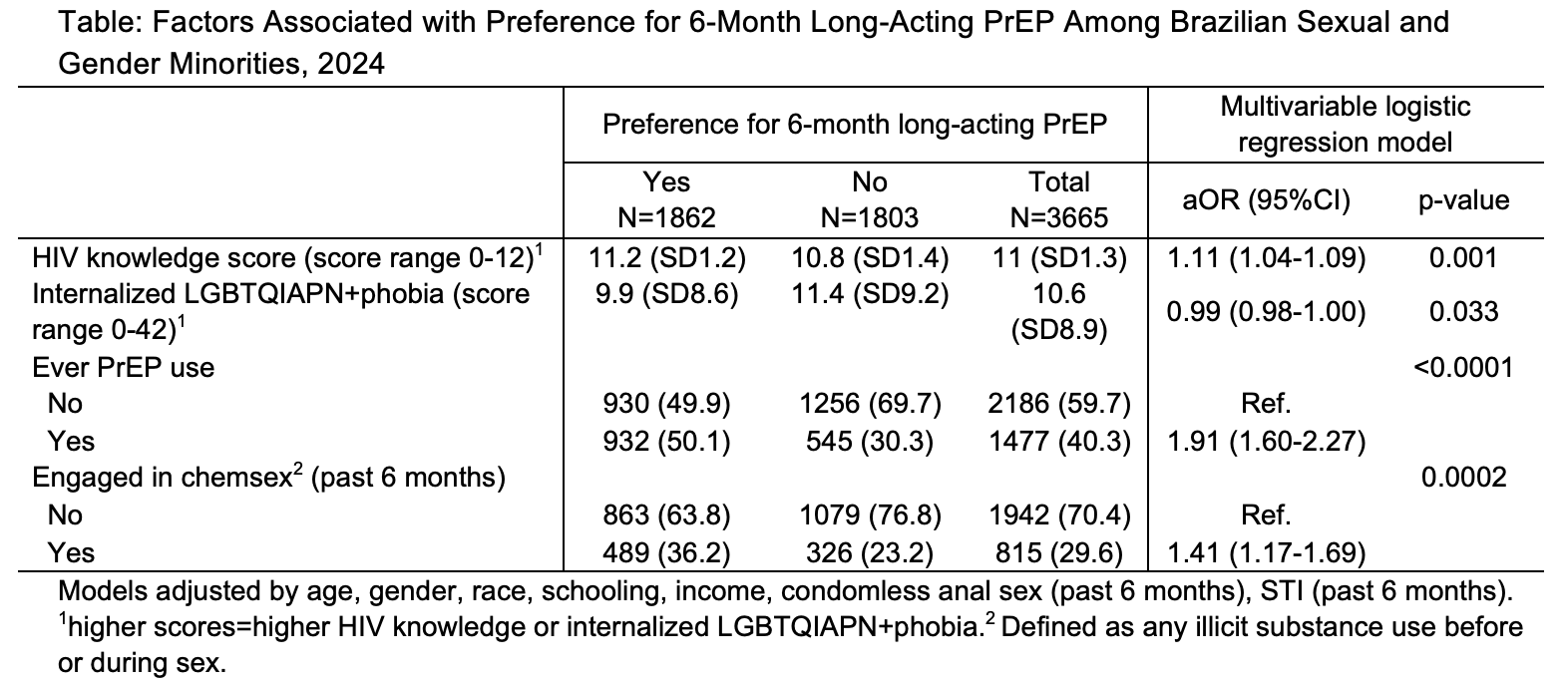
From August-September 2024, 3,665 completed the questionnaire. Median age was 38 (IQR:31-46) years; 94.3% cis-men, 2.9% non-binary persons, 0.8% trans-woman, 0.4% trans-men; 23.1% had secondary education or lower, 44.1% non-white, 21.3% low income (<500USD/month); 69.1% reported condomless anal sex, 29.6% chemsex and 12.6% STI, all in the past 6 months; 6% never tested for HIV; 32.4% ever used PrEP. Mean HIV knowledge score was high (11; SD1.3) and mean internalized LGBTQIAPN+phobia was low (10.6; SD8.9). Most (50.8%) preferred 6-month-PrEP, followed by 2-month-PrEP (16.5%), d-PrEP (16.5%), ED-PrEP (13.8%), and 2.6% would never use PrEP. Factors associated with preferring 6-month-PrEP included higher HIV knowledge, lower internalized LGBTQIAPN+phobia, ever used PrEP and reporting chemsex (Table).
Conclusions
Our results reveal a strong preference for long-acting PrEP among Brazilian SGM, highlighting the demand for prolonged protection. Urgent efforts are needed to increase awareness of HIV prevention and combat LGBTQIAPN+phobia. Priority should be given to implementation studies on the acceptability and uptake of lenacapravir in Brazil, especially among populations at increased vulnerability to HIV, such as those engaging in chemsex.
Table or Figure