Background
Little is known about post-transplant outcomes in people living with HIV (PLWH). Traditional survival analysis typically assumes the presence of a single outcome, but in real-world scenarios, multiple competing events can influence survival and other key metrics. This study aims to assess clinical outcomes in PLWH post-lung transplantation (LTx) using a competing risk analysis to better understand the true incidence of complications and death.
Methods
We conducted a retrospective cohort study of PLWH and non-PLWH, aged 18 and older, who underwent LTx between 2022 and 2024. Data were collected from 64 healthcare organizations within the TriNetX U.S. Network. We applied the Aalen-Johansen method to estimate the cumulative incidence function (CIF) for three post-transplant outcomes: non-infection complications (surgical complications), infection complications (CMV, bacterial pneumonia, bacteremia, mycosis, CDI, RSV), and death. The analysis spanned one year after transplantation, stratifying by HIV status.
Results
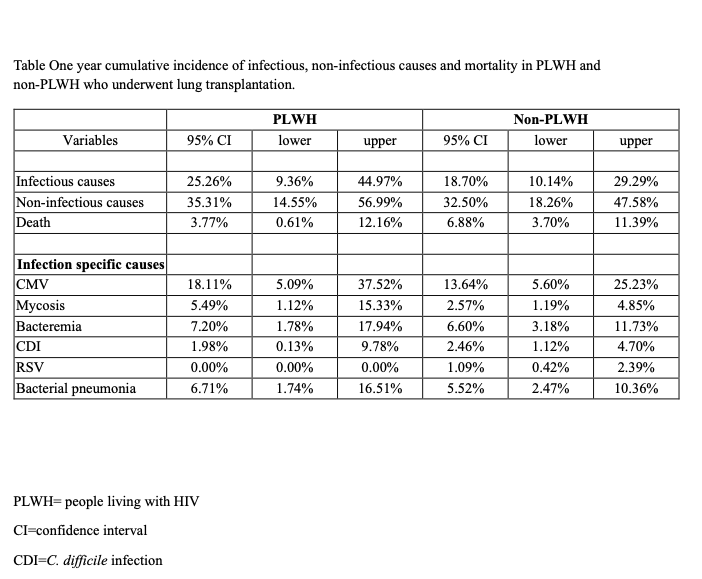
A total of 63 PLWH and 3,874 non-PLWH were included in the study. The median age at the time of transplantation was 56 years for both groups, with a higher proportion of males (66.1% vs. 59%) and non-Hispanics (71% vs. 67.1%) in each respective cohort. Non-infection complications were the most common outcome in both groups, with similar CIFs (35.3% vs. 32.5%) Table. PLWH had a higher CIF for infection-related complications (25.3% vs. 18.7%) yet a lower mortality CIF (3.8% vs. 6.9%) than non-PLWH Table. CMV infection was the most frequent infection complication in both groups, with PLWH experiencing a higher incidence within the first year (18.1% vs. 13.6%) Table. Notably, the risk of mycosis was higher in PLWH (5.5% vs. 2.6%), while RSV cumulative incidence was significantly higher in the non-PLWH group Table.
Conclusions
PLWH undergoing LTx experience a distinct post-transplant complication profile, particularly regarding infection risks. Despite a higher incidence of infection complications, PLWH had lower mortality within the first year post-LTx, suggesting that further investigation into tailored infection prevention strategies and post-transplant management is warranted. These findings underscore the importance of using competing risk analysis to capture the full spectrum of outcomes in this unique patient population.
Table or Figure