Background
HIV acquisition during long-acting cabotegravir (CAB) PrEP is rare but poses significant challenges for HIV detection and monitoring within prevention programs. We present the first analysis of HIV-1 acquisitions on CAB PrEP in routine public health settings in Brazil.
Methods
ImPrEP CAB Brasil is an implementation study of same‐day CAB initiation at oral PrEP clinics across 6 Brazilian cities. Individuals aged 18–30 years are enrolled after negative rapid antibody (Ab)-only diagnostic tests (RDT) and undetectable HIV-1 RNA GeneXpert; HIV-1 RNA (Roche COBAS), Ab/Ag RDT and 4th gen Abbott Architect are performed retrospectively. Geenius is performed with any positive test result. Research testing includes BioPlex 2200 HIV Ag-Ab, HIV-1 RNA single copy assay (SCA; LOD ≥1 c/mL), and quantitation of cell-associated LTR DNA (CAD). Plasma HIV-1 RNA mutations are identified by single or whole genome sequencing (SGS/WGS) of full-length integrase.
Results
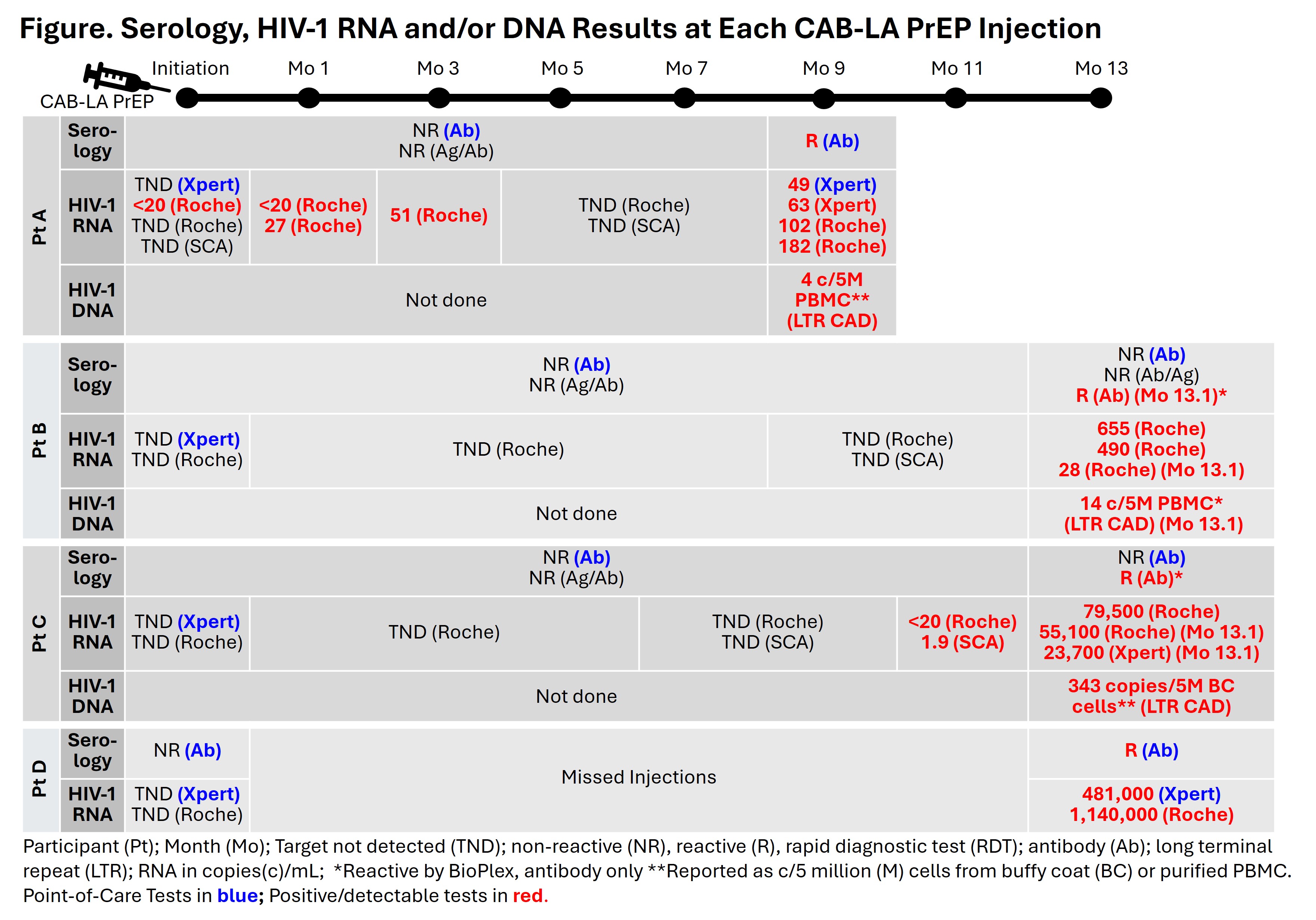
Among 1220 participants (pt) enrolled in the ImPrEP incidence cohort between 11/2023-9/2024, 4 HIV-1 acquisitions occurred on CAB (all MSM, ages 19–25). HIV-1 RNA was detectable at CAB initiation in 1 pt (A) at <20 c/mL (undetectable by SCA and repeat RNA), in 2 pt (B, C) after 7 and 8 on-time injections with HIV-1 RNA 1.9 – 655 at time of detection, and in 1 pt (D) 13 mo. after CAB initiation and no subsequent injections. DNA was detected in 3/3 tested by CAD (Pt A-C: 4-343 c/5×106 blood cells). Ab-only RDT showed delayed reactivity in 3 pt: Pt A had reactive RDT 9 mo. after first detectable HIV-1 RNA; RDT remained non-reactive for Pt B and C at time of HIV diagnosis but was retrospectively found to be reactive by BioPlex (Pt B and C) and Geenius (Pt C) (Figure). Major INSTI resistance was detected only in Pt C (50% Q148R, 53% N155H). Three pt initiated TLD; 2 were undetectable at 12 (Pt A) and 6 (Pt B) mo.; Pt C remained unsuppressed (79 c/mL) 6 mo. after switching to DRV/r/TDF/3TC. Pt D disengaged from care.
Conclusions
Among 4 CAB-LA PrEP users in Brazil who acquired HIV-1, 3 had HIV-1 RNA <1000 c/mL at diagnosis, and delayed Ab detection (2-9 months after first detectable RNA). Major INSTI mutations were observed only in 1 individual despite continued use of CAB prior to HIV confirmation. These findings confirm CAB’s high efficacy for PrEP and the rarity of breakthrough infections, while underscoring the need for sensitive point of care diagnostics and additional data on responses to INSTI based ART in such clinical scenarios.
Table or Figure