Background
Lifelong antiretroviral therapy (ART) is the mainstay of HIV care, but can be challenging to maintain. HIV viral load (VL) testing is the standard for monitoring ART, but requires laboratory infrastructure and only reflects recent ART. Long-term ART has been hypothesized to reduce HIV antibody avidity, which can be measured by rapid immunoassays, potentially at the point-of-care. We leveraged an evaluation panel for avidity assays – the Consortium for the Evaluation and Performance of HIV Incidence Assays (CEPHIA) – to test the association between ART duration and HIV antibody avidity.
Methods
We analyzed CEPHIA data on 13 avidity assays: Sedia Asante Electronic, Sedia Asante Visual, Maxim Lag Avidity, Sedia Lag Avidity, Abbott Architect, Bio-Rad Geenius, LS-Vitros, Vitros Avidity, Architect Avidity, BED, CDC Bio-Rad Avidity, Glasgow Bio-Rad Avidity, and IDE-V3. VL suppression (VLS) was defined as <1000 copies/mL. Among participants with an estimated date of detectable infection (EDDI), a documented or self-reported ART initiation date, and VLS at all study visits, we fit linear mixed effect (LME) models to assess the association between ART duration and assay readouts, standardized as a percentage between minimum and maximum reader outputs. In subgroup analysis, we fit LME models for participants initiating ART ≥ 1 year after EDDI.
Results
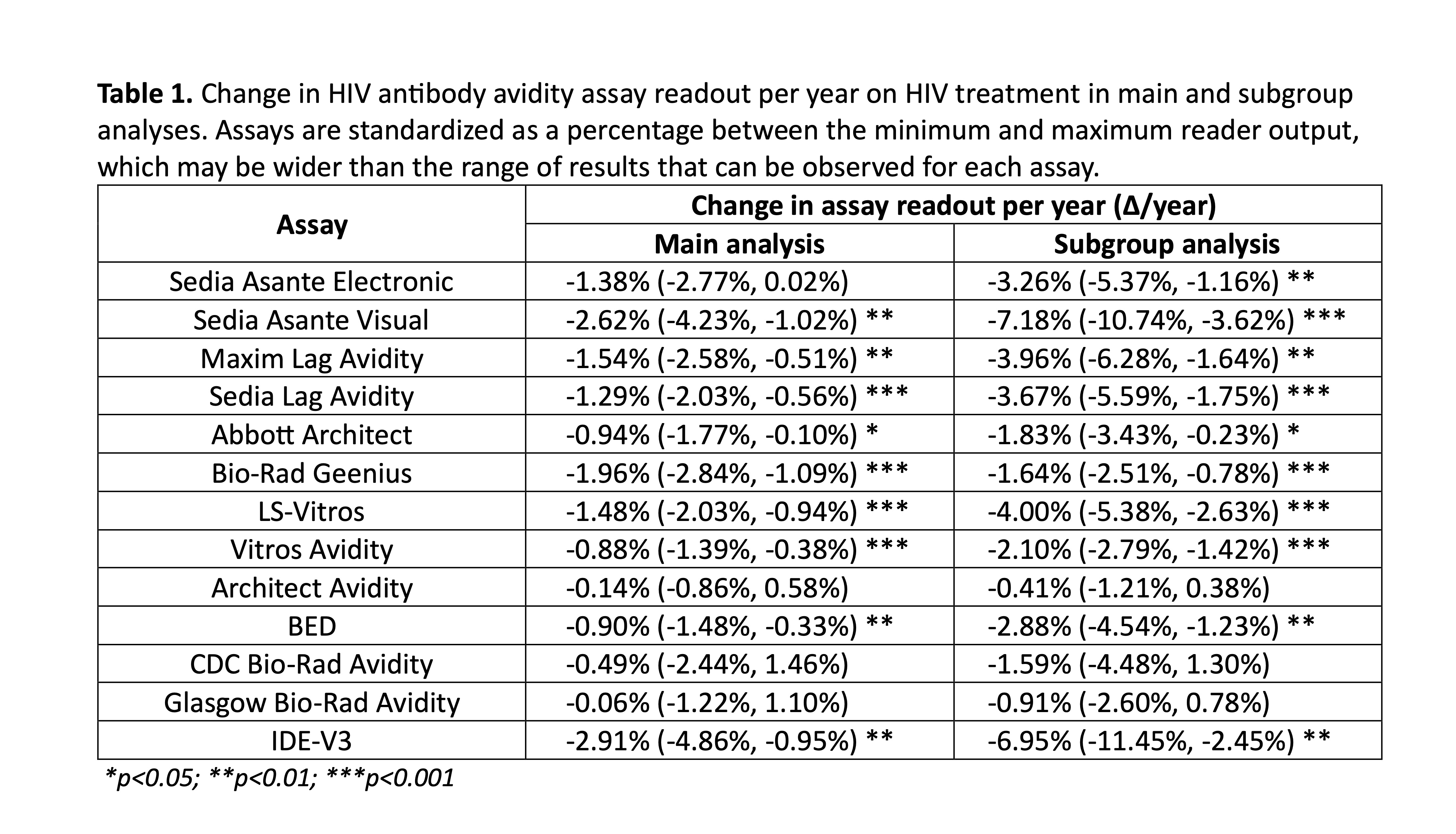
Of 139 eligible participants (99.3% male; age 24–74), 263 specimens were tested with all assays. Nine of thirteen assays showed statistically significant avidity declines with longer ART duration in both primary analysis and subgroup analysis (Table 1). Subgroup participants showed steeper declines. In primary analysis, IDE-V3 and Asante Visual showed the steepest declines, with an annual reduction of 2.91% (95% CI: 0.95%, 4.86%) and 2.62% (95% CI: 1.02%, 4.23%) in assay readouts per additional year on ART. In subgroup analysis, these rates were 6.95% (95% CI: 2.45%, 11.45%) and 7.18% (95% CI: 3.62%, 10.74%). Four assays showed no significant associations between time on ART and assay readout in primary analysis: Architect Avidity, Sedia Asante Electronic, CDC Bio-Rad Avidity, or Glasgow Bio-Rad Avidity.
Conclusions
Most avidity assays showed significant declines in readout per additional year on ART, with the steepest declines among those initiating ART ≥1 year after acquiring HIV. Further research is necessary to understand how VL trajectories influence antibody avidity and to evaluate the feasibility of using avidity testing for ART monitoring.
Table or Figure