Background
Body-weight-based dosing has been typically used in phase 1 trials of therapeutic and prophylactic monoclonal antibodies (mAbs). In recent years, pharmacokinetics (PK) modeling and simulations aided label changes of multiple marketed mAbs for alternative fixed dosing regimens that reduce inter-individual PK variability while maintaining the same average mAb concentrations. We aimed to evaluate fixed dosing versus weight-based dosing for 3 IgG1-based HIV-1 mAbs, VRC07-523LS, PGT121.414.LS and PGDM1400LS, that are planned for HIV-1 prevention efficacy testing, based on data from earlier clinical trials of these mAbs in people without HIV-1.
Methods
For each mAb, we used a 2-compartment population PK model to describe the overall trend and inter-individual variabilities in serum concentrations over time post mAb administration from 251 individuals for VRC07-523LS, 113 for PGT121.414.LS and 95 for PGDM1400LS. We evaluated the effect of body weight on each PK parameter. Using the final best-fitting PK model, we performed simulations of mAb serum concentrations to compare inter-individual variabilities in concentrations at 1 day, 12 weeks and 24 weeks post IV infusion and in area under the time-concentration curve (AUC) between the two dosing regimens. To mirror real-world populations, the simulations were based on sex-specific weights observed in 1302 females-at-birth and 1779 males-at-birth in a recent HIV-1 mAb efficacy study.
Results
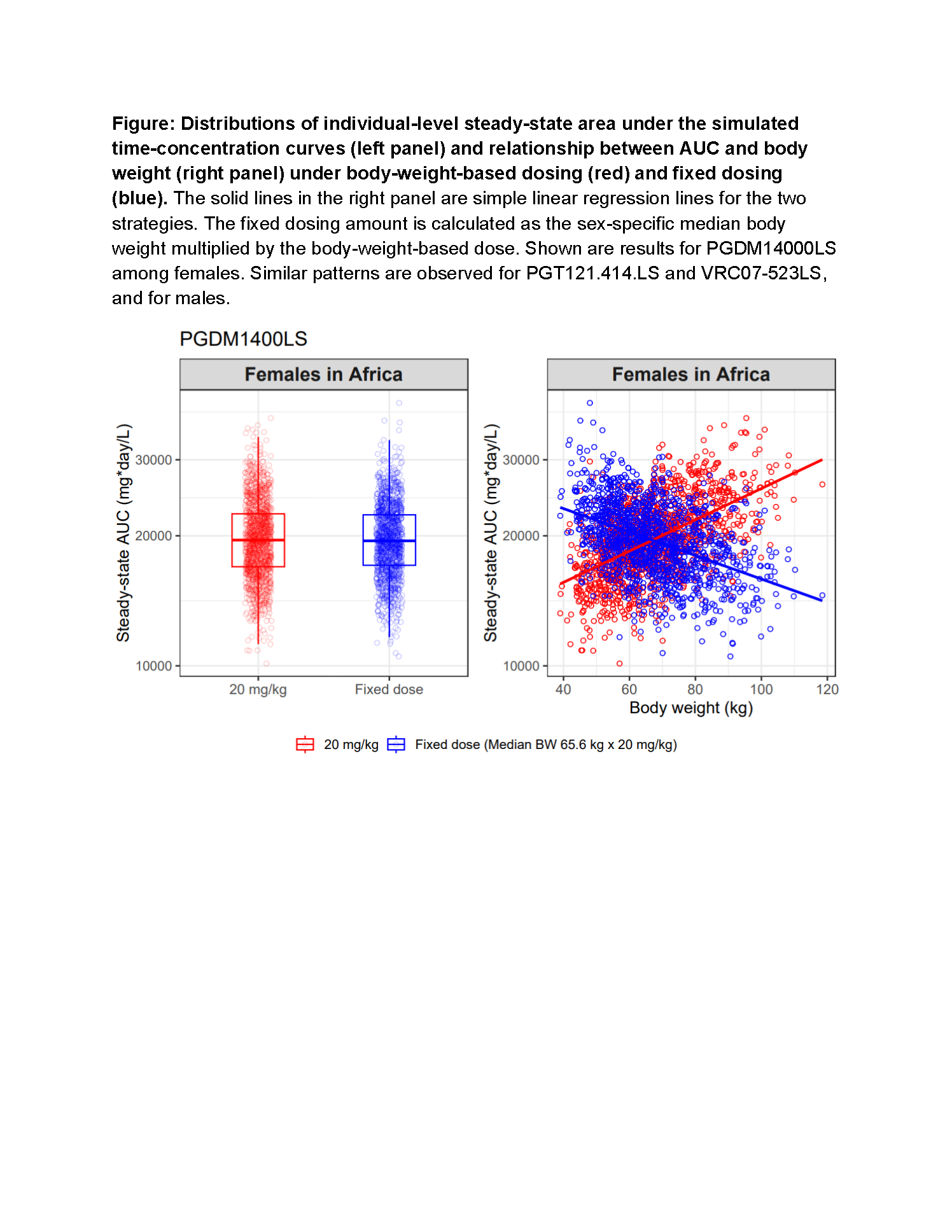
For all 3 mAbs, we observed a significant but generally modest effect of body weight on PK parameters — clearance rate, volume of central compartment, and volume of peripheral compartment — with an estimate of ~5% increase of each PK parameter per 10% increase in body weight. Correspondingly, overall magnitude and variability in the time-specific concentrations and in AUC were comparable between the two dosing regimens for both females- and males-at-birth. Consistent with the PK models, the relationship between body weight and concentrations differs between the 2 dosing regimens with a generally positive correlation for weight-based dosing but a negative correlation for fixed dosing (Figure). For individuals with body weight below the 15th or above the 85th percentiles, fixed dosing results in < 3% difference in median AUC compared to the overall population.
Conclusions
Given the advantage of fixed dosing in reducing vial wastage and increasing operational efficiency, fixed dosing is recommended for these 3 HIV-1 mAbs in future clinical testing.
Table or Figure