Background
Persons with HIV (PWH) have elevated risk for chronic lung disease, independent of smoking. Studies measuring diffusing capacity of the lungs for carbon monoxide (DLCO) to quantify oxygen transfer in PWH are uncommon, longitudinal data are rare, and data in cohorts of persons both with and without HIV are lacking. We report here, to our knowledge, the first study to assess associations between HIV serostatus, smoking and longitudinal DLCO changes.
Methods
We included MWCCS participants (with and at risk for HIV) who completed DLCO tests at both baseline (2017-2019) and follow-up (2021-2024). We assessed relationships between two primary predictors (smoking and HIV serostatus) and the annual rate of DLCO change. Multivariable linear regression models accounted for age, sex, race, height, injection drug use and hepatitis C, as well as baseline DLCO and hemoglobin. We also assessed associations between HIV control variables (e.g. CD4+ T-cell counts, HIV-RNA) and DLCO change in PWH.
Results
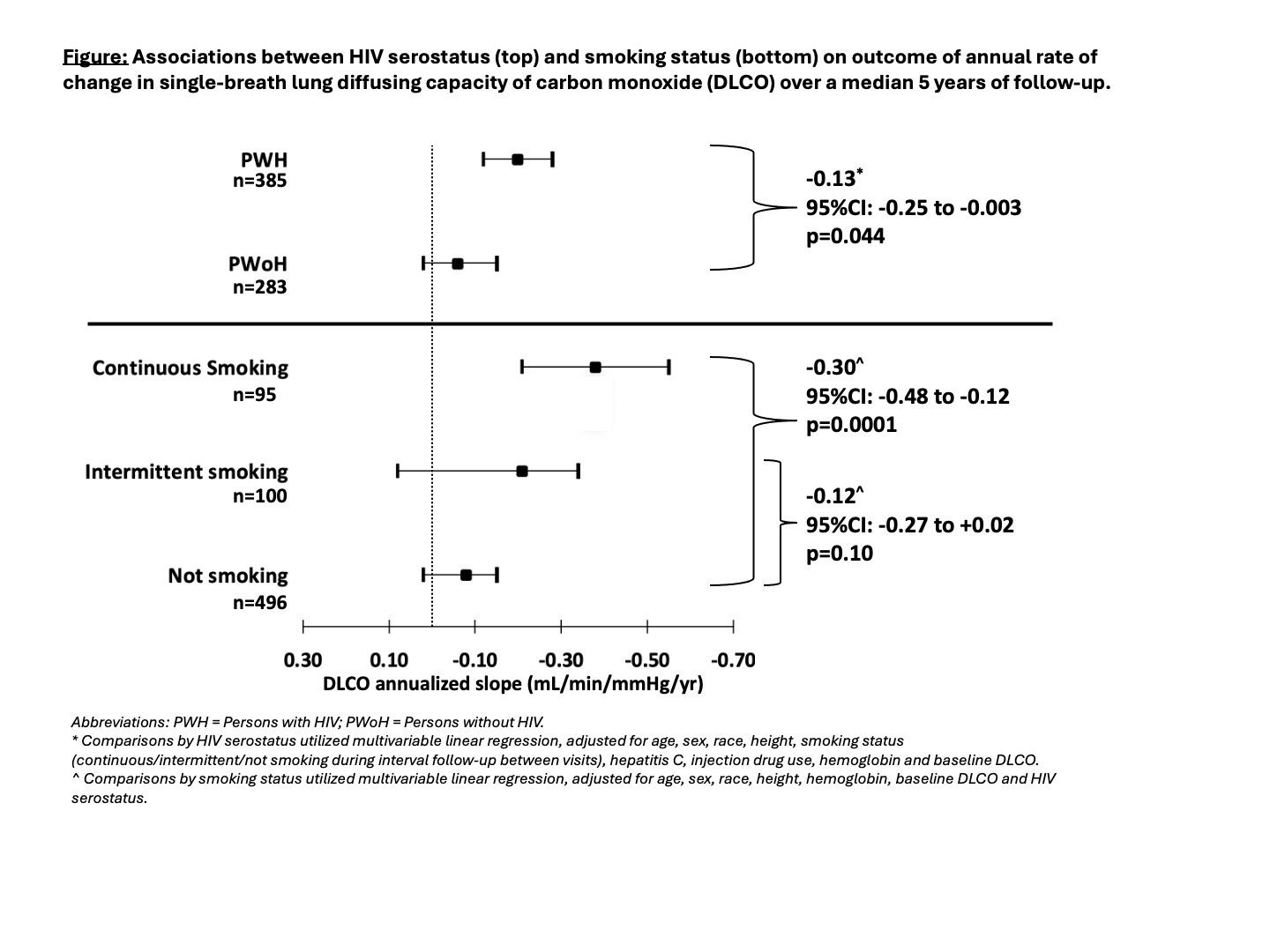
Among n=668 participants (median age 55 years, 39% women, 58% PWH with median CD4 690 cells/uL and 73% with HIV-RNA <20 copies/mL), median follow-up time between DLCO measures was 5.2 (IQR 4.8, 5.7) years. DLCO decline was fastest in persons who were smoking at every interval cohort visit between DLCO measurements (over four times as fast as those not smoking at every visit; p=0.001) and in those with HIV (nearly three times as fast as those without HIV, even after adjusting for smoking status; p=0.044) (FIGURE). We observed slower DLCO decline in those with lower viral copy-years between DLCO visits (p=0.008) and durable viral suppression (p=0.02) between DLCO visits; results were borderline for higher CD4+ T-cell counts at baseline (p=0.07) and not significant for nadir CD4 (p=0.43).
Conclusions
Our novel data demonstrate that PWH experience progressive DLCO worsening compared to those without HIV, even after accounting for the strong effects of smoking. DLCO abnormalities in PWH have been previously associated with higher symptom burden, worse health status, and higher mortality, indicating clinical relevance of these findings. In addition, improved viral control was associated with slower DLCO decline. Our findings suggest smoking cessation and optimal HIV disease control as potential modifiable factors to reduce the incidence of lung disease in this vulnerable population. Additional mechanisms contributing to DLCO decline in PWH are under active investigation.
Table or Figure