Background
People with HIV (PWH) have a higher risk of anal cancer than the general population. Current international guidelines recommend screening PWH aged ≥35 years who are men who have sex with men (MSM) or transgender women, and ≥45 years otherwise; however, access to screening is often limited. Improved risk stratification is needed to better target prevention and screening efforts. We aimed to develop and validate a prognostic model to identify PWH at highest risk of anal cancer.
Methods
We used data from the Antiretroviral Therapy Cohort Collaboration (ART-CC) to develop a binary model to predict incident anal cancer in PWH in Europe and North America. Candidate predictors routinely available at clinic visits were selected a priori: age, sex at birth, HIV transmission group, years in HIV care, nadir CD4 count, prior AIDS-defining events (excluding cancer), history of other cancers, and smoking status. Data were harmonized across cohorts. We evaluated several machine-learning algorithms, including penalized logistic regression, support vector machines, random forests and gradient boosting (XGBoost). Models were trained using stratified 10-fold cross-validation with nested hyperparameter tuning, optimizing the F1-score (combining sensitivity and positive predictive value). Class imbalance was handled using combined under-sampling and SMOTENC oversampling. Model selection prioritized high sensitivity while minimizing the proportion classified as screening eligible.
Results
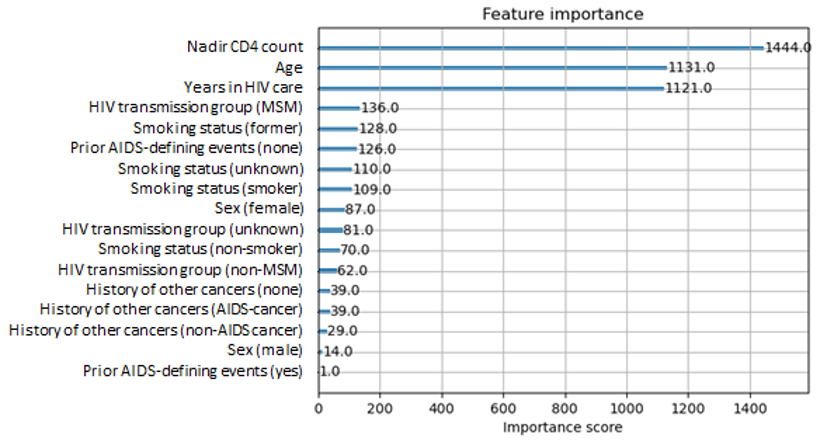
The analysis included 158,845 PWH, of whom 1,120 developed incident anal cancer. XGBoost showed the best overall performance. Using a predicted-risk probability threshold of 0.5 (corresponding to ~94% sensitivity), the model identified 67% of individuals as screening-eligible, reducing the screening burden by approximately one third compared with universal screening while maintaining high sensitivity. Feature importance analysis showed that the most influential predictors were nadir CD4 count, age, and years in HIV care, followed by MSM status and former smoking (Figure 1), highlighting the importance of immune history and cumulative HIV exposure.
Conclusions
A machine-learning-based risk stratification score using routinely collected clinical data accurately identifies PWH at highest risk of anal cancer. This approach could substantially reduce the number of individuals requiring screening while maintaining high sensitivity, thereby improving feasibility and resource allocation in settings with limited screening capacity.
Table or Figure