Background
Cabotegravir long-acting (CAB LA) is the first injectable approved for HIV pre-exposure prophylaxis (PrEP). This analysis assessed CAB LA PrEP use, HIV testing patterns, adherence and HIV acquisition in real world clinical setting.
Methods
Adults without HIV who initiated CAB LA for PrEP between December 2021-February 2025 were identified from the Trio Health Cohort. HIV testing was evaluated within 30 days before the first injection and within ±7 days of each injection during follow-up. Incident HIV was defined by detectable HIV RNA and/or positive Ag/Ab test. Continuation injections were categorized based on timing after the prior injection: on-time (53–67 days), delayed (68–112 days), missed (113–127 days), and discontinuation (no injection after >127 days).
Results
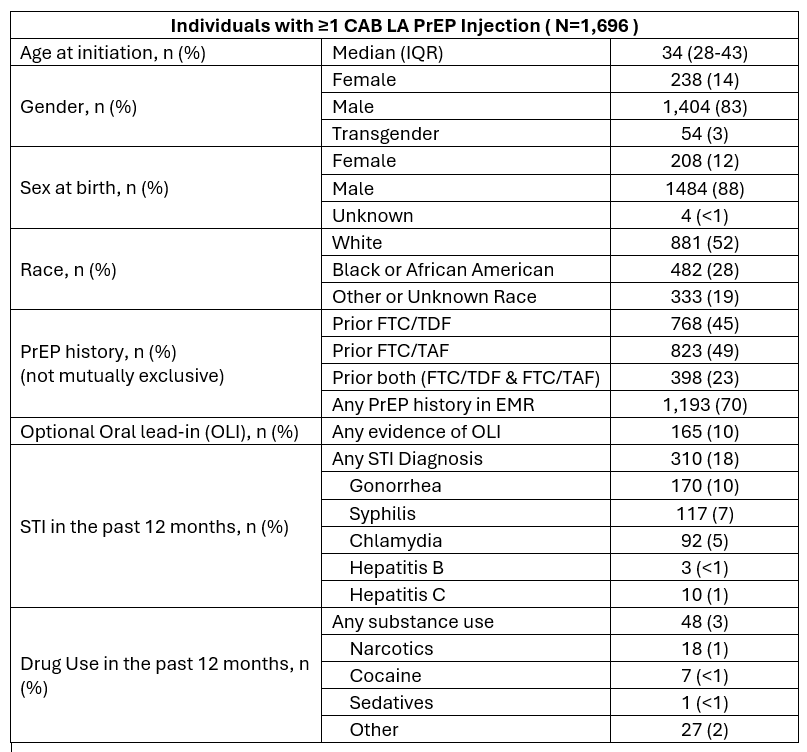
Among 1,696 individuals who received CAB LA PrEP injections, 78% had HIV RNA testing, 78% had Ag/Ab, and 65% had both prior to initiation. During follow-up, 21% had both tests, 45% had at least one test, and 5% did not always have a test at all injections received. Among 1,296 individuals with ≥3 injections, 62% had all continuation injections on time, 32% had delays (median 1 injection; IQR: 1, 2) with a median delay of 7 days (IQR: 3, 17) and 8% with missed injections (median 1; IQR: 1, 1). Overall, 549 individuals (36%) discontinued CAB LA PrEP, but 77 (14%) of them re-initiated within 6 months. Three individuals (0.2%) acquired HIV: two were diagnosed with incident HIV, and one with potential prevalent HIV. Among these, two adhered to the dosing schedule, while one did not. Most injections for these individuals were associated with either an RNA test or Ag/Ab test. Two achieved viral suppression following ARV treatment; follow-up VL data was unavailable for the third. No resistance-associated mutations were detected in two cases, and HIV genotype testing was not conducted for the third.
Conclusions
Real-world data on CAB LA PrEP use in the U.S. showed that HIV testing often did not align with the product label or CDC guidelines, highlighting the need for ongoing education. Adherence to the dosing schedule was good, with brief delays; however, variations in perceived HIV acquisition risk likely contributed to patterns of discontinuation and reinitiation, while gaps in oral bridging documentation may have inflated delays and discontinuation rates. Despite these challenges, HIV acquisition during CAB LA PrEP use was rare, further reinforcing its effectiveness as a key tool in HIV prevention within routine clinical care.
Table or Figure