Background
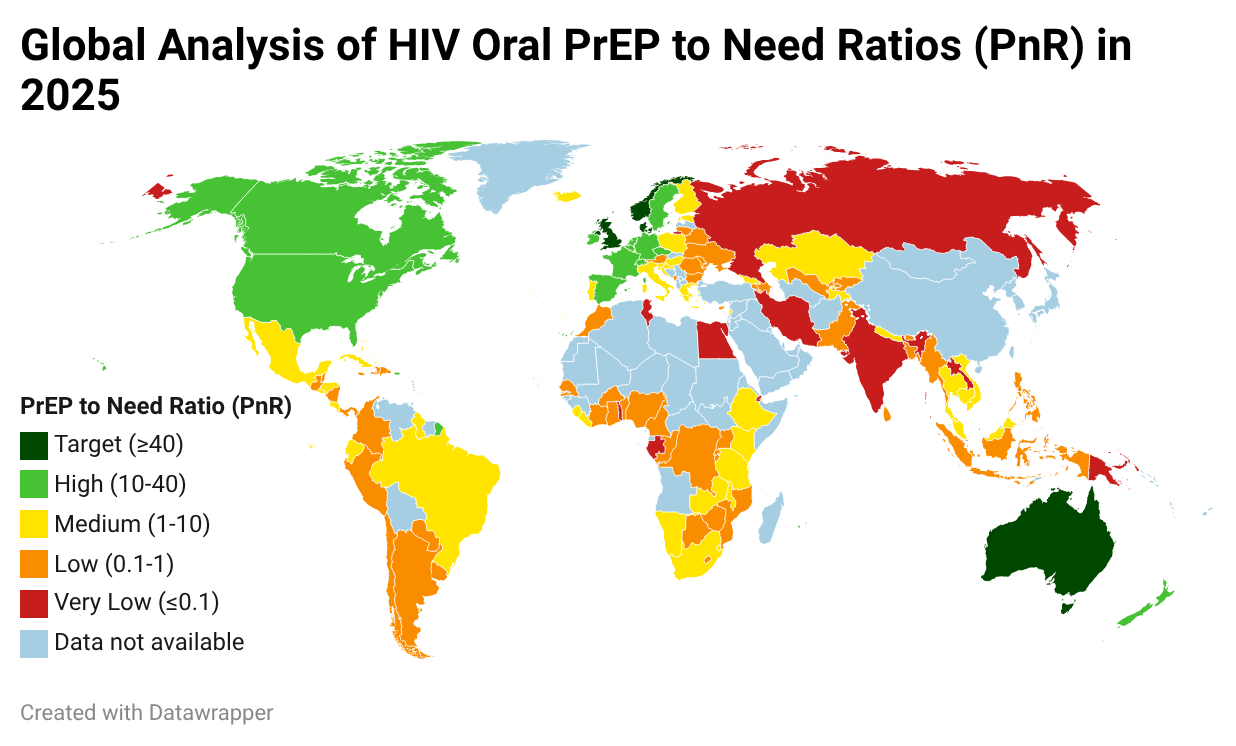
There were 1.3 million new HIV acquisitions worldwide in 2024. HIV incidence is predicted to rise significantly after cuts in USAID funding. The efficacy of HIV Pre-Exposure Prophylaxis (PrEP) depends on background HIV incidence and adherence in the populations treated. In the PURPOSE 1 and 2 trials, 42 people needed to be given lenacapavir for each HIV acquisition prevented. This number needed to treat for benefit (NNTB) will be higher for oral PrEP if adherence is sub-optimal. We estimated the PrEP to Need ratio (PnR) by country: the ratio of people taking PrEP versus annual HIV incidence.
Methods
Annual HIV incidence and current PrEP coverage were extracted from the UNAIDS AIDSInfo database 2025 and national reports. PrEP coverage estimates only include oral PrEP, which accounts for 99.7% of global PrEP initiations worldwide since 2012. Changes in PrEP use during 2025 were tracked to evaluate the impact of PEPFAR funding cuts. The mean reduction in PrEP use across PEPFAR countries was calculated: -39%. We then applied this to the remaining PEPFAR countries with no recent available data to depict a more accurate picture considering funding cuts. The PnR was calculated and categorised as: “Target” (≥40:1), “High” (10-40), “Medium” (1-10), “Low” (0.1-1), “Very Low” (≤0.1).
Results
Incidence and PrEP coverage were available for 122 countries. From these countries, there were 1,067,718 new acquisitions globally, with 2,302,200 people initiating PrEP in 2024. 80% of HIV acquisitions were in low- and middle-income countries (LMICs). Only 4 countries (4%) reached the target PnR of 40:1 (UK, Australia, Denmark and Norway). The remaining countries were categorised into high PnR (10%), medium PnR (32%), low PnR (41%) and very low PnR (13%). 69% of LMICs had a PnR of low or very low, with the remainder reporting medium. The average global PnR was 2.2, but this ranged from 1.4 in LMICs to 5 in upper-middle/HICs respectively. Lastly, since PEPFAR funding cuts in January 2025, 11 countries show a reduction in PrEP coverage, ranging from an 81% reduction in Nigeria to 13% in South Africa.
Conclusions
PrEP coverage has decreased significantly following cuts in USAID/PEPFAR funding. Coverage disparities are disproportionately low amongst LMICs; those most affected by PEPFAR cuts. Our data likely overestimates true PrEP coverage as monitoring facilities and infrastructure supporting PrEP outreach have also been significantly affected by funding reductions.
Table or Figure