Background
Long-acting pre-exposure prophylaxis (LA-PrEP) represents a major advancement in HIV prevention. However, its acceptability among heterosexual men remains poorly understood. Leveraging the HPTN 111 study in the fishing communities of Kalangala district, Uganda, a setting with high heterosexual HIV transmission, we assessed men’s perspectives and interest in LA-PrEP to inform future HIV prevention research.
Methods
HPTN 111 was a barbershop-based HIV prevention study conducted among heterosexual men in Kalangala. Barbershops were randomized 2:1 to either the intervention arm (n=12) or standard of care (SOC) (n=6) with men recruited under these barbershops. Intervention barbers were trained to provide participants with status-neutral HIV education, distribute HIV self-test kits, and facilitate peer-support discussions. SOC participants received routine HIV prevention services at local HIV clinics. At study exit (week 52), interest in LA-PrEP was assessed using a structured questionnaire. Participants who responded “very interested” or “somewhat interested” to ‘how interested would you be in taking LA injectable PrEP’ were classified as expressing interest. Interest was analyzed using adjusted probability differences accounting for shop-level clustering and adjusting for shop characteristics.
Results
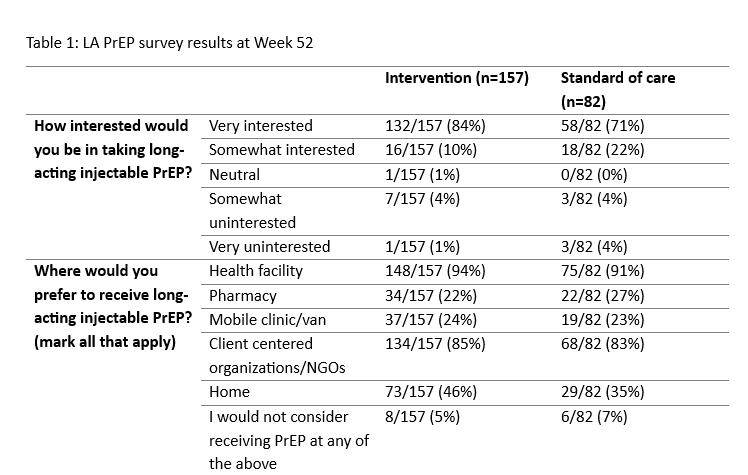
We enrolled 250 men. At baseline, participants had a median age of 29 (IQR 24,35) years and in the past three months, reported 4 (IQR 2,6) sexual partners with 75% (188/250) engaging in transactional sex.Treatable STI prevalence was 18% (45/250). At week 52, 239 participants completed the LA-PrEP questionnaire and 94% (224/239) were interested in LA injectable PrEP with no significant difference between arms (intervention: 148/157, 94%; SOC: 76/82, 93%; adjusted difference in probabilities: 3.0%, 95% CI -3.6%, 9.5%). Some men preferred cabotegravir over lenacapavir (18%, 42/239), but 47% (113/239) preferred lenacapavir for injectable PrEP. Most (93%, 223/239) expressed interest in a monthly PrEP pill if it becomes available. Participants liked the discreetness of LA-PrEP. Health facilities and client centered organizations were the most preferred LA-PrEP delivery options.
Conclusions
Heterosexual men demonstrated very high interest in LA-PrEP, underscoring an important opportunity to expand male-focused HIV prevention strategies. Implementation programs and future LA-PrEP trials should prioritize this population and examine the transition from interest to uptake and sustained use.
Table or Figure