Background
CAB LA every-2-months is approved for use in pre-exposure prophylaxis (PrEP) and the treatment of HIV infection. Pregnancy can alter drug clearance and protein binding, affecting total and unbound drug concentrations. A pregnancy population PK (PPK) model was developed, and exploratory analysis of unbound CAB concentrations was performed to support dosing recommendations for CAB use during pregnancy.
Methods
An established CAB PPK model was adapted to describe total CAB concentrations in 75 women from HPTN 084 who continued CAB LA PrEP during pregnancy. Previous model parameters were fixed, and clearance (CL/F) and absorption rate constant (KA2) were estimated. Time from start of pregnancy and time post-pregnancy outcome were tested as continuous covariates on CL/F and KA2. The final CAB pregnancy PPK model was used to simulate total plasma concentration-time profiles during pregnancy. Continuation simulations assumed CAB steady state was achieved prior to pregnancy. Simulations were also performed to explore CAB LA initiation during each trimester (TM). Individual fraction unbound (fu) observed pre-pregnancy and during each TM and predicted total CAB concentrations for these periods were used to derive predicted unbound CAB trough (Ct) values, which were compared to the in vitro IC90 (0.407 ng/mL).
Results
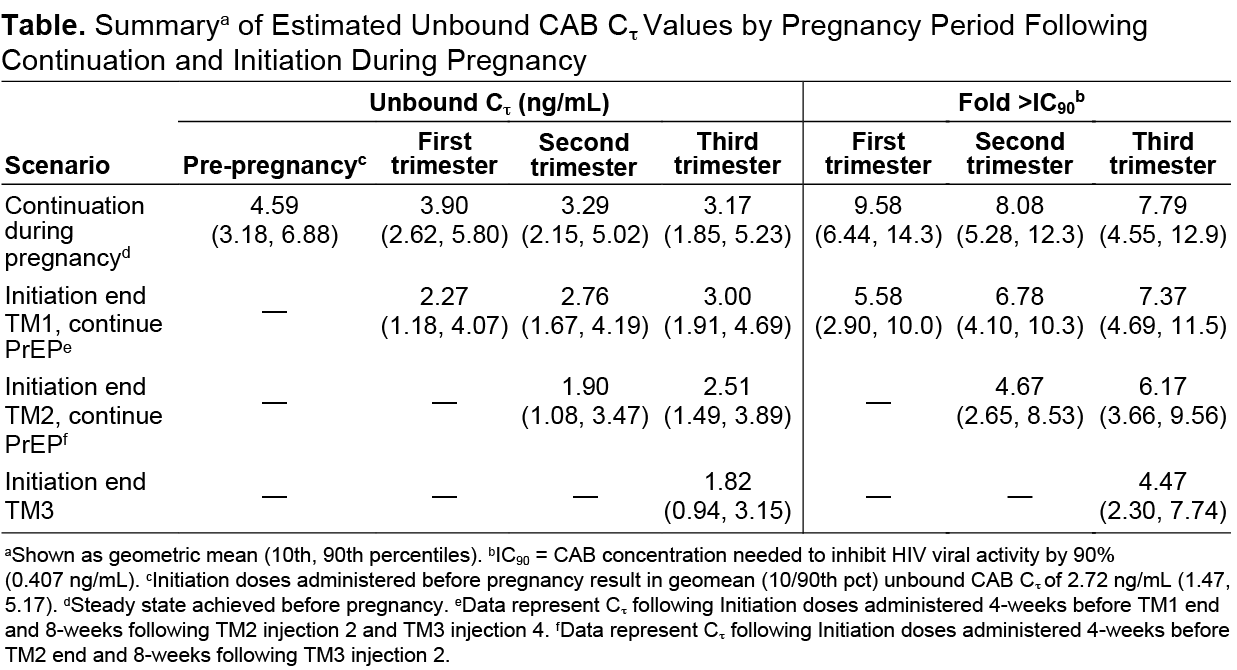
2679 total CAB concentrations were included in the PPK analysis: 55.9% pre-pregnancy, 6.6% in TM1, 9.6% in TM2, 8.4% in TM3, and 19.5% post-partum. The established adult model over-predicted total CAB concentrations during pregnancy. Pregnancy-related covariates on CL/F improved model performance. CL/F increased linearly during pregnancy (0.401%/day) from 0.125 L/h to 0.167 L/h (33.7% increase), 0.22 L/h (75.8% increase), and 0.265 L/h (112% increase) at the end of TM1, TM2, and TM3, respectively; pre-pregnancy CL/F was re-established by 8 weeks post-partum. Pregnancy-related covariates on KA2 were not retained in the model. Simulated geometric mean total CAB Ct decreased from 2.79 µg/mL pre-pregnancy to 1.28 µg/mL at the end of TM3. Estimated unbound CAB Ct remained >4x IC90 in >90% of women throughout pregnancy when continuing CAB LA and >IC90 following initiation during pregnancy (Table). Unbound concentrations increased with subsequent dosing following initiation during pregnancy.
Conclusions
Given the unbound CAB concentrations are predicted to remain at levels that inhibit HIV replication, CAB LA PrEP can be continued or initiated during pregnancy at the standard regimen.
Table or Figure