Background
For People Living with HIV (PLHIV) in Africa, improving hypertension (HTN) diagnosis and management is critical to sustaining the health gains achieved through antiretroviral therapy; however, resources to provide care for non-AIDS comorbidities are limited. This study aimed to assess the effectiveness of a higher-resource vs. lower-resource strategy to integrate HIV and HTN care.
Methods
From February 2023 to August 2025, we conducted a stepped-wedge cluster randomized trial within 16 government and private not-for-profit clinics in Kampala and Wakiso District, Uganda. Every two months, two clinics were randomized to implement one of two integrated care strategies (8 total steps). HTN-BASIC provided HTN medication and blood pressure (BP) cuffs to clinics along with basic training on HTN management. HTN-PLUS added enhanced training, differentiated service delivery models of HTN care, tools for self-monitoring BP, and quarterly audit and feedback sessions. The co-primary effectiveness outcomes were population BP control (measured and documented BP <140/90 among all patients) and BP control for those with a HTN diagnosis. In this primary analysis, we used generalized estimating equations with a binomial distribution, log link, and independence working correlation matrix, including fixed effects for facility and step time. Robust variance estimators and clustering by patient were used to account for the within-patient repeated measures.
Results
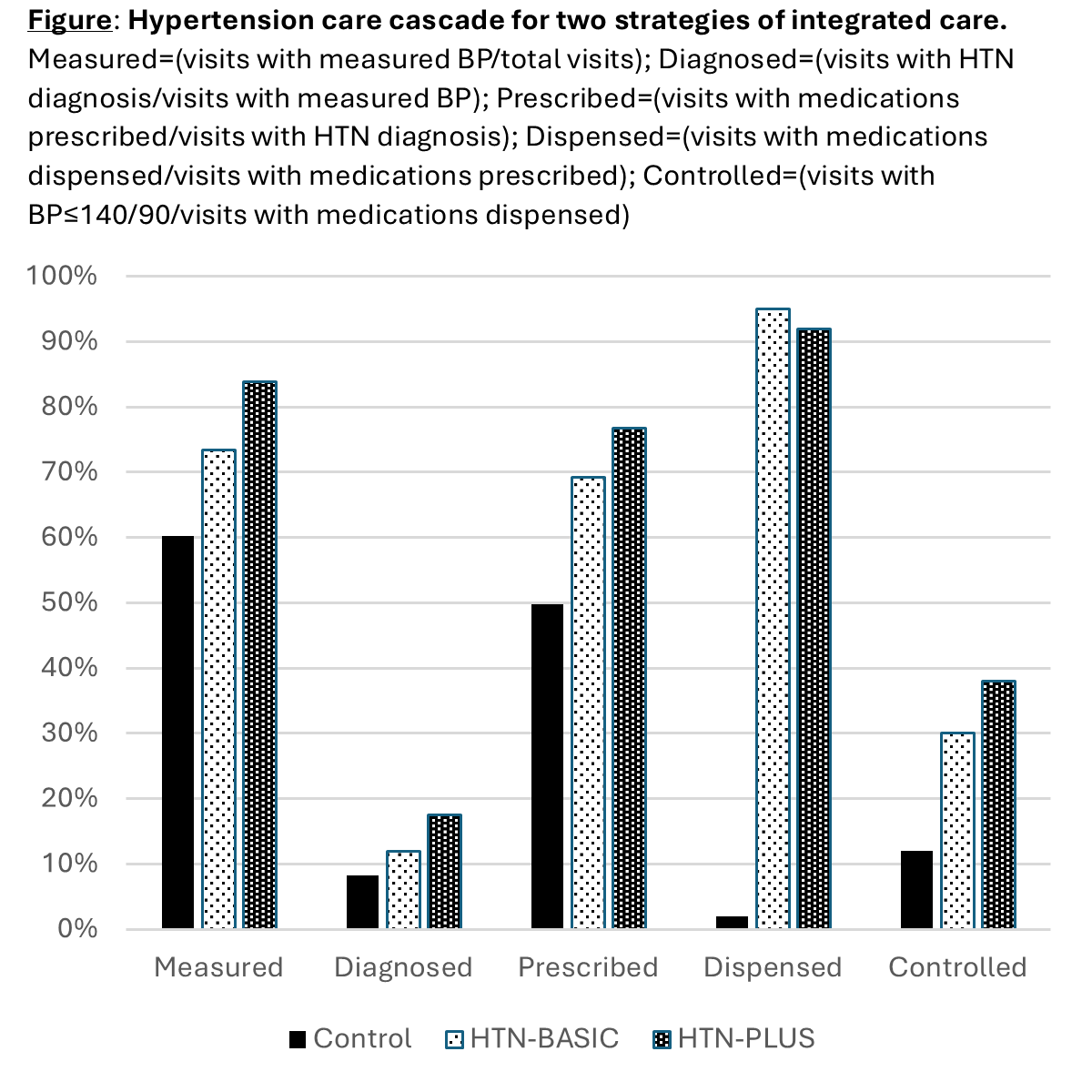
Over 30 months, BP data were collected at 450,853 visits among 87,421 individual PLHIV; mean (SD) age was 37.5 (11.1) years and 71% were female. At the population level, the risk of uncontrolled BP was lower during both HTN-BASIC (RR 0.81, 95%CI 0.79-0.83) and HTN-PLUS (RR 0.71, 95% CI 0.70, 0.73) periods compared to the control period before implementation (both p<0.001). Similarly, for PLHIV with a HTN diagnosis, the risk of uncontrolled BP was lower compared to the control period [RR 0.84 (95%CI 0.82-0.87) and RR 0.74 (95%CI 0.72-0.77) for BASIC and PLUS, respectively; p<0.001]. Hypertension care cascade steps upstream from BP control also improved with both strategies (Figure).
Conclusions
Both higher- and lower-resource strategies to integrate HTN care improved BP control in urban and peri-urban HIV clinics in Uganda. Future studies should evaluate the costs and cost-effectiveness of these two strategies.
Table or Figure