Background
HPTN 084 found that long-acting cabotegravir (CAB-LA) significantly reduced the risk of HIV acquisition in women compared to tenofovir disoproxil fumarate/emtricitabine (TDF/FTC). In the HPTN 084 open label extension, participants consented to CAB-LA injections during pregnancy. A nested sub-study evaluated the pharmacokinetics of total and unbound (bioavailable) CAB among a subset of participants who continued to receive CAB-LA injections to identify the need for dose adjustments during pregnancy.
Methods
Seventy-five HIV-negative participants who enrolled in the sub-study between 17 May 2022 and 13 September 2023 and received ≥ 4 CAB-LA injections both in the year prior to and during pregnancy were evaluated. Total trough (Ctrough) CAB concentrations were averaged within each participant over the pre-pregnant period and during each pregnancy trimester and then summarized. Unbound CAB Ctrough concentrations were evaluated from the 6 months prior to pregnancy through the end of pregnancy; the percent unbound (% unbound) CAB was calculated by visit and then summarized.
Results
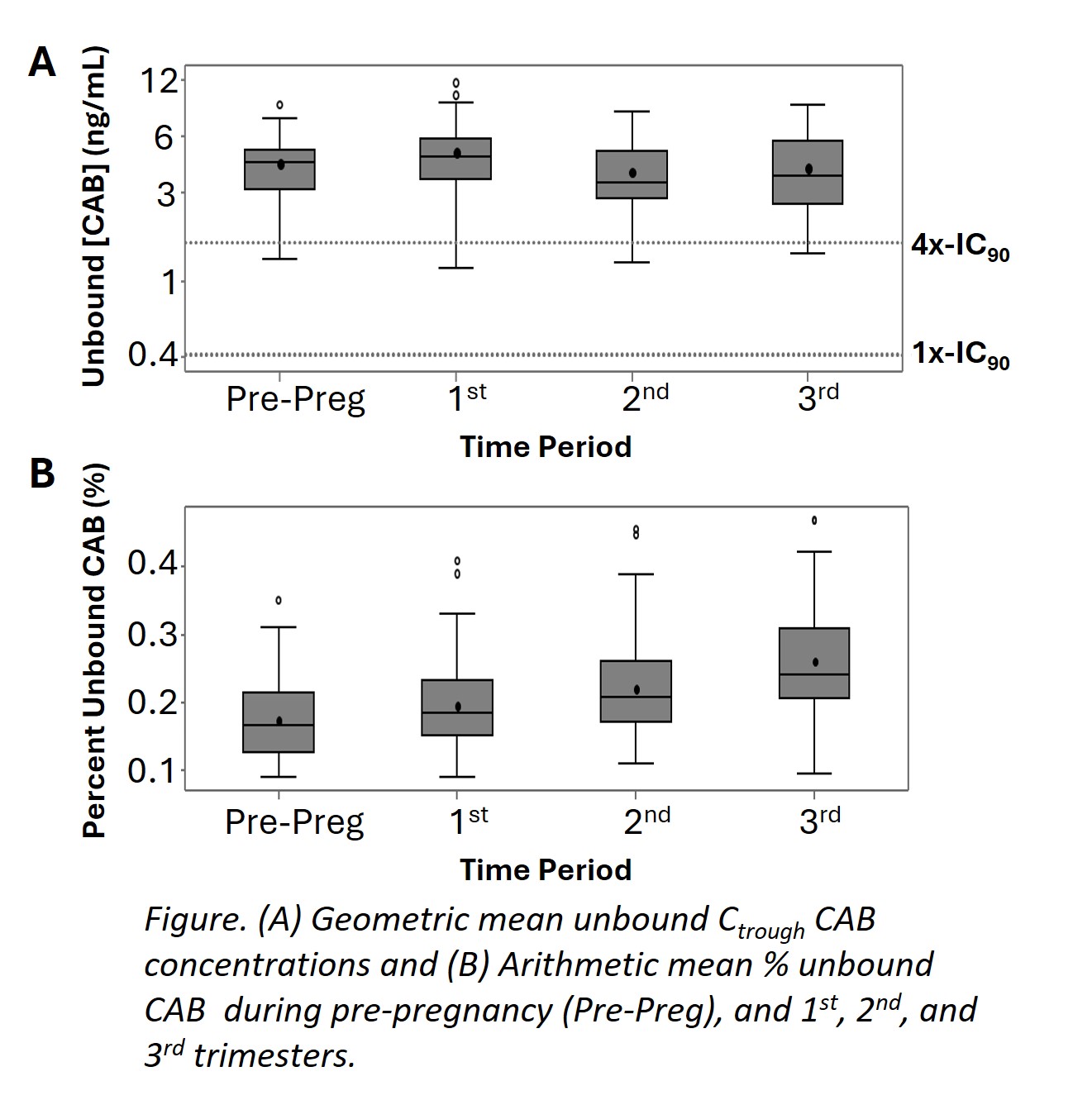
The median number of CAB-LA injections administered in the year prior to pregnancy was 6 (range: 4-7) and during pregnancy was 4 (range: 4-5). From the pre-pregnant period through the 3rd trimester, there was a median 26% reduction (IQR: 2%, 40%) in total CAB Ctrough concentrations, from 2.3 µg/mL to 1.6 µg/mL. Median unbound CAB Ctrough concentrations in the 6 months prior to pregnancy and the 1st, 2nd, and 3rd trimesters were 4.39 (IQR: 3.16, 5.08), 4.69 (IQR: 3.56, 5.89), 3.43 (IQR: 2.82, 5.02), and 3.74 (IQR: 2.63, 5.72) ng/mL, respectively. Among this cohort, 98% of unbound CAB concentrations remained above the unbound pharmacologic threshold of 1.627 ng/mL, which is the 4x-IC90 for unbound CAB. Further, the median % unbound CAB Ctrough increased from 0.16% (IQR: 0.12%, 0.22%) during the pre-pregnant period to 0.24% (IQR: 0.20%, 0.32%) in the 3rd trimester, suggesting an overall increase in the relative amount of bioavailable drug throughout pregnancy.
Conclusions
While declines in total CAB concentrations throughout pregnancy were observed, changes in unbound CAB concentrations were non-clinically relevant, and the % unbound CAB increased from the pre-pregnant period through the 3rd trimester. These data provide pharmacologic support that CAB-LA dose adjustments are not needed during pregnancy.
Table or Figure