Background
Autoimmunity contributes to HIV immunopathogenesis even in the absence of overt autoimmune disease. We previously showed that anti-CD4 autoantibodies from people with HIV (PWH) on suppressive antiretroviral therapy (ART) can mediate cytotoxicity against CD4+ T cells, implicating a role in impaired immune reconstitution. Despite viral suppression, many PWH with poor CD4 recovery exhibit chronic immune activation, microbial translocation, and dysregulated humoral immunity.
Methods
The first HIV cohort included 28 PWH on suppressive ART (17 males, 9 females) and 16 controls (5 males, 11 females). The second cohort included 16 non-HIV males and 26 PWH on suppressive ART (22 males, 4 females). Plasma samples were tested using ELISA or an autoantibody array for soluble CD4 (sCD4), anti-CD4, anti-CD8, anti-double-stranded DNA (dsDNA), and anti-nuclear antigen (ANA) IgGs, markers of microbial translocation LPS, LPS-binding protein, and soluble CD14 (sCD14), and sex hormones progesterone, 17β-estradiol, and testosterone. ANOVA, Mann-Whitney U, and Spearman’s correlation tests were applied.
Results
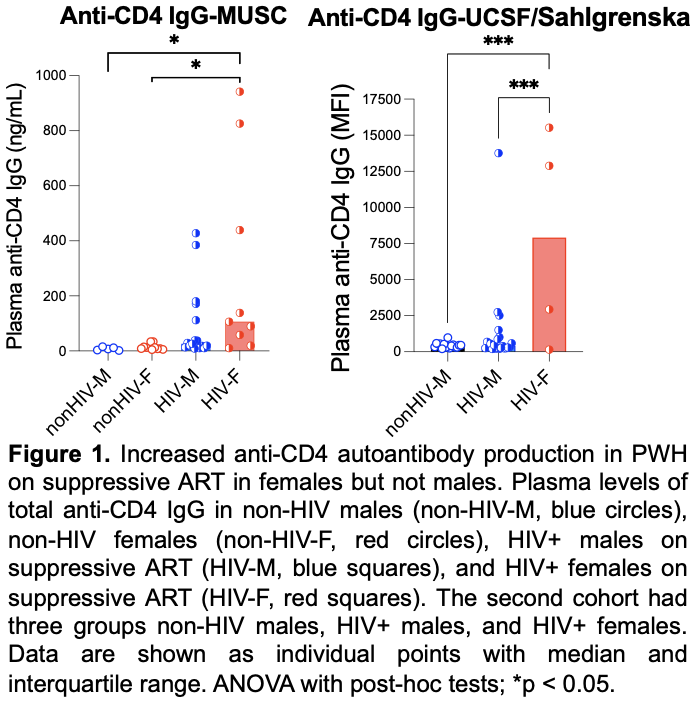
We identified a female-predominant elevation of plasma anti-CD4 IgG autoantibodies in aviremic PWH receiving ART (Figure 1). Across two independent cohorts, HIV-positive females, but not males, displayed significantly higher anti-CD4 IgG, predominantly IgG1, compared with HIV-negative controls (P > 0.05), without parallel increases in anti-CD4 IgA or IgM. This sex-specific pattern was unique to anti-CD4 IgG. sCD4, anti-CD8 IgG, anti-dsDNA IgG, or ANA IgG levels were similar in PWH versus controls (P > 0.05); these control autoantibodies correlated with one another but not with anti-CD4 IgG. Elevated anti-CD4 IgG levels were associated with lower plasma progesterone levels (r = -0.78, P = 0.02 in HIV+ females only) and reduced absolute CD4+ T-cell counts (r = -0.59, P = 0.002). sCD14, LBP, and LPS were also selectively increased in HIV-positive females, with sCD14 (r = 0.33, P = 0.03) and LBP (r = 0.35, P = 0.08) showing significant or borderline associations with anti-CD4 IgG.
Conclusions
Together, these findings identify anti-CD4 IgG as a sex-dimorphic autoimmune signature in treated HIV infection, linked to progesterone levels, persistent microbial translocation, and incomplete immune recovery, and suggest potential therapeutic targets (i.e., progesterone supplement) to improve immune reconstitution in women.
Table or Figure